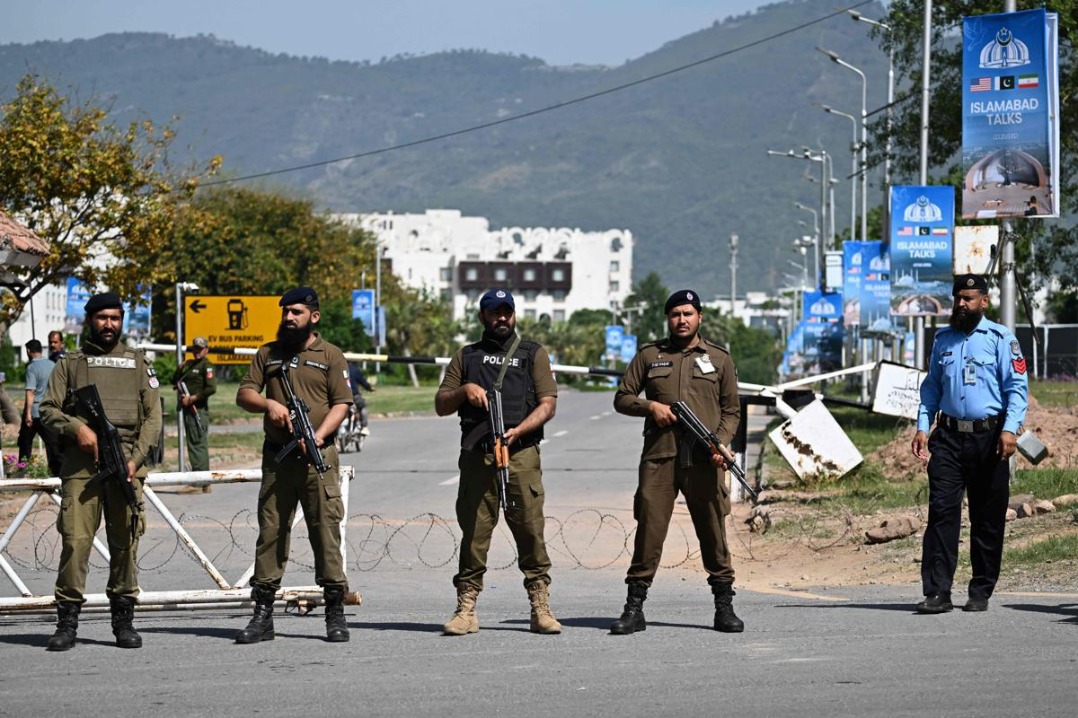
As a fragile two-week ceasefire between the United States and Iran is set to expire this Wednesday, plans for a second round of peace negotiations in Islamabad, Pakistan remain clouded in uncertainty after a recent maritime confrontation reignited tensions between the two long-time adversaries.
The Associated Press, citing two unnamed Pakistani officials, reported Monday that Iranian authorities have signaled willingness to dispatch a delegation to the upcoming talks, though details remain undisclosed for security reasons. The officials warned that the negotiation schedule is still fluid and called on media outlets to avoid unfounded speculation. US President Donald Trump announced Sunday that Washington’s negotiating team would arrive in Islamabad on Monday to meet with Iranian representatives, but Iranian officials have not issued a direct confirmation of Trump’s statement.
Escalating tensions in recent days have thrown the diplomatic process into doubt. Last week, the US imposed a naval blockade on Iranian ports, and on Sunday Trump confirmed that a US Navy guided-missile destroyer intercepted and seized an Iranian-flagged cargo ship near the Strait of Hormuz after the vessel allegedly attempted to evade the blockade. This marked the first confirmed interception since the blockade was implemented.
Iran condemned the seizure as an act of “armed piracy” and launched retaliatory drone strikes on US military vessels in the region. Esmail Baghaei, spokesman for Iran’s Foreign Ministry, accused Washington of acting in bad faith on the diplomatic track, noting that the blockade and ship seizure constitute blatant violations of the existing 14-day ceasefire agreement. While Baghaei stated Iran has no “immediate plans” to proceed with new talks, he did not explicitly rule out future diplomatic engagement.
Pakistan, which is serving as the neutral host for the negotiations, has already stepped up preparatory work. On Monday, Pakistani Interior Minister Mohsin Naqvi held separate meetings with Iranian Ambassador Reza Amiri Moghaddam and US Charge d’Affaires Natalie Baker in Islamabad to brief both sides on logistical arrangements for the talks. Naqvi was part of a Pakistani delegation that traveled to Tehran last week to advance the peace initiative. A statement from the Pakistani interior ministry confirmed that all parties reaffirmed their commitment to pursuing a lasting peaceful resolution through diplomatic dialogue to ease regional tensions. To safeguard the negotiating venue and participants, Pakistan has deployed nearly 20,000 security personnel drawn from national police, paramilitary forces and the regular army, and placed the entire capital city of Islamabad on high security alert.
Alongside the maritime confrontation, the standoff over the Strait of Hormuz has already sent shockwaves through global energy markets. On Monday, international oil prices rose more than 5% amid disrupted shipping activity through the strategic waterway, which carries roughly a fifth of global oil supplies. Benchmark Brent crude traded around $95 per barrel, representing a more than 30% price increase since late February when the current conflict between the US and Iran began.
Iran’s First Vice-President Mohammad Reza Aref emphasized the critical importance of regional security for global energy markets in a social media post Monday. “The security of the Strait of Hormuz is not free. The choice is clear: either a free oil market for all, or the risk of significant costs for everyone,” Aref wrote, adding that stable global fuel prices can only be guaranteed by a permanent end to all economic and military pressure on Iran and its regional allies.
Beyond the Strait of Hormuz dispute, the Iranian nuclear program remains a core sticking point between the two sides. Last week, Trump stated that Washington is seeking a deal that would see Iran remove all of its enriched uranium stockpiles from the country. CNN, citing unnamed informed sources, reported that the US has offered to unfreeze $20 billion in Iranian overseas assets in exchange for Tehran handing over its entire enriched uranium reserve. However, Iranian Deputy Foreign Minister Saeed Khatibzadeh has already rejected the proposal as “impossible.”
Many regional analysts warn that a sweeping, quick resolution to the decades-long conflict is out of reach. Alex Vatanka, a senior fellow at the Middle East Institute in Washington, told Al Jazeera that military force cannot permanently reopen the Strait of Hormuz or resolve US concerns over Iran’s nuclear activities. “The idea of a grand bargain in the short term is impossible to achieve,” Vatanka said. “The best you can do is reach some kind of an agreement of a basic framework. And then you have to go and quickly build on it. It will take at least months, if not years.”
As of Monday, Iran has also released its first official death toll from the conflict that began on February 28. Iran’s forensic chief confirmed that at least 3,375 people have been killed since hostilities broke out, offering the most comprehensive public casualty count to date.