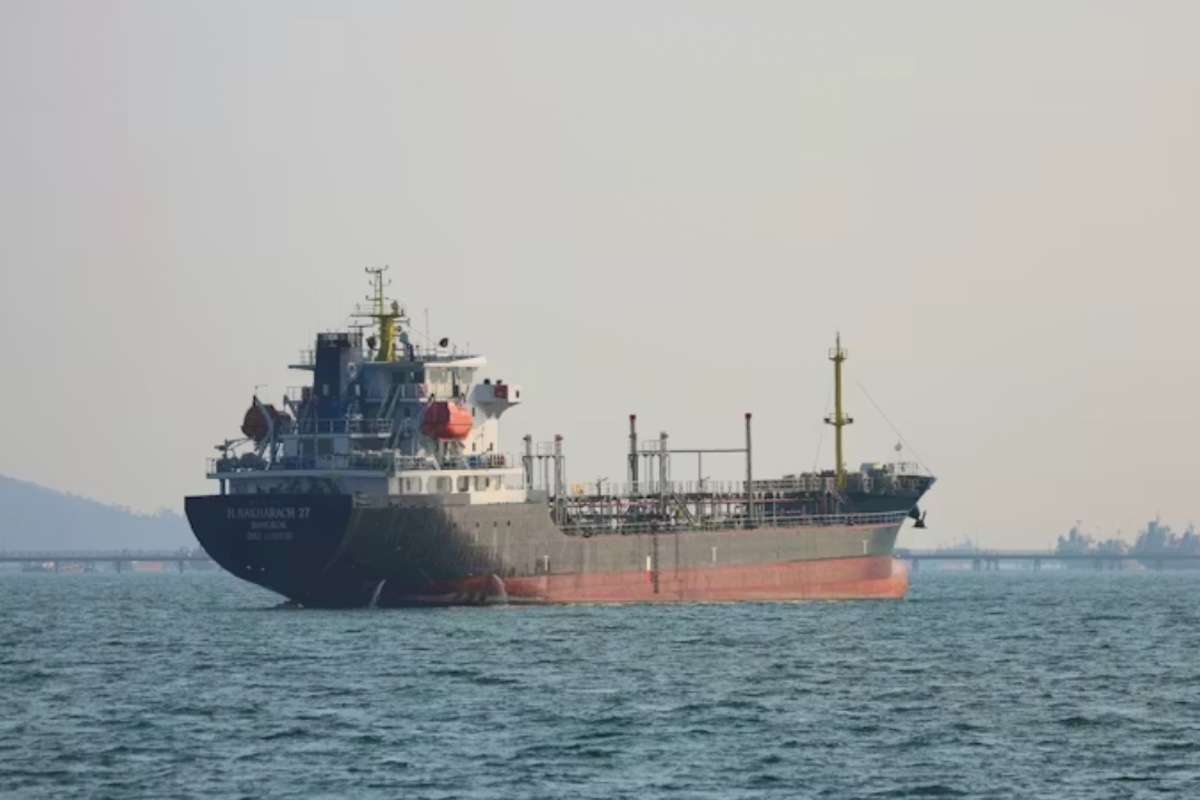
In a development that has stoked new fears of great power confrontation in the Persian Gulf, the Rich Starry, a US-sanctioned tanker linked to China, has completed a transit of the Strait of Hormuz, defying the broad US naval blockade imposed on Iranian coastal waters earlier this month.
According to leading maritime intelligence provider Lloyd’s List, the vessel operates under a false flag of registration in the southern African nation of Malawi, but is ultimately Chinese-owned and carries an all-Chinese crew. It was placed under US sanctions for its history of transporting Iranian goods, and details of its current cargo remain undisclosed. After anchoring off the coast of the United Arab Emirates, the transit did not technically violate the terms of the US blockade, which only restricts travel to and from Iranian ports, but the incident has sent ripple effects through global maritime and diplomatic circles, as other vessels are reportedly preparing to follow the Rich Starry’s path despite US restrictions.
The US blockade was announced by former President Donald Trump on April 11, immediately after US-Iran peace talks in Islamabad collapsed in deadlock. The following day, US Central Command issued a clarifying statement, outlining that the operation would bar all vessels from entering or exiting Iranian ports and coastal areas, but would not block transit of the strait for ships traveling to and from non-Iranian destinations. Trump additionally issued an order instructing the US Navy to interdict any vessel in international waters that has paid the required toll to Iran, noting that no ship that complies with Iran’s illegal toll system will be granted safe passage. It remains unclear whether this order will be fully implemented.
The Strait of Hormuz, one of the world’s most critical energy chokepoints, has been effectively closed to most commercial traffic since shortly after the joint US-Israeli military strikes on Iran in late February. The vast majority of ship owners, charterers, and insurance providers have refused to take on the significant financial and human risk of transiting the waterway amid the threat of Iranian military action.
Blockades are a traditional naval strategy designed to convert maritime dominance into land-based leverage, cutting off an adversary’s imports and exports – in this case, Iran’s primary export of crude oil – to squeeze the target government and population by damaging their economy. For its part, Iran’s strategy of closing the strait after being attacked was intended to disrupt the global energy market, forcing the international community to pressure Washington to roll back its actions.
Tehran has long threatened to exploit its unique geographic position adjacent to the Strait of Hormuz to shut down the waterway. After proving the severe impact a closure can have on global oil and liquefied natural gas prices, Iran has increasingly asserted its regional influence by requiring all transiting vessels to pay a tariff of up to $2 million for passage. Lloyd’s List reported on March 25 that 26 transits had already been completed under a pre-approval system run by the Islamic Revolutionary Guard Corps (IRGC), which requires ship operators to complete a vetting process to gain access.
This Iranian demand to retain control over the strait and the right to collect tolls became a major sticking point in the April 11 talks in Pakistan. Washington has insisted that the international right to free maritime passage must be fully enforced, and the breakdown of negotiations triggered Trump’s decision to impose the naval blockade.
Speaking to the BBC on April 13, former US diplomat to the Middle East David Satterfield framed the standoff as a test of endurance. “It’s now about which country can absorb more pain,” he said, adding that “the Iranians believe … that they can absorb more pain for a longer period than their opponents can.”
The cost and risk calculus of the current standoff is deeply asymmetric. Maintaining the open-ended blockade will impose far higher costs on Washington than it did on Tehran to close the strait. A key open question is whether the US can sustain the interdiction operation long enough to meaningfully pressure the Iranian government, which has spent decades preparing for just such a large-scale sanctions and naval pressure campaign.
If effectively enforced over time, the blockade could further damage Iran’s already fragile economy, which has been battered by years of sweeping sanctions, weakened by the recent war and hit by widespread nationwide anti-government protests in January. The timeline for any such impact remains uncertain, however.
An effective blockade requires a massive commitment of naval resources. Reports indicate the US has already deployed as many as 21 warships to the Middle East, including the nuclear-powered aircraft carrier USS Abraham Lincoln and the amphibious assault ship USS Tripoli, which carries a contingent of marines trained to board suspect vessels via helicopter and small craft.
This large deployment near Iranian coasts introduces an additional layer of risk: US assets must be protected against Iranian anti-ship missiles, attack drones, and fast-attack craft. As a result, the blockade is resource-intensive, operationally complex, and creates significant political vulnerability for the Trump administration.
How exactly the US will enforce the blockade remains to be determined. In late 2025 and early 2026, US Navy and Coast Guard vessels boarded and seized multiple vessels linked to Venezuela’s shadow oil fleet that violated US sanctions. Whether Washington will take the same aggressive action against a Chinese-linked vessel is an open question. While firing warning shots is another potential enforcement option, that tactic carries extreme risk for tanker vessels, given the high potential for a catastrophic oil spill, as well as major political ramifications of attacking or threatening a vessel with Chinese connections.
At present, there is no indication that the US blockade will restore free navigation through the strait in the near term. What is clear is that in the absence of unimpeded free passage, some actors are already willing to test US resolve and transit the waterway despite the blockade. The biggest risk facing all parties is a dangerous escalation if Washington moves to enforce the blockade against the Chinese-owned tanker, a scenario that is unlikely to be welcomed by Trump and his national security team.