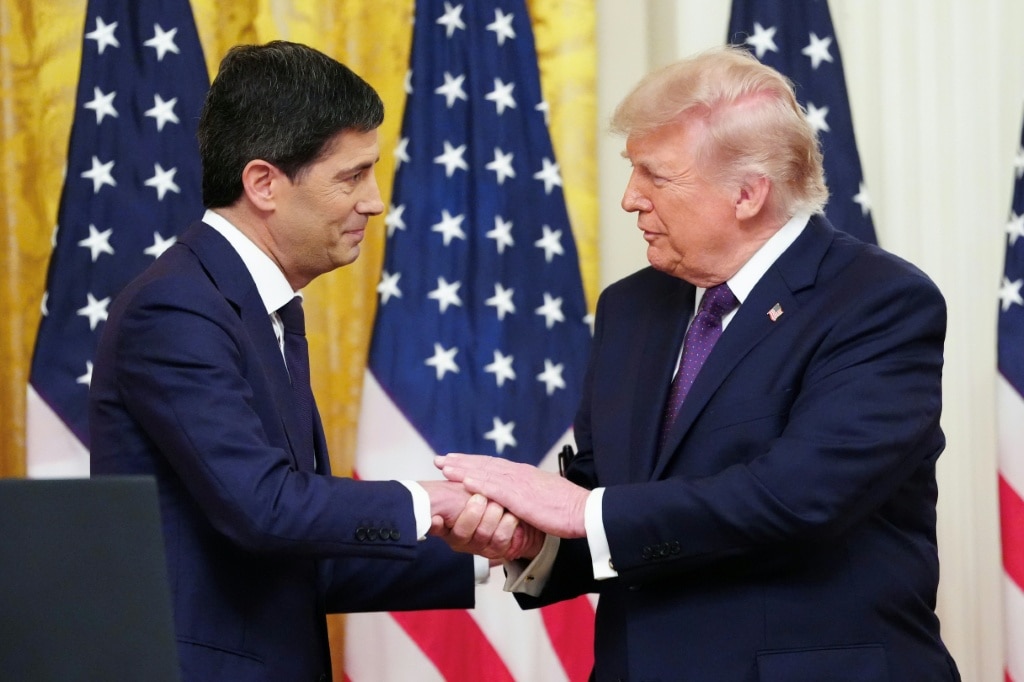
In a highly unusual high-profile ceremony held at the White House on Friday, Kevin Warsh officially took office as the new Chair of the United States Federal Reserve, marking a fresh chapter for the world’s most influential central bank amid simmering tensions over institutional independence and competing economic priorities.
Supreme Court Justice Clarence Thomas, one of two sitting Supreme Court justices in attendance alongside Brett Kavanaugh, administered the oath of office to Warsh in the White House East Room, an event that drew a who’s who of American political and economic elite, including former Vice President Dan Quayle, former Secretary of State Condoleezza Rice, and sitting Central Intelligence Agency director. The warm, smiling entrance of Warsh and former President Donald Trump stood in stark contrast to Trump’s only nationally televised second-term meeting with Warsh’s predecessor, Jerome Powell, during which Trump publicly berated the departing Fed leader.
In his first remarks after taking the oath, Warsh struck a deliberate, reform-focused tone, promising to steer the Fed with a commitment to adaptive policy and unwavering integrity. “I will lead a reform-oriented Federal Reserve, learning from past successes and mistakes both, escaping static frameworks and models, and upholding clear standards of integrity and performance,” Warsh said. He emphasized that central bankers must pursue their core mandates “with wisdom and clarity, independence and resolve,” arguing that effective policy could deliver lower inflation, stronger growth, higher take-home wages, and broader shared prosperity for the American public. During his Senate confirmation process, Warsh firmly pushed back against suggestions he would align with Trump’s political preferences, telling lawmakers he would “absolutely not” be a puppet for the White House.
For his part, Trump used the ceremony to praise his nominee, insisting the new Fed chief would operate with full institutional autonomy, a statement that comes in the wake of the former president’s unprecedented public and private pressure on the central bank to cut interest rates. “Kevin understands that when the economy is booming, that’s a good thing. We want to stop inflation, but we don’t want to stop greatness,” Trump said. Hours after the inauguration, the former president doubled down on his priorities, telling attendees at a separate event he expected interest rates to fall “very quickly.”
It is extremely rare for a sitting Federal Reserve chair to be sworn in at the White House; the last time a Fed leader took the oath at 1600 Pennsylvania Avenue was Alan Greenspan’s 1987 inauguration, nearly four decades ago. The ceremony also unfolded as the Supreme Court prepares to rule on Trump’s bid to oust sitting Fed Governor Lisa Cook, a case that could have far-reaching implications for the central bank’s institutional structure.
Warsh, who has supported interest rate cuts in the past even as inflation remains above the Fed’s long-term target, inherits a divided central bank navigating an extraordinarily tricky economic landscape. Inflation hit 3.8% in April, a three-year high, leaving American households still reeling from years of above-target price hikes that began in the wake of the COVID-19 pandemic. The current inflation surge has been fueled in large part by energy price volatility tied to Trump’s ongoing conflict with Iran. On the labor side, unemployment has held steady around 4.3% over the past year, but monthly job growth has seesawed between expansion and contraction, signaling inconsistent momentum in the broader economy.
The Fed’s statutory dual mandate requires policymakers to balance 2% long-term inflation with maximum employment, a target that has put the central bank in a bind amid current conditions: bringing inflation down to target typically requires tighter monetary policy, which risks further weakening job growth. Just last month, a majority of sitting Fed policymakers signaled that additional rate hikes could be necessary if inflation stays above target, putting the central bank’s existing outlook at odds with the White House’s demand for rapid cuts.
Warsh has pushed back on the idea that strong growth necessarily stokes inflation, arguing that productivity gains from artificial intelligence-driven innovation will allow the U.S. economy to expand rapidly without reigniting price growth. Even so, policy analysts warn a clash between the new Fed chair and the White House may be inevitable. “Kevin Warsh will not be able to deliver the rate cuts that the president wants,” said David Wessel, senior fellow at the Brookings Institution. “At some point, the president may grow impatient and will begin attacking Mr. Warsh as he did Jerome Powell.”
Adding another layer of complexity to Warsh’s tenure is the unprecedented decision by Powell, his predecessor, to remain on the Fed’s Board of Governors after stepping down as chair. Powell has cited growing threats to the Fed’s institutional independence as the core reason for his decision to stay on the board, a move that has drawn pushback from the White House. On Friday, White House economic advisor Kevin Hassett said he hoped Powell would “step aside” soon to allow Warsh to take “complete and easy control of the Fed.”
Columbia Law professor Kathryn Judge, a leading scholar of central banking, noted that Warsh takes office at a moment of profound shift in the balance of power between the executive branch and independent regulatory institutions. “Warsh takes over at a time of disruption and rebalancing in the overall authority of the president,” Judge explained, a context that adds to the already significant economic and political challenges the new Fed chair will face over his tenure.