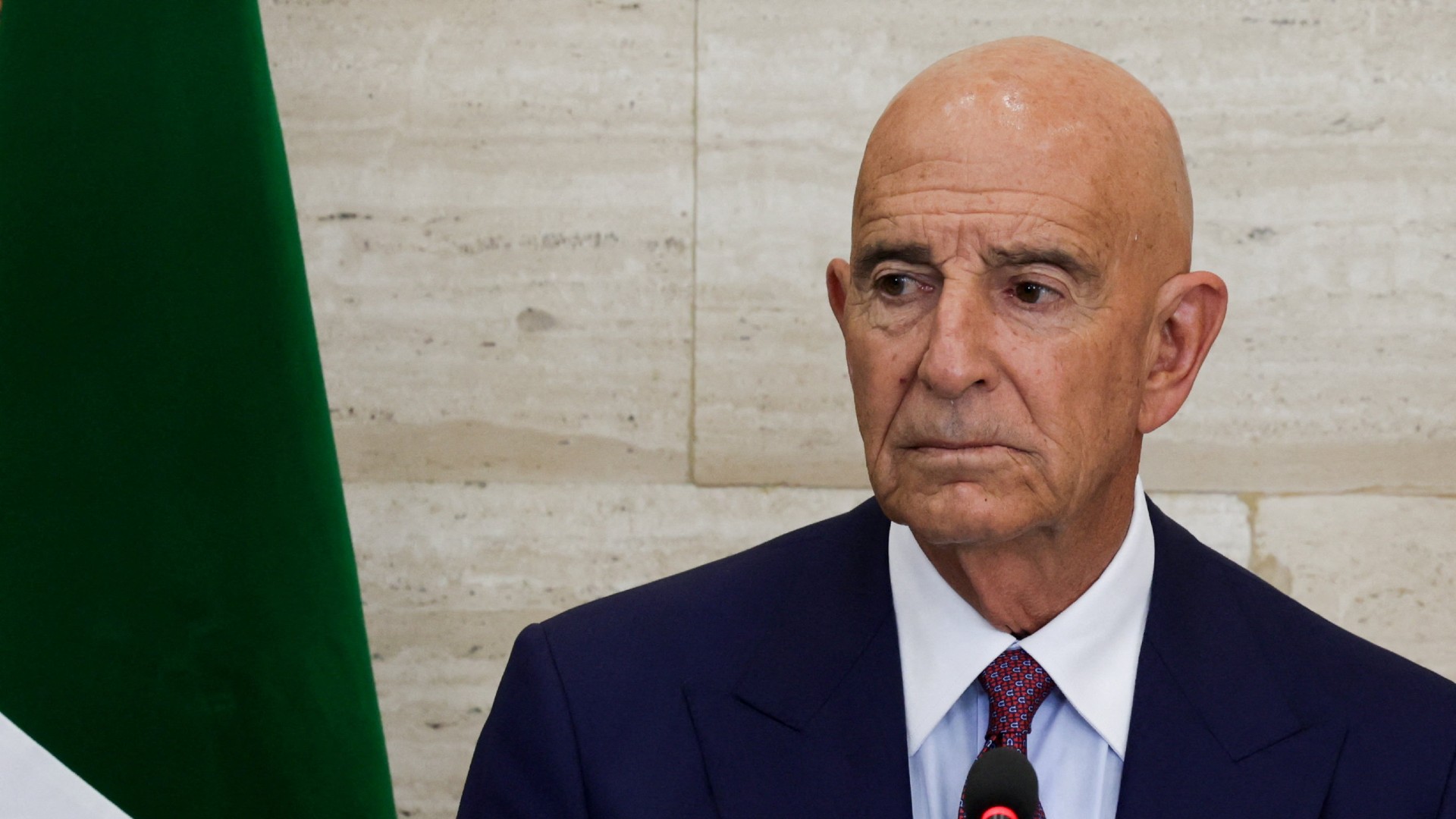
A rare public split between a senior U.S. diplomatic representative and existing White House policy has emerged after Tom Barrack, the current U.S. ambassador to Turkey, openly labeled Israel’s long-standing control of Syria’s Golan Heights as an unlawful occupation that directly violates United Nations resolutions and global international law.\n\nBarrack’s comments mark a stark departure from the official stance of the U.S. government under former President Donald Trump, who formally recognized Israeli sovereignty over the contested strategic plateau in 2019 — a move that was immediately rejected by most of the international community.\n\nLocated at the intersection of Israel, Syria, and southern Lebanon, the Golan Heights is a strategically critical highland region that Israel first seized from Syrian control during the 1967 Six-Day Middle East War. Israel unilaterally annexed the territory shortly after its capture, but this territorial claim has never received formal recognition from the broader global community. Binding UN Security Council Resolution 242, adopted shortly after the 1967 conflict, explicitly requires Israel to withdraw from all territories captured during the war, including the Golan Heights, the Gaza Strip, and the West Bank. Today, the Golan is home to approximately 20,000 Israeli settlers and 26,000 original Syrian inhabitants, most of whom are members of the Druze ethnic community who retain their Syrian national identity.\n\nBarrack made the contentious remarks during a wide-ranging interview with broadcaster Mario Nawfal, where he also discussed regional tensions over potential Israeli plans to annex additional Lebanese territory. On that topic, he argued that Israeli leaders recognize the international community would never allow such a move, noting that U.S. public and political support for Israel is gradually softening. ‘Even young Democrats are coming against them,’ he stated, adding that even former President Trump sought to carve out a moderate approach to the conflict. He added that upcoming Israeli national elections will likely reshape the country’s political and policy landscape, making any large-scale territorial annexation of Lebanese land even less feasible.\n\nReturning to the question of the Golan Heights, Barrack reaffirmed his assessment: ‘Now saying that, in the Golan with Syria, they still occupy the Golan against the UN resolutions, against all of the international order, which has said the Golan is Syria’s.’\n\nThe ambassador also addressed rising regional tensions following a recent Israeli air strike on Syria’s Abu al-Duhur air base, noting that the operation carried a significant risk of direct military confrontation between Israel and Turkey. He outlined multiple competing theories to explain what prompted the strike, which he described as ‘serious and worrying.’\n\nThe first theory he cited was unconfirmed Israeli intelligence that Turkish military assets were preparing to deploy to the base, a claim that has not been verified by subsequent checks. A second possibility is that Israeli forces detected unusual troop movements that other regional actors failed to pick up. Barrack called a third explanation the ‘probably most likely’ scenario: Israeli intelligence intercepted conversations indicating Turkey planned to expand its military training operations at the Abu al-Duhur base.\n\nHe also raised a more provocative possibility: that Israel deliberately baited Turkey by launching the strike without any prior notification to Ankara, as a test of Turkey’s response to Israeli military activity in the area. A final theory centers on internal coordination failure within Israel’s security establishment, suggesting the Israel Defense Forces, Mossad, and the prime minister’s office may have operated on conflicting intelligence assessments that led to the unplanned strike.\n\nBarrack warned that the risk of accidental escalation in the already volatile region carries severe consequences. ‘The unintended consequence of a mistake could be really consequential,’ he said, noting that Turkish forces could scramble fighter jets in response to an unannounced incursion with no advance knowledge of Israeli intentions, raising the risk of open conflict between the two military powers.\n\nBarrack also noted that reaching a diplomatic de-escalation of ongoing Israeli incursions into Lebanon remains challenging, as key decision-making power in the region is held by Iran and the Lebanese militant group Hezbollah, with no ongoing negotiations between all relevant parties.
US envoy to Turkey: ‘Israel occupies Golan despite UN resolutions, international order’