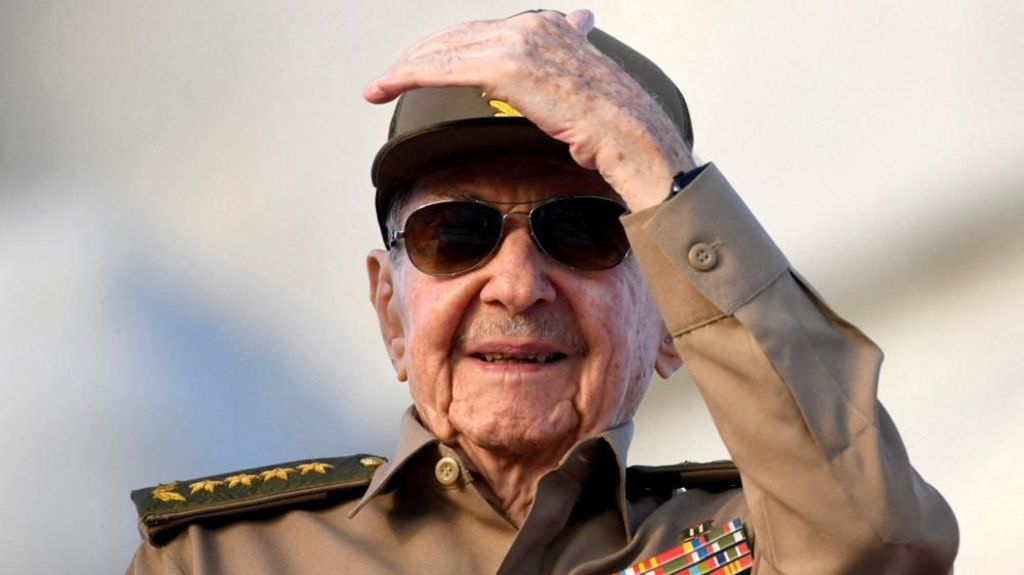
In a sharp escalation of long-running U.S. pressure on Cuba’s communist government, the U.S. Department of Justice has unsealed long-dormant charges against 94-year-old former Cuban leader Raúl Castro, accusing him of conspiracy to murder U.S. nationals, destruction of civilian aircraft, and four counts of murder linked to the 1996 shooting down of two planes operated by Cuban-exile group Brothers to the Rescue that killed four people, three of them U.S. citizens.
Acting U.S. Attorney General Todd Blanche made the announcement official during a press event Wednesday at Miami’s Freedom Tower, a site deeply symbolic for the Cuban-American exile community. Standing in front of photos of the four victims — Armando Alejandre Jr., Carlos Alberto Costa, Mario Manuel de la Peña, and Pablo Morales — Blanche confirmed that an arrest warrant for Castro has been issued, adding pointedly: “We expect he will show up here, by his own will or another way.” He emphasized that the U.S. and the Trump administration would never forget the lives of the four citizens lost in the incident.
The charges, originally filed under seal in 2003, are being brought at a moment when the Trump administration has ramped up economic and diplomatic pressure on Cuba, aiming to force the country’s one-party government to adopt sweeping political and economic reforms. The move also coincides with Cuba’s Independence Day, when Secretary of State Marco Rubio released a pre-recorded message to the Cuban people framing the Trump administration as an advocate for change on the island. Rubio blamed GAESA, the Cuban military-controlled economic conglomerate that dominates major sectors from ports and energy to hospitality, for the widespread blackouts and acute food shortages that have gripped the country amid a decades-long U.S. trade embargo and recent targeted oil sanctions.
Cuban President Miguel Díaz-Canel has rejected the charges outright, dismissing them as a baseless political maneuver designed to justify potential military aggression against Cuba. He reiterated the Cuban government’s long-held position that the 1996 interception of the planes was an act of legitimate self-defense carried out within Cuba’s territorial waters. Díaz-Canel also accused the U.S. of distorting historical facts and imposing collective punishment on the Cuban people through its sanctions policy. Cuban state media has echoed this condemnation, labeling the accusations false, and the government has signaled it will harden its long-held “no surrender, no concessions” stance against U.S. pressure, dimming prospects for the quiet exploratory talks between U.S. and Cuban representatives that have taken place in recent months.
Now 94, Castro stepped down from formal leadership roles in 2018 after a decade serving as Cuba’s president, but he remains a revered, influential figure as the last surviving leader of the 1959 Cuban Revolution. During his tenure, he oversaw a brief historic thaw in bilateral relations with the U.S. under former President Barack Obama, a detente that has since been fully reversed by the Trump administration’s hardline policy.
The announcement drew enthusiastic support from Cuban-American exiles who gathered in Miami for the event, many of whom have opposed the Cuban government for decades. Isela Fiterre, a member of the exile community, called the long-delayed action long overdue, saying: “Raúl Castro did not merely kill four individuals. Over the course of many years, he has killed countless people.” Fellow attendee Mercedes Puid-Soto echoed the sentiment, saying “Justice has been served” and noting the charges would help the victims’ families and the broader Cuban exile community find closure.
Regional policy experts warn the charges carry significant geopolitical risks, drawing parallels to the January 2025 U.S. military operation to detain indicted Venezuelan President Nicolás Maduro. “Still looming over Blanche’s announcement was the answer to whether the Trump administration will use this indictment in a similar way that it used the indictment against Maduro, as a justification to carry out a military operation under the cover of a law enforcement action,” said Roxanna Vigil, an international affairs fellow at the Council on Foreign Relations. Vigil added that the Cuban government is unlikely to comply with U.S. demands, and any attempt to negotiate with Havana would face fierce pushback from the politically influential Cuban-American diaspora in the U.S.
William LeoGrand, a Latin American politics specialist at American University, framed the move as part of a deliberate incremental pressure strategy. “The strategy is to increase the pressure gradually to the point where the Cuban government will give in and surrender at the bargaining table,” he explained. U.S. President Donald Trump framed the action around humanitarian goals when asked about its political motivations, noting his longstanding close ties to the Cuban-American community and saying “On a humanitarian basis, we’re here to help.”