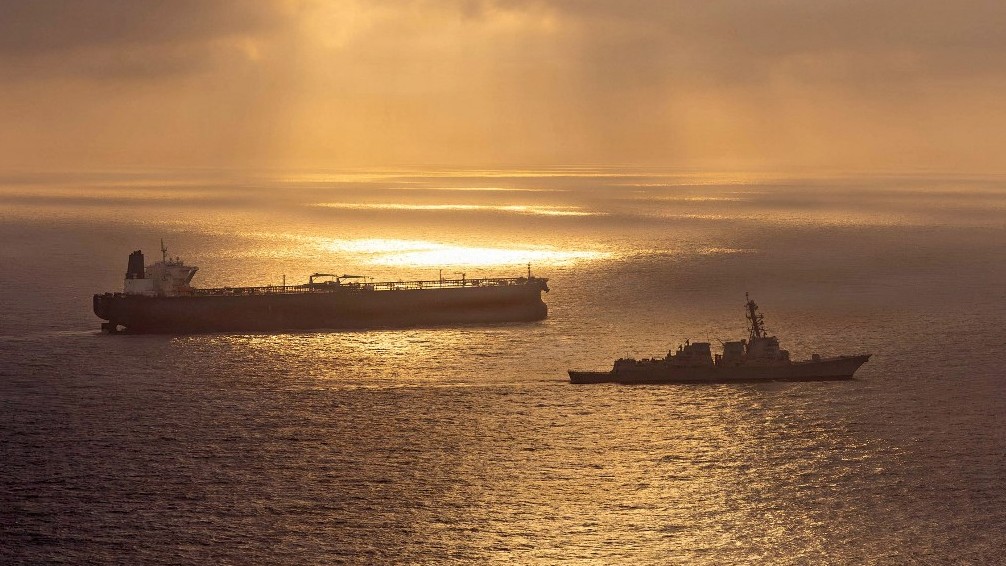
In late April 2026, former U.S. President Donald Trump made a bold prediction: Iran’s critical oil fields and energy infrastructure would “explode” within days, a collapse he credited entirely to Washington’s newly imposed naval blockade of Iranian ports. Framing the blockade as a flawless, genius strategy, Trump told reporters that Tehran would soon be forced to surrender, saying “They have to cry uncle; that’s all they have to do. Just say, ‘We give up.’”
Nearly a month on, however, Trump’s forecast has proven drastically overstated, with Iran’s long history of navigating energy crises allowing it to adapt rather than collapse. Decades of institutional experience coping with output cuts stretch back to the 1980s Iran-Iraq War, when Tehran slashed production from more than 5 million barrels per day to under 1.5 million to withstand pressure. More recently, during the first Trump administration’s 2018–2020 “maximum pressure” sanctions campaign, Iran cut output by another 2 million barrels per day without systemic energy collapse. Drawing on that hard-won expertise, Iran has already adjusted to the 2026 blockade, cutting current output by an estimated 400,000 barrels per day without widespread infrastructure failure. “We have enough expertise and experience,” said Hamid Hosseini, spokesman for the Iranian Oil, Gas and Petrochemical Products Exporters’ Association. “We’re not worried.”
Instead of collapsing Iran, the crisis has shifted pressure outward, hitting U.S. closest regional Gulf allies after Iran retaliated by closing a key segment of the Strait of Hormuz — the waterway through which roughly one-fifth of global oil production transits. The disruption has already choked off exports for vulnerable Gulf producers: shipping monitor TankerTrackers.com recorded zero crude oil exports from Kuwait in April 2026, the first time that has happened since the 1991 Gulf War. Unlike wealthier neighbors Saudi Arabia and the United Arab Emirates (UAE), Kuwait has no alternative routes to reroute exports, forcing it to divert all production to domestic storage and refining.
Unlike Iran, which has honed strategies for surviving external pressure for decades, Gulf economies have no comparable experience navigating prolonged blockades and export disruptions. What is more, their growth models rely heavily on stable conditions to retain large migrant workforces, which are likely to depart if economic conditions worsen sharply. “The dual blockade is damaging Iran, but it is also attacking the foundations of the Gulf economic model,” explained Andreas Krieg, associate professor of security studies at King’s College London, in an interview with Middle East Eye. “It means Gulf producers cannot simply watch Iran suffer from a safe distance. Their own exports, logistics, insurance costs, food imports, aviation routes, LNG deliveries and investor confidence are all hit.” While Gulf states accumulated large financial reserves during decades of high oil prices, the current crisis has eroded long-held confidence in the region as a stable, low-friction hub for global energy, trade, capital and aviation, Krieg added.
The strain has already exposed deep vulnerabilities in the UAE’s geopolitical gambit: Abu Dhabi’s bet on an alliance with Israel to project regional power has backfired spectacularly, according to analysis from Moody’s Analytics. Before the conflict erupted in March, the UAE had claimed its non-oil sectors, particularly tourism, were robust enough to absorb regional shocks. That assumption has collapsed: Moody’s now projects hotel occupancy in the second half of 2026 will plummet to just 10 percent, down from 80 percent pre-conflict, amounting to an effective shutdown of large swathes of the country’s hospitality sector. Thousands of tourism workers have already been laid off, furloughed, or forced to take unpaid leave, with many businesses delaying salary payments amid collapsing revenue.
The ripple effects of the crisis extend far beyond the Middle East. South Asian economies that rely heavily on remittances and capital inflows from the Gulf have already been hit hard. When cash-strapped Pakistan attempted to mediate between Washington and Tehran to de-escalate the conflict, the UAE — angered by Islamabad’s mediation efforts and facing its own cash shortages — demanded immediate repayment of a $3.5 billion loan. The UAE has also entered talks with the Trump administration to secure a large international financial bailout, similar to the emergency rescue package extended to Argentina in 2025. Further afield, Egypt, Lebanon and Syria, all heavily dependent on Gulf investment, remittances, aid and political stability, are already bracing for deep cuts to external funding as Gulf states pare back spending to conserve reserves. “When Gulf states face revenue losses, they tend to become more selective, more conditional and more strategic,” Krieg noted.
In Southeast Asia, where major economies are overwhelmingly dependent on Middle Eastern energy imports, the crisis has triggered immediate austerity measures and pushed food insecurity to alarming levels. The Philippines imports 95 to 96 percent of its oil from the Gulf, while Vietnam imports 85 to 87 percent, and Thailand relies on Gulf supplies for roughly 60 percent of its crude needs. The disruption to gas supplies has hit global fertilizer production, driving prices up 80 percent in just over a month; Svein Tore Holsether, CEO of global fertilizer giant Yara International, warned that reduced fertilizer supplies could cut global crop yields by as much as 50 percent. The UN Food and Agriculture Organization reported that global food prices hit their highest level since 2023 in April, with the Middle East conflict cited as a primary driver. To conserve fuel, the Philippines and Thailand have already introduced four-day workweeks and expanded work-from-home policies, while retail fuel prices have doubled across much of the region. In many countries, government fuel subsidies are the only thing preventing public unrest, but the cost of those subsidies has exploded, making the policy unsustainable long-term, according to Kuala Lumpur-based geopolitical analyst Arnaud Bertrand.
While the immediate crisis has forced governments to focus on short-term survival, business leaders in the region note the conflict is likely to accelerate a permanent shift toward renewable energy. “The war is likely to accelerate the move towards solar and wind and geothermal and hydro power across the region,” said Chris Humphrey of the EU-ASEAN Business Council in a CNBC interview. “All the governments in Southeast Asia are absolutely committed to that as a strategy going forward.”
Beyond the immediate economic damage, analysts warn the crisis has inflicted lasting damage to the credibility of U.S. power in the Indo-Pacific and beyond. Even prominent U.S. foreign policy hawks have warned that Washington is facing a major strategic defeat. Robert Kagan, one of the most influential neoconservative voices and a long-time pro-Israel hardliner, wrote in an essay for *The Atlantic* earlier this month that Washington is heading toward “total defeat” in its campaign against Iran, and that the damage “can neither be repaired nor ignored. There will be no return to the status quo ante, no ultimate American triumph that will undo or overcome the harm done.” Former senior U.S. diplomat Tom Pickering, who served as U.S. ambassador to Israel and under secretary of state for political affairs, wrote in *Foreign Affairs* that Washington’s insistence that it can force Iran into total surrender is contradicted by months of on-the-ground evidence, and that the U.S. may ultimately have to accept a compromise arrangement that aligns with core Iranian demands for a transit surcharge on ships passing through the strait.
The failed U.S. “Project Freedom” initiative, launched in early May to escort stranded ships through the Strait of Hormuz and break Iran’s blockade, underscored the gap between Trump’s rhetoric and results. The operation, which Trump claimed was launched at the request of countries with trapped vessels, ultimately succeeded in escorting just two U.S.-flagged ships through the waterway. “This war has shattered the idea that U.S. power, whatever its flaws, at least worked towards open sea lanes and at least helped protect you if you were an ‘ally’,” Bertrand noted. Even long-time U.S. partners in the region are shifting their approach: Philippines President Ferdinand Marcos Jr., once one of Washington’s closest Indo-Pacific allies, has recently made overtures to Beijing as U.S. policy fails to resolve the energy crisis.
This report was originally published by Middle East Eye, an independent outlet covering the Middle East, North Africa and global affairs.