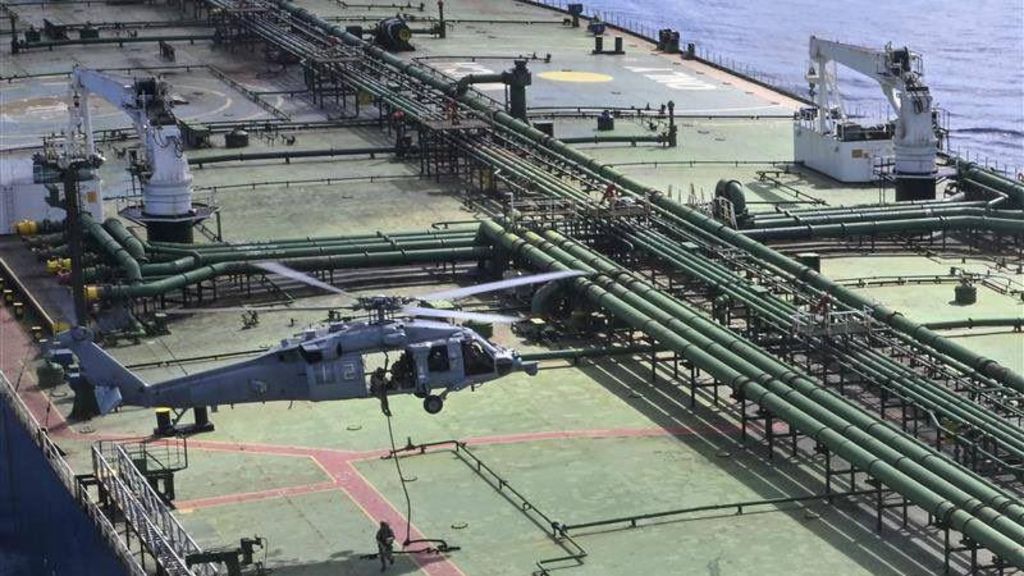
The United States has launched another provocative naval operation targeting Iran, with U.S. defense officials confirming that American forces have boarded the M/T Majestic X, a sanctioned vessel carrying Iranian crude oil, in the Indian Ocean as part of a widening maritime interdiction campaign. This interception marks the latest in a string of seizures implemented after the Trump administration imposed a full naval blockade on all maritime traffic entering and exiting Iranian ports on April 13.
According to a public statement from the U.S. Department of Defense (DoD), the operation qualifies as a formal maritime interdiction – a military action where naval forces intercept and inspect vessels suspected of hostile activity or violations of international sanctions. U.S. Central Command (Centcom) reports that under the current blockade, it has already ordered 33 vessels to return to their ports of origin, and the DoD has pledged to continue intercepting any vessel suspected of providing material support to Iran, regardless of where the ships are operating in global waters.
This latest interception comes on the heels of a dramatic order from President Donald Trump, who directed U.S. Navy forces to “shoot and kill” any boat caught laying mines in the Strait of Hormuz, the strategically critical global shipping chokepoint that connects the Persian Gulf to the Arabian Sea. Trump’s aggressive stance is part of a broader strategy to cripple Iran’s economy by cutting off the country’s core oil export revenues, as well as blocking toll revenues that Iran began collecting from commercial vessels passing through the Strait of Hormuz.
Speaking at a White House event on Thursday, Trump claimed the blockade is already “100% effective” and asserted that Iran is currently “getting no business” from its oil exports. He also made the surprising announcement that he rejected a recent Iranian offer to reopen the Strait of Hormuz, stating that the waterway “will open when we make a deal” on a broader peace agreement.
Iran has pushed back fiercely against U.S. operations, labeling an earlier U.S. interception of an Iranian-linked vessel this week as outright “piracy.” On Thursday, Hamidreza Haji Bababei, deputy speaker of the Iranian Parliament, claimed that the first batch of toll revenues collected from commercial vessels using the Strait of Hormuz had already been deposited with Iran’s Central Bank. No additional details have been released regarding the total amount of the toll, how it is being collected, or which shipping companies have paid, and the BBC has not been able to independently verify this claim.
The heightened U.S. military activity comes even after Trump agreed to extend a temporary two-week ceasefire at the request of Pakistani mediators, raising questions about the sustainability of the truce. Mohammad Bagher Ghalibaf, who led Iran’s first round of peace negotiations with the U.S., stated that it is “not possible” for Iran to reopen the Strait of Hormuz under the current blockade, which Iran says already amounts to a ceasefire violation by the U.S.
In a post to his Truth Social platform on Thursday, Trump claimed that U.S. military forces now hold “total control” over the Strait of Hormuz, and repeated a baseless claim that Iranian leaders are in disarray, saying Iranians are “having a very hard time figuring out who their leader is.” This comment references the fact that Mojtaba Khamenei, who succeeded his late father Ayatollah Ali Khamenei – Iran’s supreme leader of 34 years who was killed in the opening day of the U.S.-Israeli attack on Iran on February 28 – has not been seen in public since taking office on March 8.
Just one day before Trump’s post, Iran’s navy announced it had seized two commercial cargo ships in the Strait of Hormuz and escorted them to Iranian territorial waters, following reports that three vessels had come under fire from Iranian forces. The Islamic Revolutionary Guard Corps (IRGC), Iran’s elite revolutionary military force, claimed responsibility for the seizures through its affiliated Fars News Agency. BBC Verify conducted an independent analysis of aerial footage released by the IRGC purporting to show the seizure, and confirmed that the two vessels – the MSC Francesca and the Epaminondas – are correctly identified, but found that the footage was filmed several hours after the reported initial attack. Greek authorities have denied that the Epaminondas was seized, saying the vessel’s captain remains in full control, though transponder signals for both ships have been switched off, an unusual move for commercial vessels operating in open waters.
Expanding on his earlier order, Trump confirmed Thursday that he had issued a formal order to the U.S. Navy to “shoot and kill” any boats caught laying mines in the Strait of Hormuz, saying “There is to be no hesitation” in carrying out the order. He added that U.S. minesweepers are already actively clearing mines from the shipping lane “right now.” The order comes after unconfirmed reports suggested that U.S. military assessments estimated it could take up to six months to clear all mines from the strait if it were heavily mined, a claim the Pentagon has strongly rejected.
“One assessment does not mean the assessment is plausible, and a six-month closure of the Strait of Hormuz is an impossibility and completely unacceptable to the Secretary,” Pentagon Chief Spokesman Sean Parnell told the BBC in a statement.
In a nearly five-minute phone interview with the BBC’s North America editor Sarah Smith, Trump insisted that Iran is “dying to make a deal” and argued that his hardline approach “seems to be working very well.” He announced a two-week extension of the ceasefire earlier this week to give Iranian officials time to draft a “unified proposal” to end the ongoing conflict, but declined to specify how long the extended truce will remain in place. He also pushed back against reports that he is eager to wrap up the conflict quickly, writing on Truth Social that while he has “all the time in the World …Iran doesn’t – The clock is ticking!”
Despite the severe economic pressure the conflict has placed on Iran, whose economy was already struggling before the war, and has now seen massive layoffs and a sharp collapse in consumer spending, Iranian officials have shown no public sign of backing down. Iranian Foreign Minister Abbas Araghchi said in a statement on X that the country is “united, more than ever before,” and Iranian President Masoud Pezeshkian and lead negotiator Ghalibaf echoed that claim, highlighting what they called Iran’s “iron unity” in the face of U.S. aggression.
Israel, which joined the U.S. in launching the initial attack on Iran on February 28, has also maintained a hardline stance. Israeli Defense Minister Israel Katz said Thursday that his country stands ready to immediately resume hostilities and return Iran “to the dark and stone ages.” Katz added that Israel is “waiting for the green light from the US…to complete the elimination of the Khamenei dynasty.”