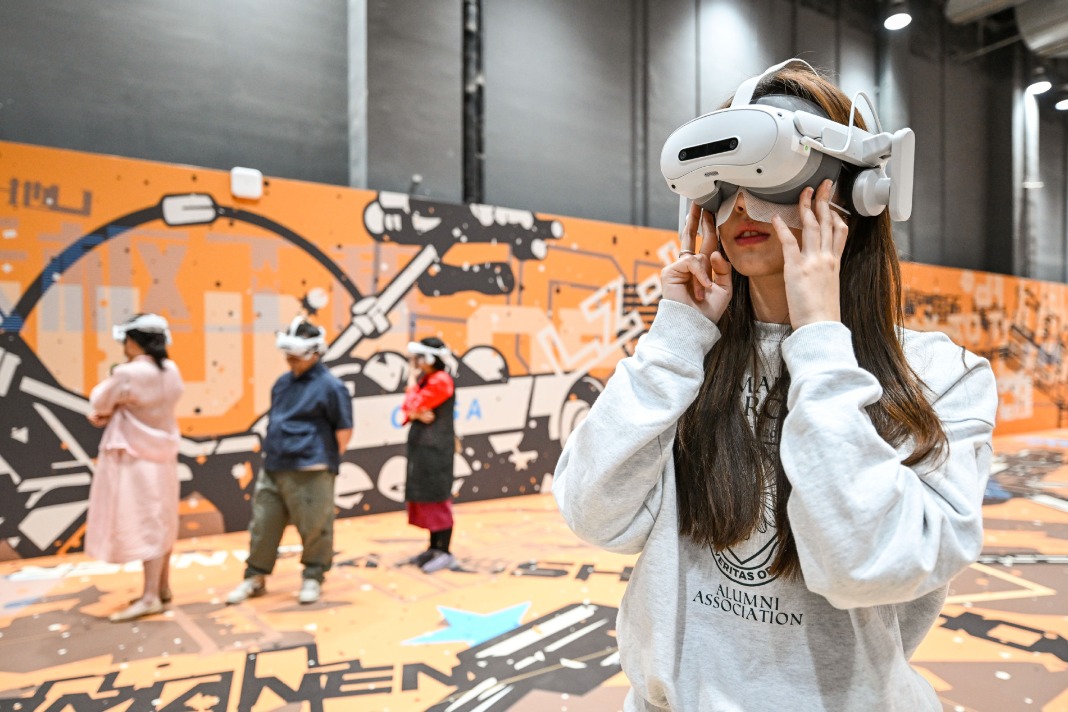
To mark China’s annual Space Day, which fell on Thursday this year, a groundbreaking immersive exhibition focused on China’s far side of the Moon exploration missions opened to the public at the China Science and Technology Museum in Beijing on April 24, 2026. Jointly organized by the China Science and Technology Museum and the China National Space Administration, the showcase blends traditional artifact displays with cutting-edge large-scale virtual reality (VR) experiences to offer visitors a one-of-a-kind journey through China’s decades-long lunar exploration program. Unlike standard science exhibitions that rely on static displays, this dual-format event invites guests not only to view landmark technological achievements, but also to step into the landscape of the Moon themselves.
Among the physical exhibits on display are two key examples of China’s indigenous aerospace innovation: the high-strength, high-toughness steel developed entirely in China for Chang’e series lunar spacecraft, and a decommissioned rocket engine. These tangible artifacts serve as concrete proof of the major leaps forward China has made in space technology over the past two decades. Complementing these core pieces, the exhibition also features high-resolution satellite imagery captured during actual lunar missions, original documentary footage of mission operations, and ultra-high-precision scale models of Chang’e spacecraft. Curators arranged these materials to trace the full evolutionary timeline of China’s lunar exploration program, breaking down complex scientific principles and critical technological breakthroughs that made far side lunar exploration accessible for a general audience.
The centerpiece of the showcase is the dedicated VR zone, built using real, authenticated data from China’s past lunar exploration missions to deliver a hyper-accurate simulated experience. This immersive zone lets visitors step into a hypothetical 2049 mission to the Tianshu Base located at the lunar south pole, a long-term goal outlined in China’s deep space exploration roadmap. Guests can walk through every step of a full lunar mission: from feeling the rumble of a rocket launch, to transitioning between Earth and Moon orbits, completing a lunar spacewalk, and conducting the first crewed landing on the lunar surface. The simulation also recreates the harsh natural conditions of the lunar environment, including visual renderings of meteorite impacts, cosmic radiation bursts, and intense solar storms, giving visitors a realistic sense of the challenges that deep space exploration poses.
Running through August 16, the exhibition was developed with a core outreach goal: to ignite widespread public enthusiasm for space science, exploration, and technological innovation, particularly among children and young people who are the future of China’s space program.