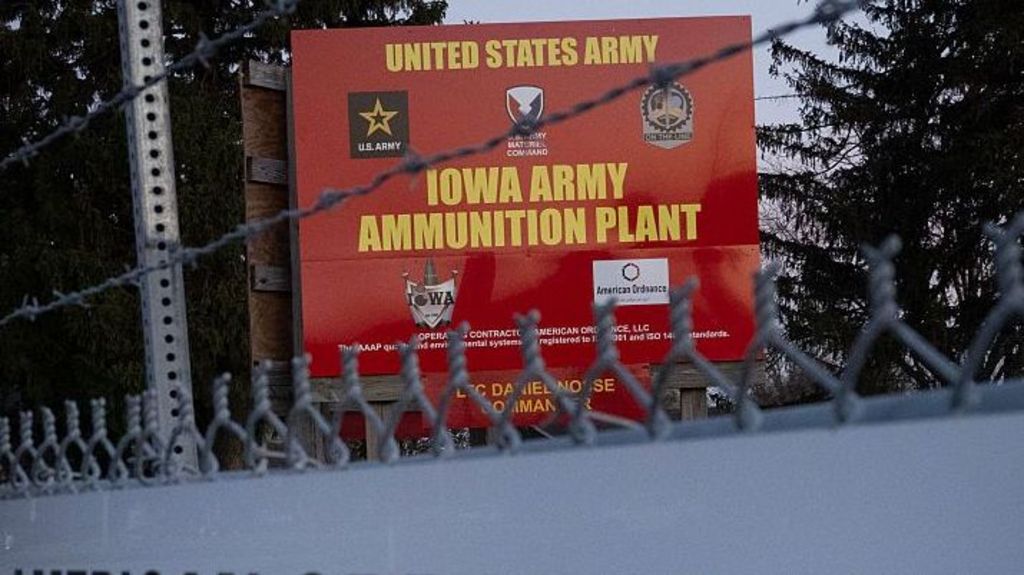
In a late Saturday court filing, the U.S. Department of the Army has revealed its intent to move forward with the controlled detonation of five tonnes of severely degraded explosive material at the Iowa Army Ammunition Plant (IAAAP) in Middletown, Iowa, despite a recent federal court ruling that imposed an indefinite halt to the operation. The Department of Justice, representing the Army, submitted a formal notice to the court asserting that immediate action is non-negotiable to safeguard both military personnel and nearby civilian communities, emphasizing that delaying the operation would pose greater unmitigated risks to public health and local ecosystems. The operation, initially slated for the preceding Friday, was temporarily suspended by a federal court order after Middletown residents raised urgent alarms over the potential for toxic lead particles to disperse across residential zones following the blast. The Army now aims to complete the detonation no later than November 24, and has signaled it will invoke a little-used emergency regulatory exclusion to bypass the existing court-ordered pause. Military officials argued in the new filing that plummeting regional temperatures, forecast to drop below 30 degrees Fahrenheit (-1 Celsius) in the coming days, will drastically increase the volatility of the stored lead azide, a highly sensitive compound used as a primary detonator. The filing warns that an unplanned, accidental detonation of the degraded stockpile is an immediate and growing threat if no controlled action is taken. According to local Iowa Public Radio reports, the stockpile of lead azide at IAAAP degraded over extended storage earlier this year to such an unstable state that transporting the material off-site is deemed far too dangerous to attempt. Military and federal environmental regulators, including the Environmental Protection Agency (EPA), jointly concluded that detonating the material in its current on-site location is the lowest-risk strategy to eliminate the explosive hazard. The EPA previously issued an emergency permit authorizing the detonation of 68 drums of the volatile compound, stating the unaddressed blast risk represented an imminent, substantial threat to human health and the surrounding environment. Prior to the original planned detonation date, the Army had issued public advisories urging all residents in affected zones to evacuate their homes for a full six hours, covering the duration of the blast and the subsequent period required for residual dust to settle, and warned all people in adjacent areas to avoid outdoor exposure entirely during the operation. The Army has not yet released specific timing or logistics details for the rescheduled detonation, and noted it is coordinating closely with the U.S. Department of Health and Human Services and the EPA to implement maximum safety protocols. The planned operation has faced fierce pushback from environmental advocacy groups, which filed formal lawsuits on Thursday to block the detonation. The Iowa Environmental Council, a lead plaintiff in the litigation, argued that the Army failed to fully evaluate and implement viable, safer alternative disposal methods, and that a large share of residents living within the designated risk zone had no advance notice of the planned blast. The group emphasized that no level of lead exposure is medically safe, and that local Iowans were given only a few days to prepare for a detonation that could release toxic lead particulates into the air, water, and local food chains.
US Army to detonate tonnes of unstable explosives in Iowa despite court order