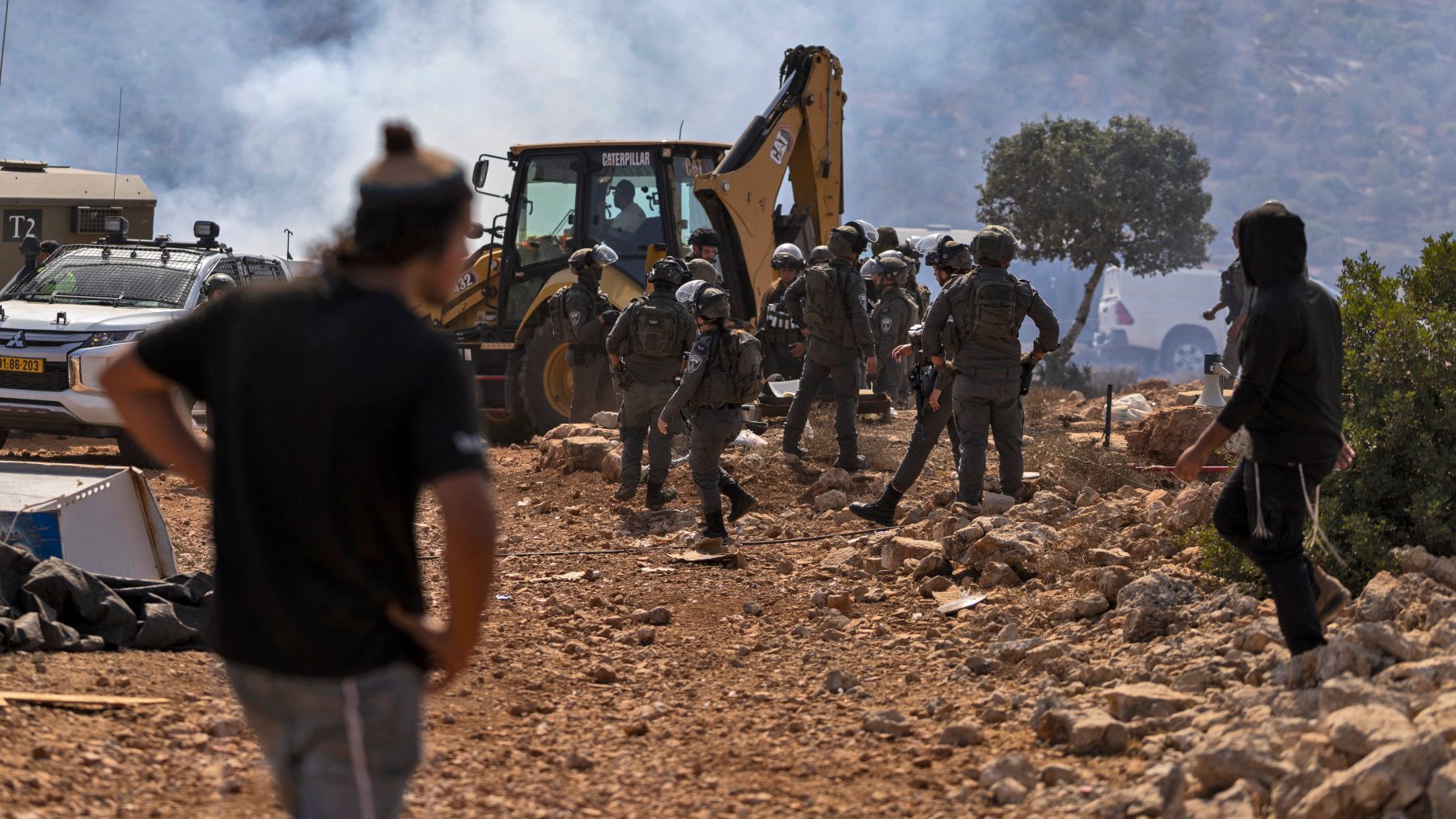
Prominent Israeli statesman Gadi Eisenkot, leader of the centrist Yashar party and the figure tapped by Israeli President Isaac Herzog on November 8 to negotiate the formation of the country’s next governing coalition, has issued a scathing public condemnation of a recent wave of coordinated settler arson assaults in the occupied West Bank, labeling the unrestrained violence against Palestinian communities as unambiguous “Jewish terrorism”.
The latest spate of attacks unfolded overnight between Saturday and Sunday, targeting three Palestinian villages near Ramallah: Deir al-Sudan, Deir Abu Mashal, and Kafr Malik. Verified reports from the official Palestinian news agency Wafa confirm that extremist settler groups set fire to 12 privately owned Palestinian vehicles, defaced residential properties with racist hate graffiti, and inflicted widespread property damage across the three communities.
In a public post published on the X social platform, Eisenkot did not mince words when assigning blame, explicitly naming two senior far-right cabinet members — National Security Minister Itamar Ben Gvir and Finance Minister Bezalel Smotrich — as the primary forces driving the West Bank to the precipice of unregulated anarchy. “These acts of sabotage by extremist factions, who set fire to vehicles and threaten family homes, do not just harm innocent Palestinian civilians: they erode regional stability, put countless lives at immediate risk, and inflict severe, lasting damage to Israel’s national security standing and its global diplomatic relationships,” Eisenkot wrote. He went on to urge Israeli state security institutions to deploy every available enforcement tool, including administrative detention protocols and targeted operational interventions by the Shin Bet domestic security agency, to crack down on violent settler perpetrators without delay. “This chaotic, violent reality is not a foregone conclusion,” Eisenkot emphasized. “It is the direct, predictable outcome of reckless, abdicated leadership from the current government.”
Eisenkot’s tough remarks were echoed by fellow opposition leader and former prime minister Yair Lapid, who also categorized the ongoing settler assaults as acts of terrorism rooted in deliberate governmental neglect. “Jewish terrorism is not an accidental, unforeseen phenomenon: it is the direct product of the Israeli government’s criminal failure to enforce the law equally across all communities under its jurisdiction,” Lapid stated. “By choosing to remain silent in the face of these atrocities, senior cabinet ministers are actively, intentionally encouraging these pogrom-style attacks. When our opposition bloc succeeds in forming a new governing coalition, we will take firm, decisive action to dismantle this terrorist threat and restore full governance, legal accountability, and public order to every part of the territory.”
Israeli law enforcement authorities have confirmed that formal criminal investigations into the incidents of arson, vandalism, and property destruction are now underway.
This latest wave of targeted violence is part of a sharply accelerating, months-long surge in settler hostilities across the occupied West Bank, where Palestinian communities have faced a relentless pattern of physical assaults, arson attacks on homes and agricultural assets, arbitrary property destruction, systemic restrictions on farmer access to vital farmland, and rapid, unregulated expansion of unauthorized settler outposts. Data compiled by the United Nations Office for the Coordination of Humanitarian Affairs (OCHA) paints a stark picture of the escalating crisis: between November 10 and November 16 alone, the agency documented 40 separate settler attacks that resulted in physical casualties or significant property damage, impacting 30 distinct Palestinian communities. These incidents left 38 Palestinian civilians injured and displaced 68 people, 31 of whom are children.
Over the course of the 2026 olive harvest season, running from September 1 to November 16, OCHA recorded 428 settler attacks that caused casualties or destroyed property, severely disrupting Palestinian farmers’ ability to tend to their olive groves, damaging critical agricultural assets, and putting thousands of families’ primary source of livelihood at risk. The month of October 2026 saw 467 documented settler attacks, marking the highest monthly total of such incidents since OCHA began systematic tracking of settler violence across the West Bank in 2006. Since January 2023, the cumulative impact of settler assaults and movement restrictions has displaced roughly 6,800 Palestinian people, including more than 3,200 children, across 137 separate communities. In 2026 alone, 2,894 Palestinians have been forced to flee their homes due to settler harassment and violence.
Israeli settlement monitoring organization Peace Now further confirms that extremist settlers have seized full control of more than 100,000 dunams (equivalent to 10,000 hectares) of land in Areas A and B of the West Bank, using sustained violence and targeted threats to block Palestinian access to their own property and, in many cases, coerce entire families into abandoning their permanent residences entirely to make way for expanding unauthorized outposts.
‘Jewish terrorism in every sense’: Eisenkot blames Smotrich and Ben Gvir for settler attacks