Diplomatic sources confirmed Thursday that the United States, Britain, France and Germany have finalized a draft resolution for the International Atomic Energy Agency (IAEA) Board of Governors that would formally bring Iran’s ongoing noncompliance with nuclear nonproliferation rules before the United Nations Security Council, a move that comes after months of stalled diplomacy and heightened regional conflict over Tehran’s atomic program.
Under the terms of the global Nuclear Non-Proliferation Treaty (NPT), Iran bears a legal obligation to fully disclose all nuclear material and activities to the IAEA, and grant the Vienna-based watchdog’s inspectors unimpeded access to verify that no nuclear resources are diverted toward weapons development. For decades, this framework has formed the foundation of international oversight of Iran’s nuclear program, but cooperation collapsed dramatically this year amid escalating military activity.
The push for a formal referral dates back to June 2025, when the IAEA Board of Governors issued its first formal finding of Iranian noncompliance in 20 years — a ruling that came just one day before the U.S. and Israel launched coordinated military strikes on Iranian nuclear facilities. For months, action on a referral was paused to give diplomatic efforts a final chance to resolve the standoff, but senior Western officials say that path has been exhausted.
“The IAEA board has to follow its mandate and act now,” a senior Western diplomat, speaking on condition of anonymity due to the sensitivity of the negotiations, told reporters. “Not only has Iran refused to cooperate, all meaningful communication has ceased.”
Since the June 2025 strikes that came amid a 12-day open conflict between the U.S., Israel and Iran, Tehran has blocked IAEA inspectors from accessing nuclear sites damaged in the bombings, despite its legal requirements under the NPT. The watchdog has also been unable to verify the current status of Iran’s stockpile of near-weapons-grade uranium, a challenge compounded by the broader ongoing war that began when the U.S. and Israel launched large-scale strikes on Feb. 28, with fresh exchanges of fire between the two sides continuing this week.
In a confidential IAEA report obtained by the Associated Press this Tuesday, the agency warned that Iran’s continued refusal of access and failure to cooperate on material verification constitutes a critical “proliferation risk” that must be “addressed with the utmost urgency.”
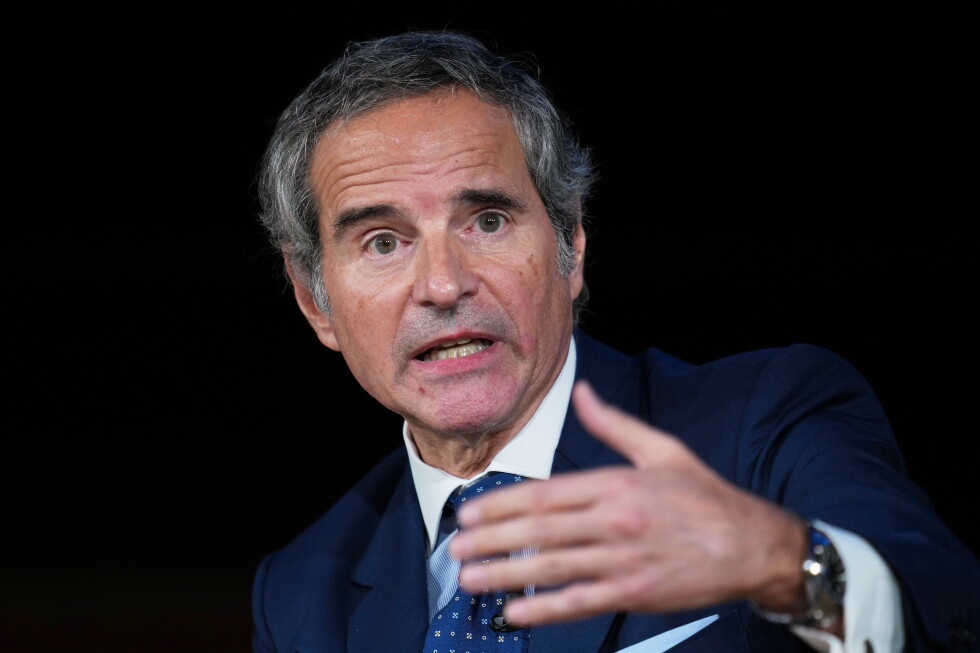
Current IAEA data puts Iran’s stockpile of uranium enriched to 60% purity at 440.9 kilograms (972 pounds). Enrichment to 90% purity qualifies as weapons-grade material, meaning 60% enrichment is just one short technical step from a weapons-capable material. IAEA Director General Rafael Grossi warned in an AP interview last year that this stockpile is large enough to allow Iran to build up to 10 nuclear bombs if it chooses to pursue weaponization — though he emphasized this does not mean Tehran currently possesses a nuclear weapon.
The Tuesday report also confirmed that the IAEA has made no progress on its long-running investigation into unexplained uranium traces found at multiple undeclared sites across Iran. Western intelligence officials suspect these traces could indicate Iran ran a secret nuclear weapons program prior to 2003, a claim Iran has consistently denied. Tehran has repeatedly maintained that its entire nuclear program is for peaceful purposes, including energy production and medical research.
A referral to the Security Council would shift oversight of the dispute to a higher international body with the authority to impose legally binding punitive measures, including sweeping economic sanctions and asset freezes. However, substantive UN action is widely expected to face an immediate block: Iran’s allies Russia and China both hold permanent veto power on the Security Council, and have previously blocked punitive measures against Tehran.
The draft resolution, which was first reported by Reuters and reviewed by the AP, requests that Grossi transmit the text, alongside all previously adopted IAEA resolutions on Iran’s noncompliance, to all IAEA member states, as well as the UN Security Council and General Assembly, in line with the IAEA’s founding statute. Even in the face of expected Security Council gridlock, Western powers argue that a formal referral carries significant diplomatic weight.
Notably, the draft also reaffirms the co-sponsors’ commitment to a negotiated end to the standoff. The text “stresses its support for a diplomatic solution to the challenges posed by the Iranian nuclear programme and its implications for regional peace and stability leading to an agreement that addresses all international concerns related to Iran’s nuclear activities, and encourages all parties to constructively engage in diplomacy.”
Diplomats caution that the draft remains in active negotiation, and has not yet been formally submitted to the 35-member IAEA Board of Governors. The text could still be amended before a vote, which is scheduled to take place during next week’s Board meeting in Vienna.
Iran has long rejected international pressure to restrict its nuclear program, and has repeatedly criticized IAEA investigations as politically motivated by Western powers.