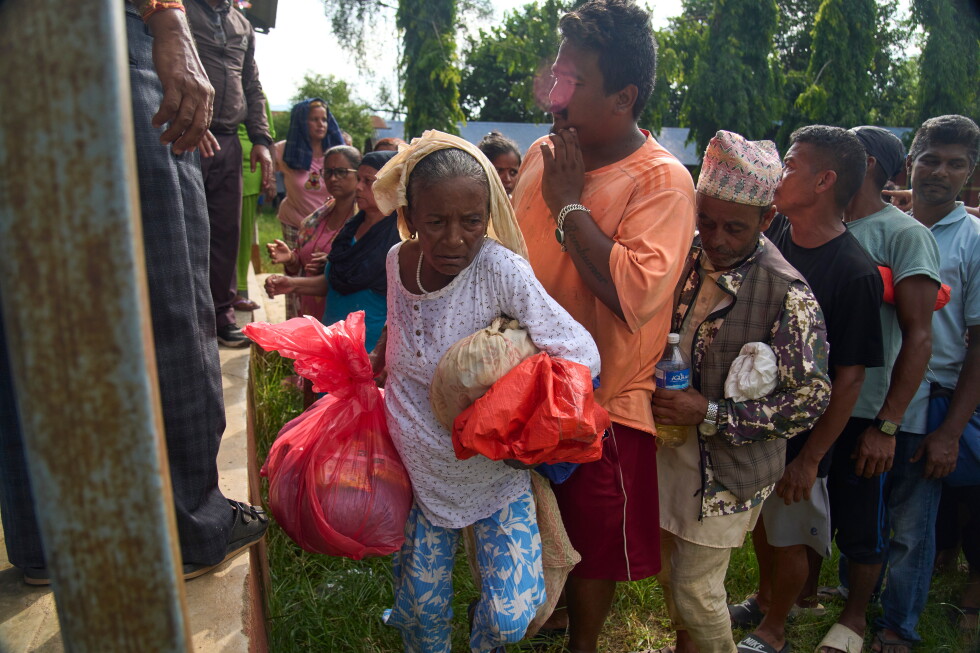
Friday marked the first day that life-saving humanitarian aid reached vulnerable communities in Nepal, after catastrophic flash floods tore through the rugged mountainous border zone between Nepal and China. As rescue crews continue to clear mud and debris to reach cut-off areas, the full scale of the disaster is slowly coming into focus, leaving thousands displaced and seeking safety in makeshift relief camps run by the Nepali army.
In Nuwakot, one of the hardest-hit districts located just a short distance from Nepal’s capital Kathmandu, entire villages were erased by surging floodwaters in less than an hour. What was not swept away remains blanketed in thick sediment and mud: fragments of a local golden temple poke through the sand, while the carcass of a drowned buffalo lies abandoned in the open. Survivors who lost their homes have initially gathered in roadside tea shops, waiting for evacuation and assistance.
The international humanitarian community has warned of widespread urgent needs in the wake of the disaster. The United Nations Children’s Fund (UNICEF) confirms that at least 17,000 children require immediate life-saving support, with 18 schools completely destroyed and another 20 damaged beyond immediate use. The International Committee of the Red Cross estimates that more than 93,000 people have been impacted by the floods, all facing severe shortages of food, shelter and basic supplies.
Nepal’s National Disaster Risk Reduction and Management Authority announced Friday that the number of people listed as missing has doubled to nearly 2,000, as search teams continue to recover bodies and survey damaged areas. A total of 14,829 security personnel have been deployed to lead search and rescue operations, with drones used to scan hard-to-reach, high-risk areas that are too dangerous for ground teams to access.
Rescued people are transported by helicopter to Maithali Barrack, a former military training facility in Nuwakot that has been converted into a main relief camp and emergency shelter. Helicopters rotate constantly between the camp and flood zones, bringing in new survivors and critical supplies, while anxious family members line the barbed wire perimeter of the camp, waiting for word of loved ones.
An army medic, speaking on condition of anonymity to the Associated Press, confirmed that those receiving medical care at the camp include local residents, foreign tourists and Chinese workers pulled from the flood zone. Severe medical cases, such as a pregnant woman who went into labor at the camp, are immediately airlifted to fully equipped hospitals in nearby urban centers.
Minors separated from their families during the chaos of the floods are housed separately at the camp, with staff working around the clock to reunite them with relatives. For many families, however, the camp has become a site of mourning: bodies recovered from flood zones are stored behind colored tarps as workers wait for relatives to identify them.
Sixty-two-year-old Chanda Lal Chitrakar, a local tea shop owner who survived the disaster by fleeing to higher ground, shared his account of the morning the flood hit. Having lived through severe flooding the previous year, he initially downplayed the government warning messages sent to his phone, only closing his shop’s doors and windows instead of evacuating. After less than an hour, he saw a massive wall of water rushing down from the surrounding hills, so tall it obscured the top of the area’s tallest tree. He fled to a high hill behind the local police station with nothing but the clothes on his back and his phone, only able to breathe easily once he reached the summit.
One local school in Nuwakot has been repurposed as a temporary aid distribution hub, where nongovernmental organizations have been handing out critical supplies including solar panels, clothing and basic hygiene products. For Kanchi Nepali, a flood survivor who lost everything, the small donation she received was life-changing. “What I’ve been given today is worth more than a million,” she said. “I have no food, no shelter, no utensils to cook with. Only my body survived.”
This reporting on climate and environmental disaster is supported by multiple private foundations, with The Associated Press retaining full editorial control over all content.