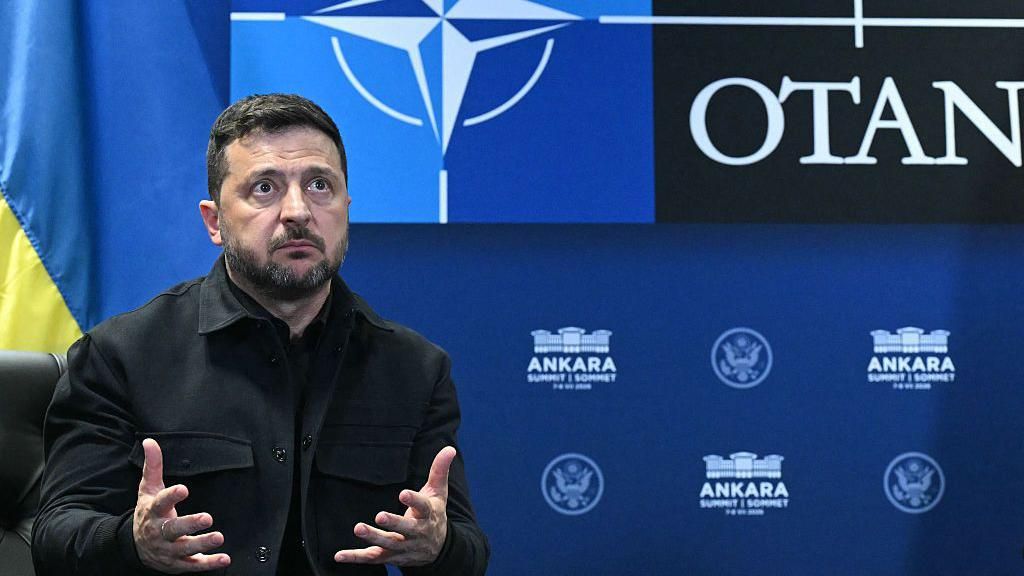
At Wednesday’s NATO summit held in Ankara, U.S. President Donald Trump made a landmark announcement to Ukrainian President Volodymyr Zelenskyy: the United States will grant Ukraine a license to domestically produce Patriot air defense interceptor missiles, a critical capability Kyiv has urgently sought to fend off intensifying Russian ballistic missile attacks.
“We are gonna give you a licence to make Patriots,” Trump told Zelenskyy during the meeting. “I think they can produce them very quickly once we explain it.” The U.S. leader added that he had not yet notified the two primary manufacturers of the Patriot system—defense giants Lockheed Martin and Raytheon—of his decision, but expressed confidence that the plan would move forward smoothly.
The Patriot system, globally recognized as one of the world’s most capable air defense platforms, is designed to detect and destroy incoming hostile missiles. However, it is also one of the most expensive: a full single battery, including its complement of interceptors, carries an estimated price tag of roughly $1 billion. Production of the missiles is also a slow, complex process, with U.S. Department of Defense data showing only 600 interceptors roll off production lines annually.
Washington has been unwilling to draw down its existing stockpile of Patriots for Ukraine, a reluctance underscored by data from the Center for Strategic and International Studies (CSIS), a Washington-based think tank. The group notes that the U.S. already depleted more than half of its Patriot stockpile during its conflict with Iran earlier this year. “We have Patriots, but we don’t have that many. We need them for ourselves too,” Trump acknowledged.
For Ukraine, the need for additional Patriot interceptors could not be more pressing. Over recent months, Russia has dramatically ramped up its ballistic missile campaign against Ukrainian targets, with dozens of fatalities recorded in Kyiv alone in the week leading up to the NATO summit. As far back as late May, Zelenskyy publicly confirmed that Ukraine had submitted a formal request to the U.S. for authorization to produce Patriots under license.
After more than four years of full-scale war, frontline fighting has largely stagnated, and maritime activity across the Black Sea remains at a standstill. Ukraine has also developed effective tactics to counter the nearly nightly waves of Iranian-designed Shahed drones Russia launches at its infrastructure. But ballistic missiles remain Russia’s “last major advantage,” as Zelenskyy has framed them: they travel at hypersonic speeds along steep trajectories, making them far harder to intercept than slower drones, and many routinely breach Ukraine’s overstretched, under-resourced air defense networks.
Just days before the summit, the Ukrainian Air Force revealed that a severe shortage of interceptor missiles left its defenses unable to shoot down a single one of the 23 Russian ballistic missiles fired in a major Sunday night attack. The strike killed more than 20 civilians.
Trump framed the license offer as a solution to Ukraine’s repeated calls for more air defense capabilities, saying it would mean Ukraine “couldn’t complain that we’re not giving them enough.”
Despite the announcement, however, skepticism remains widespread in Kyiv about the feasibility of producing the advanced interceptors on Ukrainian territory amid ongoing war. Military expert Ivan Stupak, a former Ukrainian security service officer, told the BBC that while Patriots are irreplaceable for Ukraine’s national defense, domestic manufacturing is not currently possible. “Unfortunately, Ukraine is not able to produce such kinds of advanced munition, because it’s really sophisticated, cutting-edge equipment,” Stupak explained.
Stupak argued that any licensed production would most likely be relocated to other European soil under Western supervision, a shift that would add many months to the process. He added that security concerns make production in Ukraine impossible right now: “We have no safe place on the entire Ukrainian territory.”
Beyond the Patriot announcement, the summit discussion also covered Ukraine’s recent long-range strike campaign, which has successfully hit Russian targets thousands of kilometers behind the front line. Trump acknowledged that the strikes represent an escalation of the conflict, but argued that the pressure could ultimately help bring the war to a close: “It’s an escalation, but it’s also an escalation that can help lead to an end.”
U.S. Secretary of State Marco Rubio, who joined Trump for the meeting, echoed that framing, saying Ukrainian strikes on Russian oil refineries are necessary to demonstrate to the Kremlin that its own airspace is far from impenetrable, creating greater incentive for Moscow to negotiate an end to the conflict.
Trump also repeated his longstanding claim that Russian President Vladimir Putin, with whom Trump says he speaks regularly, is open to striking a peace deal to end the full-scale invasion that began in 2022. The U.S. president has made similar assertions repeatedly, but his past efforts to broker peace talks between Kyiv and Moscow have yet to produce any tangible progress.
As he has done in the past, Trump raised the possibility of a direct meeting between Zelenskyy and Putin to negotiate an end to hostilities. Putin has repeatedly stated he would be open to such a meeting, but has insisted it be held in Moscow—a condition widely viewed as a provocation, since the Kremlin knows Zelenskyy would never agree to travel to the Russian capital for talks. When Trump asked Zelenskyy directly if he would be willing to travel to Moscow, the Ukrainian president responded with a characteristic quip: “It’s difficult – there are a lot of Ukrainian drones there.”