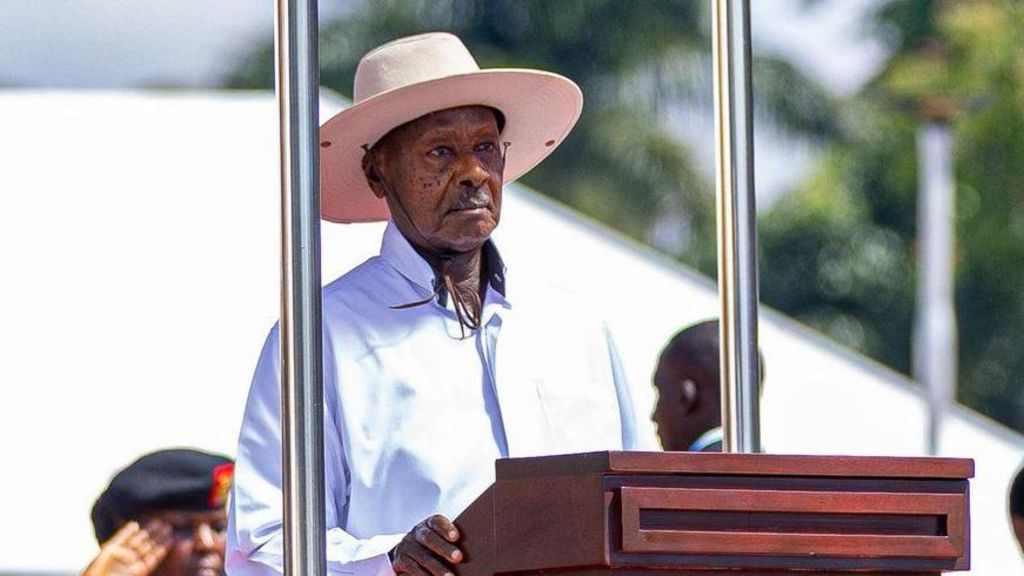
Eight-one-year-old Yoweri Museveni, Uganda’s long-standing head of state, has officially been sworn into office for a historic seventh consecutive presidential term, capping off a turbulent electoral process that has divided the East African nation and drawn international scrutiny. Museveni’s latest inauguration extends his nearly 40-year rule, placing him among the longest-serving incumbent leaders on the African continent, and will keep him in power through 2031.
Days before the inauguration ceremony held at Kampala’s Kololo Independence Grounds — a national holiday declared by the ruling government — authorities deployed heavy security across the capital, including armored battle tanks. Police officials framed the extraordinary security buildup as a necessary measure to preserve public order, but critics view it as a show of force intended to deter opposition protests.
Museveni first claimed victory in the January 2026 general election, with official results granting him more than 70% of the popular vote. However, his main challenger, 44-year-old singer-turned-politician Bobi Wine (whose legal name is Robert Kyagulanyi Ssentamu), has flatly rejected the outcome, alleging widespread ballot stuffing and systemic electoral fraud. National election officials have repeatedly denied all claims of irregularity.
Following the election, Wine, who leads the opposition National Unity Platform party, fled Uganda, stating he faced credible threats of assassination at the hands of the ruling regime. Prior to his departure, his home was raided by security forces, and he accused authorities of targeting him and his family. Police have refuted these accusations, claiming they only deployed personnel to provide standard security for a presidential candidate. Museveni, for his part, has labeled opposition figures challenging the election results “terrorists” seeking to overturn the democratic outcome through violence.
Museveni first seized power as a rebel leader in 1986, and has since won seven consecutive presidential elections. He joins a small cohort of African leaders who have held national power for more than four decades, alongside figures including Denis Sassou Nguesso of Congo-Brazzaville, Teodoro Obiang Nguema Mbasogo of Equatorial Guinea, and Paul Biya of Cameroon.
The inauguration drew attendance from multiple regional heads of state, including Tanzania’s Samia Suluhu Hassan, Félix Tshisekedi of the Democratic Republic of Congo, South Sudan’s Salva Kiir, and Somalia’s Hassan Sheikh Mohamud. A defining demographic context of Museveni’s extended rule is Uganda’s status as one of the world’s youngest countries: a majority of the nation’s population has never lived under any other president.
To date, Museveni has not publicly announced a timeline for his retirement, though many political analysts predict this seventh term will be his last. Widespread speculation has centered on his 51-year-old son, General Muhoozi Kainerugaba, the country’s top military commander, as the most likely successor. Kainerugaba, however, has faced growing backlash for inflammatory social media posts targeting opposition figures. Earlier this year, he posted — and later removed — a threat on X to remove Bobi Wine’s testicles, drawing widespread condemnation.
Human rights organizations have continued to level sharp criticism at Museveni’s government over a harsh post-election crackdown on opposition dissent. In a report released last month, Amnesty International documented that at least 16 unarmed civilians, none of whom posed an immediate threat to security forces, were likely killed by police and military personnel between January 15 and 18, 2026. The organization has also criticized the detention of another senior opposition leader, Kizza Besigye, who has remained in Ugandan custody since late 2024 after being abducted from Kenya and forcibly returned to Uganda. He faces military charges of illegal pistol possession and attempting to purchase weapons abroad, all of which he denies.
Most recently, the Ugandan parliament passed a controversial Sovereignty Bill that has raised alarm among civil society groups. The new legislation criminalizes any action deemed to “promote the interests of a foreigner against those of Uganda” and classifies organizations and individuals receiving foreign funding as “agents of foreigners”, a move critics say will further restrict political dissent and close democratic space in the country.