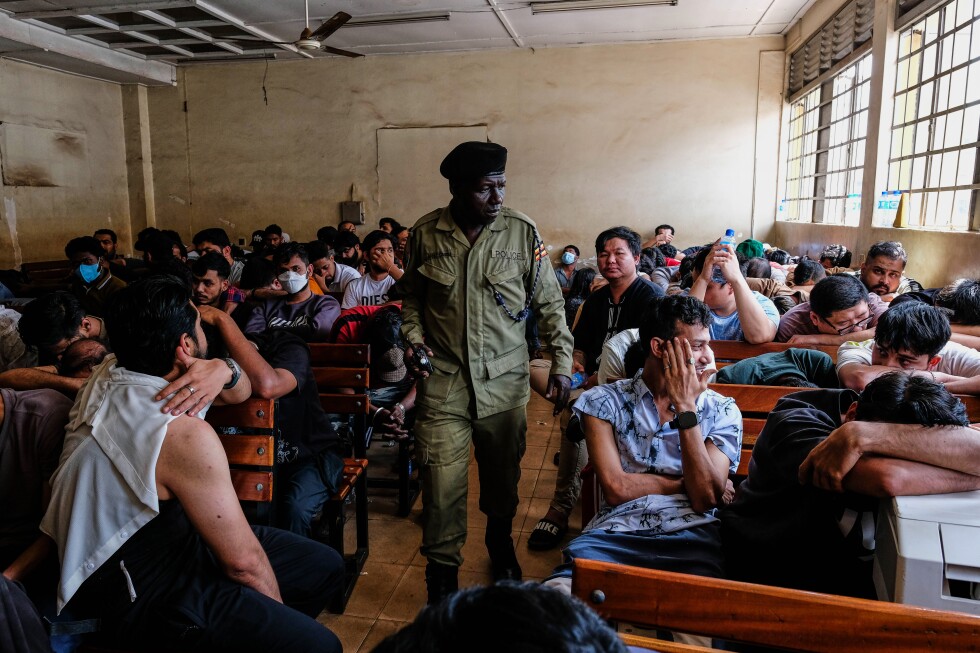
KAMPALA, Uganda — A sweeping nationwide crackdown on unauthorized migration has led Ugandan law enforcement and internal affairs officials to detain more than 200 foreign nationals this week, with investigations linking many of the detainees to transnational human trafficking networks and organized cyber fraud operations, government representatives announced Tuesday.
The multi-location operation, which launched early Monday, unfolded across two key sites: a residential enclave in northern Uganda home to a large community of Nigerian migrants, and a tightly secured, closed-off residential compound in the heart of Kampala, Uganda’s capital. In total, 231 people have been placed in custody for questioning across both locations.
Officials with Uganda’s Ministry of Internal Affairs detailed that 169 detainees were discovered in the capital’s restricted compound, a self-contained apartment complex purpose-built to limit outside movement, complete with its own private restaurant and on-site amenities. Thirty-six of the people found at that site were women, and detainees held there held citizenship from across Asia and Africa, including Pakistan, India, Bangladesh, Ghana, Myanmar, Ethiopia, Sri Lanka, Cambodia, and Malaysia.
The operation was launched following verified intelligence reports that large groups of foreign nationals were residing and working in Uganda without the mandatory legal documentation required for residency or employment, ministry officials confirmed. During the raids, many detainees were found to be in possession of no valid passport or identity paperwork at all.
In an official public statement, the ministry outlined the preliminary findings from the operation: “Some individuals have claimed they were trafficked into Uganda with false promises of formal employment. Others were directly engaged in cyber-scamming activities. A few were found in possession of materials linking them to additional other criminal enterprises.”
Simon Peter Mundeyi, a spokesperson for the Ministry of Internal Affairs, explained to the Associated Press that the detainees are currently being held at two separate processing facilities and divided into three distinct categories for assessment: confirmed or suspected trafficking victims, alleged criminal perpetrators of trafficking and cybercrime, and migrants who simply overstayed their valid visas without engaging in any illegal activity.
Mundeyi confirmed that both trafficking victims and visa overstayers will be assisted to process voluntary departure from Uganda, though they will be required to cover the cost of their own return travel tickets. Suspected ringleaders of trafficking and fraud networks, by contrast, will face formal criminal prosecution in Ugandan courts before potential deportation following any completed sentence.
Unlike many regional peers, Uganda has long cultivated a reputation for being open to foreign arrivals and hosting displaced people. The East African nation currently hosts hundreds of thousands of refugees fleeing violent conflict in neighboring states including the Democratic Republic of Congo, Burundi, and South Sudan. It also maintains a liberal visa policy that waives entry visa requirements for short-term visits from citizens of dozens of African and global countries.