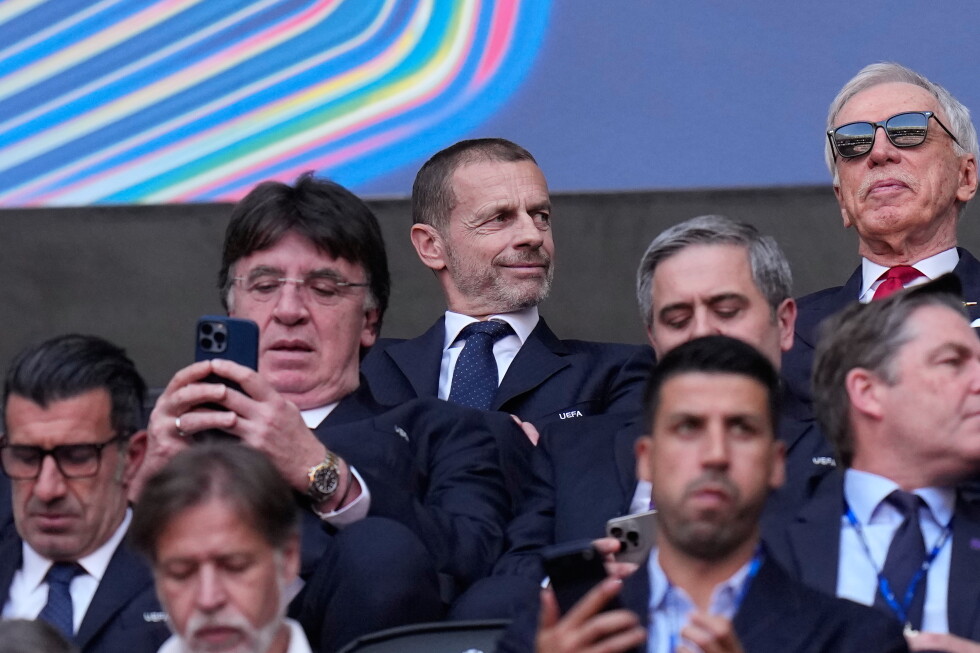
A cross-regional backlash has erupted against UEFA President Aleksander Čeferin following reported comments dismissing matches involving lower-ranked teams at the newly expanded 48-team FIFA World Cup as “completely uninteresting”, drawing joint condemnation from governing bodies across Africa, Asia and the Caribbean.
The criticism, organized and released by South Africa’s national soccer federation, brings together six associations — Cape Verde, Congo, Curaçao, Haiti, Jordan and Uzbekistan — in a show of solidarity with 10 other African federations including Algeria, Egypt, Ghana, Morocco, Senegal and Tunisia. The joint statement pushes back against Čeferin’s reported remarks, which were first published by Slovenian outlets Zurnal 24 and Dosi following a conference in Ljubljana a week before the condemnation.
While Čeferin also reportedly acknowledged that the 2026 format expansion opens the door for smaller nations to experience the thrill of the world’s biggest soccer tournament, his take on the quality of matches involving debutants and long-absent sides struck a nerve across global soccer communities. For many of the nations signing onto the statement, the current 48-team tournament marks a historic milestone: Cape Verde, Curaçao, Jordan and Uzbekistan are making their first-ever World Cup appearances, while Congo and Haiti are returning to the global stage for the first time since 1974.
“Football does not belong to a select group of nations. Its strength comes from its universality,” the statement reads. It goes on to emphasize that for emerging soccer nations, qualifying for the World Cup is far more than a simple sporting entry: it is a generational moment that can inspire young players, accelerate grassroots and professional soccer development across the region, and leave lifelong, meaningful memories for entire populations.
The statement adds: “To suggest that these matches are somehow less important is deeply disappointing and fails to recognize the efforts, sacrifices and aspirations of players, coaches, clubs, football leaders and supporters across the world. For Cape Verde, Curaçao, Jordan and Uzbekistan, qualification for the FIFA World Cup represents a historic achievement and the realization of a dream shared by generations. For nations such as Congo and Haiti, returning to football’s biggest stage after a long absence carries a special meaning for millions of supporters who have waited years, and in some cases decades, for this moment.”
Notably, the joint statement does not directly name Čeferin or explicitly quote his reported comments. As of Sunday, neither UEFA nor the signatory federations have issued immediate responses to requests for additional comment on the controversy. The condemnation comes the same day that Curaçao, one of the debutant signatory nations, played its first ever World Cup group stage match against Germany, falling 7-1 after notching the underdog side’s first-ever World Cup goal.