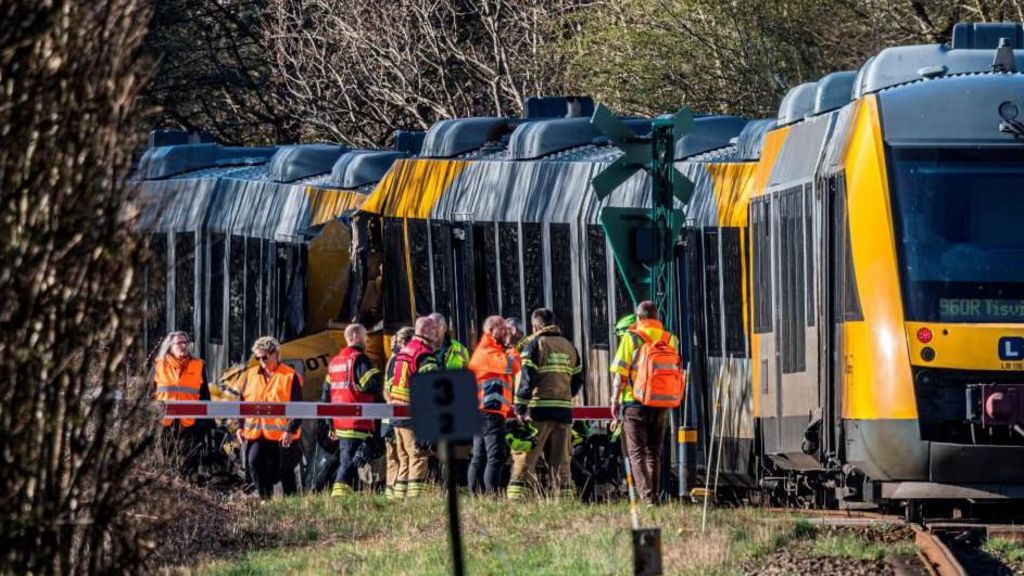
A devastating head-on collision between two trains has rocked northeastern Denmark, leaving multiple people severely injured and triggering urgent questions about regional rail network safety. The crash unfolded shortly after 6:30 a.m. local time Thursday on a track connecting the small towns of Hillerød and Kagerup, located approximately 40 kilometers northwest of Copenhagen, Denmark’s capital.
Emergency response teams rushed to the wooded accident site immediately after receiving the alert. According to Tim Ole Simonsen, a representative of the Greater Copenhagen Fire Department, all injured passengers and crew were evacuated from the scene within hours, transported to area medical facilities via both ambulance and medical air transport. As of initial official updates, four people are being treated for critical injuries, while an additional 11 people sustained harm serious enough to require inpatient hospital care.
Photos broadcast by Danish national public broadcaster DR show the two yellow and grey commuter trains, their front carriages heavily damaged, positioned facing one another on the open line near a level crossing. Trine Egetved, mayor of the Gribskov Municipality where the crash occurred, told local media she was deeply shaken by the unexpected tragedy. The critically injured patients were transferred to Copenhagen’s National Hospital, Denmark’s leading tertiary medical center, for specialized care, Egetved confirmed.
In a public post shared on Facebook, Egetved noted that the affected regional line is a core transit route for hundreds of local residents, daily commuters heading to work, and students traveling between communities. Speaking to DR, the mayor expressed shock that such a severe head-on collision could occur in Denmark, saying, “We must ensure it never happens again.”
Train collisions are extremely rare in Denmark, which maintains a generally high standard for rail safety. However, early preliminary analysis from industry experts has pointed to a potential safety gap on the line. One anonymous expert suggested the crash may have occurred after one of the train operators overrode a stop signal as the train departed a local station, accidentally entering the wrong track in the path of the oncoming service. Preliminary checks also indicate that the Gribskov line has not been retrofitted with modern automated collision prevention safety systems that automatically stop trains if a signal is violated, a detail that is expected to feature heavily in the official investigation.