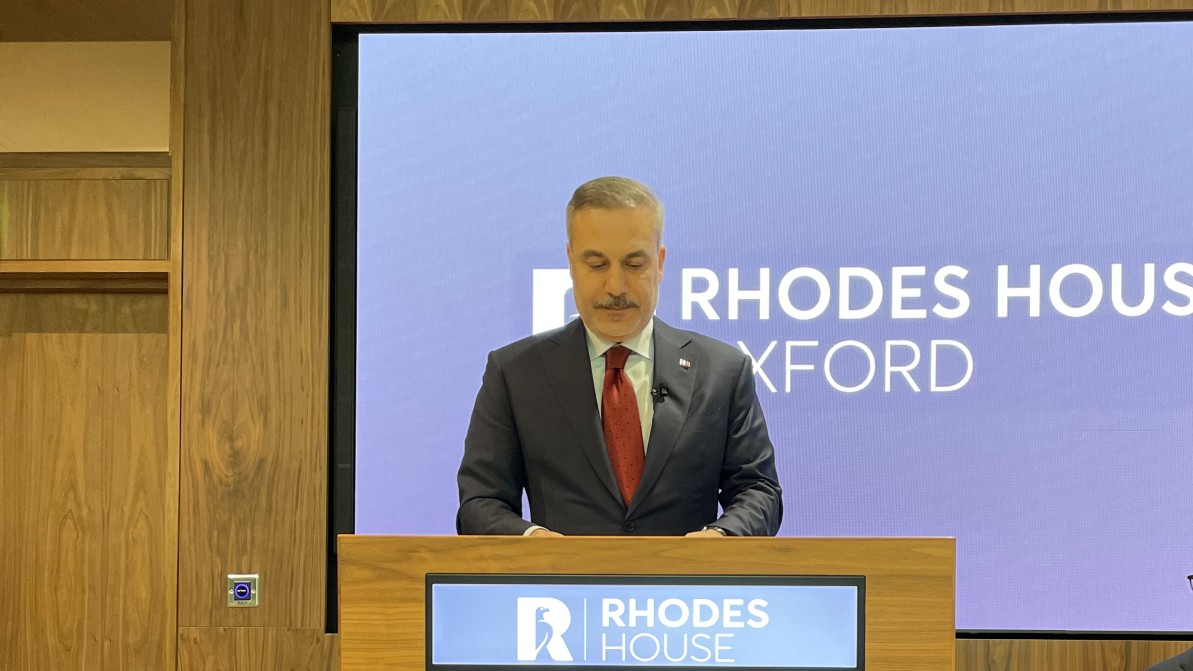
In a high-profile address at the University of Oxford on Friday, Turkish Foreign Minister Hakan Fidan laid out Turkey’s evolving role in the shifting global order, framing Ankara as an influential “middle power” uniquely equipped to broker diplomacy across the world’s most intractable conflicts.
Speaking at an event organized by the Global Orders Programme of the Oxford Centre for Global History, Fidan argued that the rising influence of middle powers marks a fundamental structural shift in modern international politics. In an era of unprecedented global uncertainty, he noted, nations with deep-rooted strategic histories are better positioned to navigate instability and bridge divides between competing actors.
Fidan emphasized that global politics today desperately requires actors committed to sustained diplomacy, de-escalation of tensions, and keeping open channels of dialogue — and he made clear Turkey views itself as a leading state ready to fill that role. “It is no coincidence that in many international circles today, Turkey is increasingly referred to as the adult in the room,” he stated.
The remarks came against a tense backdrop: a fragile temporary ceasefire is holding between the U.S. and Iran, with indirect diplomatic talks set to get underway in Islamabad this weekend amid persistent uncertainty over the future of the broader conflict. The nine-week conflict has already claimed thousands of lives and sent shockwaves through global energy markets, after Iran partially closed the Strait of Hormuz — a chokepoint through which roughly one-fifth of the world’s oil supplies pass. The closure has driven energy prices sharply upward and reduced shipping traffic to a small fraction of pre-war levels.
Addressing ongoing behind-the-scenes diplomatic efforts between Washington and Tehran, Fidan confirmed Turkey has been actively facilitating communication between the two sides. “I think I’ve been in constant communications with both sides… we are trying to help as much as we could whenever it is necessary,” he told reporters, adding that Ankara leverages its long-standing ties with both nations to deliver messages between parties and build momentum for negotiation. He added that Turkey’s long-standing mediation framework avoids imposing outcomes on conflicting sides, instead focusing on creating conditions for parties to reach their own negotiated settlements.
On the topic of recent U.S. threats of punitive measures against NATO allies that refused to back its hardline stance on Iran — including reported discussion of potential expulsion of Spain from the alliance — Fidan noted Turkey itself has not faced similar pressure from Washington. “I think we are in good coordination with the leadership of the US,” he told Middle East Eye, adding that just two weeks prior, Turkish President Recep Tayyip Erdogan spoke with U.S. President Donald Trump to congratulate him on agreeing to the ceasefire and joining diplomatic talks.
Fidan reiterated Turkey’s long-held position that any military action against Iran was premature, noting that diplomatic talks had the potential to produce tangible progress. He also expressed solidarity with Spain, saying, “I respect the position of the European countries… Spain is following a steady and stable line… asking for peace in Gaza, in Iran, in Russia. I think this is a position we also adopt.”
Beyond the US-Iran conflict, Fidan highlighted Turkey’s ongoing mediation efforts in other global hotspots, including the war in Ukraine. Ankara has previously hosted direct talks between Russian and Ukrainian officials, and remains engaged in diplomatic efforts. However, he noted that global attention has shifted toward the Middle East due to the far faster, broader global spillover from the US-Israel-Iran conflict. “The human tragedy… is huge, unbearable,” he said of the war in Ukraine, but added that the current Middle East conflict has had even wider global ripple effects in a shorter time frame.
Looking ahead to the upcoming talks in Pakistan, where U.S. negotiators including special envoy Steve Witkoff and Jared Kushner are set to arrive Saturday, Fidan offered cautious optimism. Iranian officials have signaled they will not hold direct talks with U.S. delegates, instead conveying their positions through third-party mediators. Fidan noted that both sides are feeling mounting pressure from the ongoing conflict, which could push them toward a negotiated resolution.
He also laid out potential outcomes for the Strait of Hormuz, the critical energy chokepoint at the center of the conflict. The first, preferred outcome is a negotiated return to the pre-conflict status quo, with unimpeded free maritime passage and no additional restrictions or costs for shipping. If talks collapse and conflict resumes, however, Fidan noted Turkey will evaluate its position aligned with its core foreign policy priorities, with President Erdogan already clear on the country’s approach.
Fidan also signaled that Turkey would be open in principle to joining multinational demining operations in the Strait of Hormuz if a final peace agreement is reached between Iran and the U.S., framing such work as a humanitarian duty. “If Iran and the Americans reach an agreement and peace is achieved, a coalition could carry out technical work there, including mine clearance,” he said. He stressed, however, that any Turkish participation would be contingent on the broader political context, and Ankara would re-evaluate its involvement if the coalition were dragged into renewed hostilities.
Fidan’s visit to the U.K. marked a two-day diplomatic trip that culminated in the signing of a new strategic partnership agreement between Turkey and the United Kingdom. Turkey is also set to host the upcoming NATO summit in Ankara this coming July.