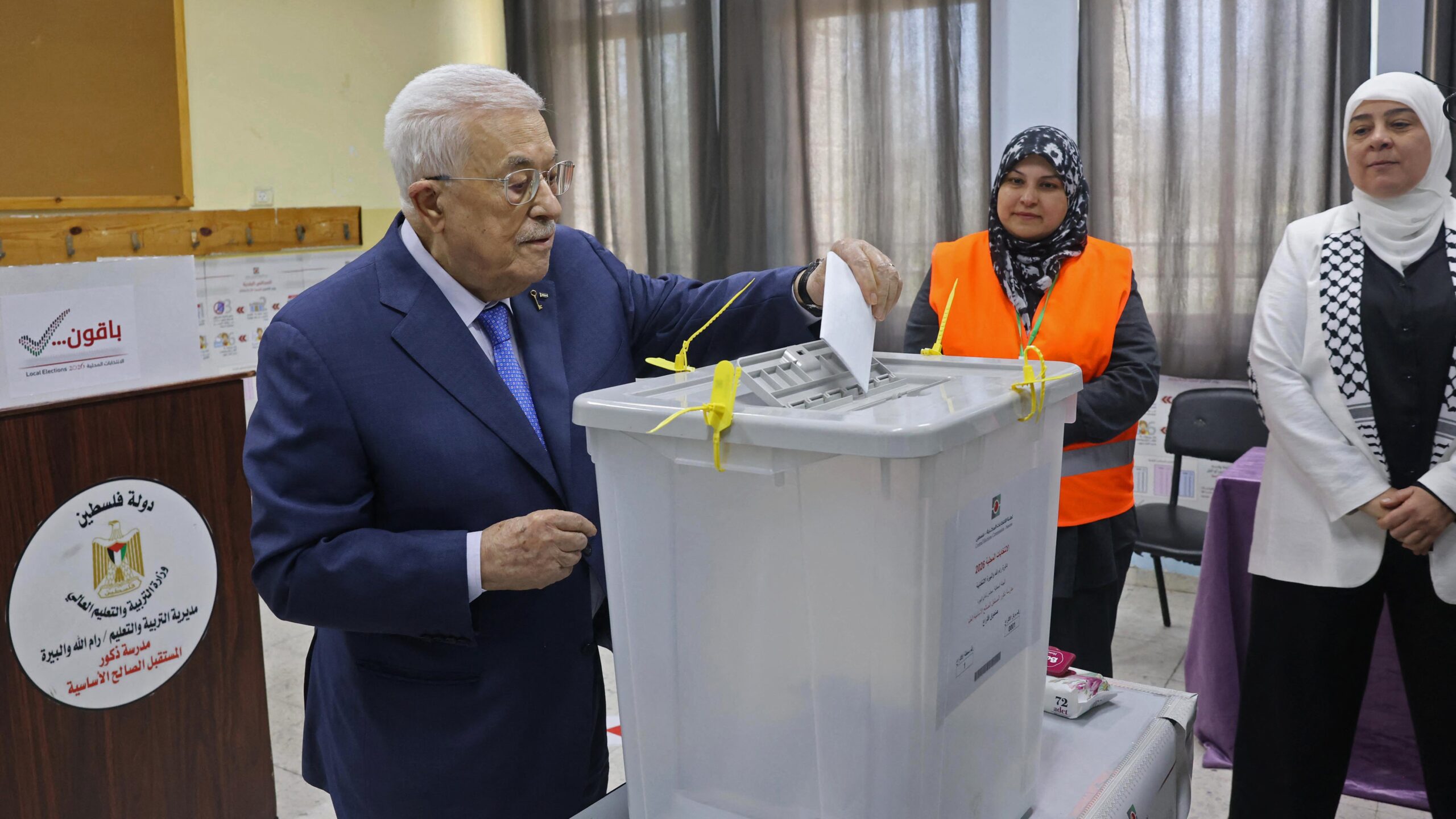
On Saturday, Palestinian voters across the occupied West Bank and the central Gaza city of Deir al-Balah took to polling stations to cast ballots in municipal elections, marking the first popular electoral exercise carried out in Palestinian territories since Israel launched its full-scale military campaign on Gaza in October 2023.
According to official data released by the Ramallah-headquartered Central Elections Commission, roughly 1.5 million eligible voters are registered in the West Bank, while an additional 70,000 registered voters reside in the Deir al-Balah region of central Gaza, the only part of the enclave where voting is being held. Unlike typical local electoral cycles, this vote features a sharply restricted pool of candidates: most contenders are either affiliated with the secular nationalist Fatah Party, the dominant political faction leading the Palestinian Authority (PA), or run as independent contenders.
Notably, no electoral lists linked to Hamas — the militant and political group that controlled half of Gaza before the current war — are permitted to participate in the election. Currently, half of the besieged Gaza Strip remains under active Israeli military occupation, while widespread displacement has emptied most other regions of their resident populations.
Across most West Bank municipalities, the election contests pit Fatah-aligned candidates against independent lists tied to the leftist Popular Front for the Liberation of Palestine, with few other political blocs represented. Even with this limited field, multiple candidates have alleged systematic barriers to their participation. Mohammed Dweikat, a candidate from the West Bank city of Nablus, told Agence France-Presse that the PA has detained a number of opposition candidates throughout the registration period, barring them from formalizing their candidacies before the vote.
Municipal councils in Palestinian territories hold responsibility for delivering core local public services, including potable water distribution, sanitation infrastructure, and neighborhood development projects, but lack authority to pass national legislation. For years, the PA has faced widespread accusations of institutional corruption, political stagnation, and eroding public legitimacy across Palestinian territories. In response, Western and regional international donors have increasingly conditioned their financial and diplomatic support for the PA on tangible progress toward governance reform, particularly at the local level.
The European Union framed the vote as a positive step forward, releasing a statement describing the election as “an important step towards broader democratisation and strengthened local governance… in line with the ongoing reforms process.”
As of 2025, more than 15 months of ongoing Israeli military operations in Gaza have left most of the densely populated enclave in ruins. Official data from Gaza’s Palestinian Ministry of Health puts the total death toll from the conflict at more than 72,000 Palestinians, the vast majority of them civilians. Nearly all public infrastructure, including sanitation networks, hospitals, and utility systems, has been destroyed or severely damaged in Israeli airstrikes and ground operations, leaving remaining basic services on the brink of total collapse.
This vote marks the first Palestinian electoral contest held in Gaza since the 2006 legislative elections, which Hamas won in a surprise victory that led to its takeover of the enclave the following year. Political scientist Jamal al-Fadi, based at Cairo’s Al-Azhar University, told AFP that the PA’s decision to restrict Gaza voting exclusively to Deir al-Balah is a deliberate strategic choice to gauge public sentiment at a time when no post-war opinion polling exists in the enclave. Deir al-Balah was selected for the pilot vote, Fadi explained, because it remains one of the only regions in Gaza that has not experienced mass forced displacement of its resident population, allowing a functional electoral process to proceed.