BUDAPEST, Hungary – When Donald Trump reclaimed the U.S. presidency one year ago, a core pillar of his international agenda was clear: reinvigorate the close ideological bonds his first administration had built with right-wing and nationalist movements across Europe, laying the groundwork for a new populist global order. Today, that project lies in tatters, as a growing wave of revulsion against Trump’s war with Iran has split the transatlantic right, once seen as a unified rising political force.
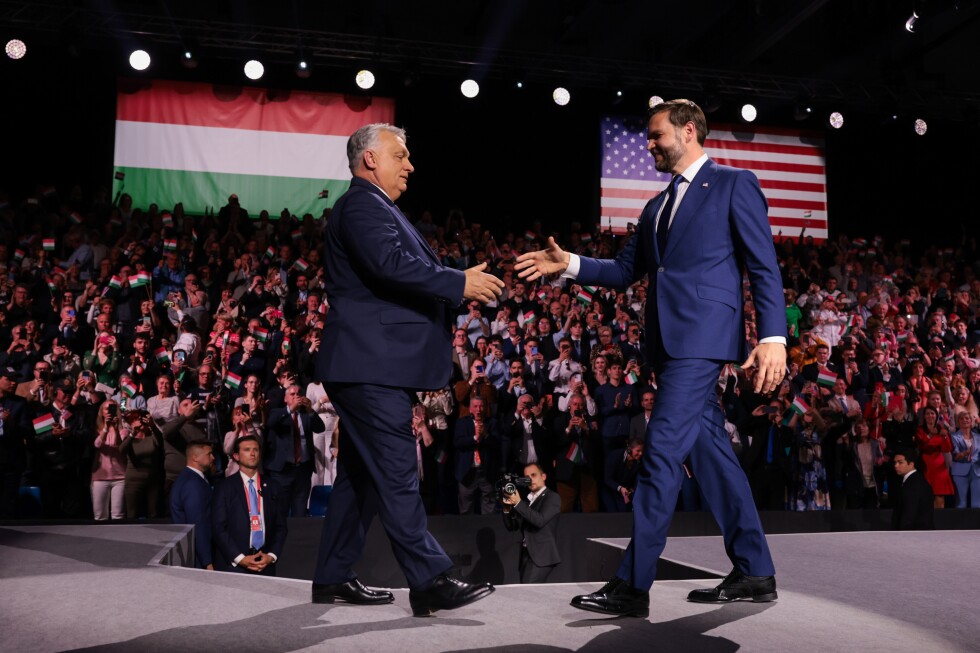
The high-profile visit of U.S. Vice President JD Vance this week, where Vance stumped directly for Hungarian Prime Minister Viktor Orbán ahead of this weekend’s hotly contested general election, is increasingly an outlier, not the norm, for European conservative and far-right leaders. Just months ago, most of these figures counted Trump as a key ideological ally. Now, many are openly breaking with the U.S. administration over its Middle East policy.
Italy’s Prime Minister Giorgia Meloni, one of Europe’s most prominent nationalist leaders, rejected Washington’s request to use a Sicilian U.S. air base for strikes against Iran. Marine Le Pen, head of France’s major far-right National Rally party, has slammed Trump’s war aims as deeply erratic. Even Alternative for Germany, the country’s largest opposition far-right party, has gone a step further: its leader is now calling for all U.S. military forces to withdraw from German soil entirely.
While a fragile ceasefire between the U.S. and Iran is currently holding, Orbán’s longstanding alliance with the Trump administration faces its biggest test yet ahead of this weekend’s vote. For more than a decade, the Hungarian leader has been the ideological standard-bearer for global right-wing populism, a model that many American conservatives have openly cited as a blueprint for restricting immigration, restructuring state institutions, and locking in long-term partisan control for his ruling Fidesz party.
Charles Kupchan, a professor of international relations at Georgetown University and senior fellow at the Council on Foreign Relations, notes that while Orbán’s longstanding ties to Trump may buffer him from the anti-Trump backlash roiling other European far-right factions, that protection is far from guaranteed. “Getting a blessing from Donald Trump is now a mixed blessing,” Kupchan explained.
This break between Trump and European nationalists follows an earlier rift triggered by Trump’s controversial demand earlier this year that Denmark cede control of Greenland to the U.S., a move that sparked widespread outrage across the European political spectrum, including among right-wing factions. Trump doubled down on his criticism of the transatlantic alliance earlier this week, writing on social media that “NATO WASN’T THERE WHEN WE NEEDED THEM, AND THEY WON’T BE THERE IF WE NEED THEM AGAIN,” going on to label Greenland “THAT BIG, POORLY RUN, PIECE OF ICE!!!”
Daniel Baer, a former U.S. ambassador and Obama administration State Department official now with the Carnegie Endowment for International Peace, said the ongoing friction between Trump and European far-right groups lays bare the fundamental limitations of his goal to build a global bloc of nationalist leaders. “Building some sort of international coalition around national chauvinism is very difficult,” Baer noted. “It’s clear the majority of people in these countries, if not anti-American, have turned anti-Trump.”
To date, Orbán has refused to join the wave of criticism against Trump, sticking to the careful neutrality he has maintained throughout the conflict. In a recent interview with British conservative outlet GB News, Orbán argued that the question of whether Trump launched a war or pursued peace remains unresolved. “It hasn’t been decided yet, historians will make a decision on that,” he said. “I think we need some time to understand whether we are moving to the peace by these strikes, or just the opposite. It’s too early to say.”
Orbán’s reluctance to criticize Trump extends far beyond shared ideology: for years, he has framed his close personal and political ties to Trump, as well as other global strongmen like Russian President Vladimir Putin, as a unique asset that lets him defend Hungarian national interests more effectively than any opposition candidate could. He has repeatedly highlighted Trump’s public praise for his leadership to his conservative base, and built his reelection campaign around the claim that his alliance with the Trump administration guarantees Hungarian security and economic prosperity.
Still, that strategy carries growing risks as anti-Trump sentiment spreads even among Hungarian voters. Vance’s visit this week, which saw the vice president denounce European Union critics of Orbán as foreign interferers in Hungary’s democratic process, did follow a familiar ideological script: Vance praised a elite Hungarian higher education institution funded by Orbán’s government and led by the prime minister’s political director for “build[ing] up the foundations of Western civilization” — echoing the Trump administration’s own domestic push to reshape the ideological direction of elite U.S. universities.
But Mario Bikarsku, senior Europe analyst at global risk intelligence firm Verisk Maplecroft, warns that Vance’s high-profile visit could end up hurting rather than helping Orbán’s election chances, as public opinion of the Trump administration has turned increasingly negative even within Hungary. “Vance’s visit could have the opposite effect on Orbán’s popularity than the one intended,” Bikarsku said.
Kupchan added that most successful European far-right parties have already built solid domestic political foundations independent of American support, giving them little incentive to align with an unpopular U.S. administration on the global stage. “Trump’s effort to create a transnational movement of far-right populists may affect the margins, but the main reason you’re seeing Reform U.K. and AfD and National Rally and other far-right parties prosper has little to do with Trump and more to do with national factors,” he explained.
That dynamic works against Orbán in particular: across the globe, voters are increasingly leaning toward opposition parties in the wake of widespread economic and political instability. For most European far-right groups, which have spent years out of power, that trend has boosted their poll numbers. For Orbán, who has held uninterrupted power for 16 years, that same wave of anti-incumbent sentiment puts his grip on office in serious jeopardy. “We are living in an age,” Kupchan said, “where being an incumbent sucks.”