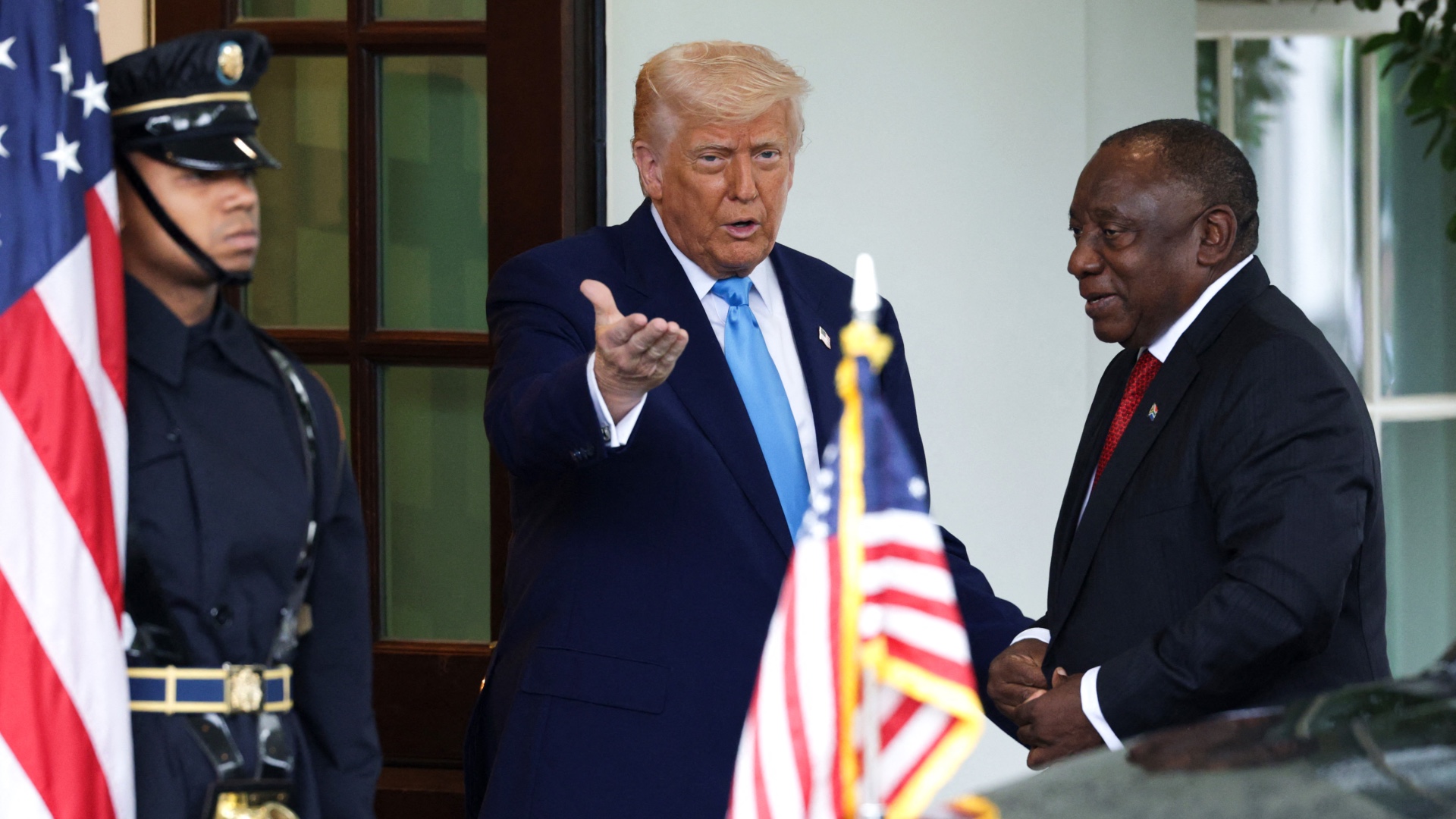
More than a year after the Trump administration rolled out a controversial policy prioritizing white South African Afrikaners for U.S. refugee resettlement, administration officials are now considering allocating over $300,000 to a targeted outreach campaign designed to boost application numbers that have failed to meet the president’s initial expectations, according to reporting from The Guardian.
The policy, first unveiled in 2024, grew out of unsubstantiated claims from former President Donald Trump that Afrikaners — descendants of Dutch colonizers who settled in southern Africa in the 17th and 18th centuries — face systemic persecution in South Africa. The South African government, including President Cyril Ramaphosa, has repeatedly rejected these claims, with a delegation of white South African leaders who met with Trump in the Oval Office last year dismissing his assertions of an ongoing “white genocide” as completely unfounded.
If approved, the proposed outreach program would launch a series of focus groups across eight South African cities spanning Gauteng, Free State, Western Cape, and Northern Cape provinces, including the Afrikaner enclave of Orania. Following the focus group discussions, organizers would distribute wide-ranging surveys to measure how many eligible white South Africans are interested in pursuing resettlement to the U.S. under the special priority pathway.
Critics have pointed to troubling context around the program, noting that the exclusive eligibility for white South Africans — which excludes other South African communities that face documented marginalization — suggests the policy may be rooted in geopolitical retaliation. South Africa has drawn Trump’s ire for bringing a case against Israel before the International Court of Justice, as well as for expanding economic and trade partnerships with China and Iran, moves that conflict with the current administration’s foreign policy priorities.
The underperformance of the existing priority pathway already been documented: separate Guardian reporting from last month found that roughly 13,000 Afrikaners have entered the U.S. over the past 18 months, while hundreds of other applicants have been rejected. The figures confirm that the resettlement process is far less accessible than the administration initially framed it to be.
The special priority policy was rolled out as part of a broader, dramatic overhaul of the U.S. refugee program that saw the Trump administration slash annual refugee admission caps to historic lows. One year ago, the administration announced a target of just 7,500 refugees for fiscal year 2026, a massive drop from the 125,000 annual cap set by former Democratic President Joe Biden. That cap was later revised upward to 17,500, still far below the levels of the previous administration.
This cutback has had sweeping humanitarian consequences. When Trump suspended the existing refugee resettlement program shortly after returning to office in January 2025, at least 12,000 vulnerable people who had already received conditional approval and booked their travel to the U.S. were left in indefinite limbo. An additional nearly 90,000 already approved applicants were also blocked from entry. While the Biden administration set a higher annual admission cap of 125,000, data from the Migration Policy Institute shows actual admissions fell short of that target: 25,465 refugees were admitted in 2022, 60,014 in 2023, 100,034 in 2024, and just 27,308 in 2025 before Biden’s term ended.
Humanitarian and refugee advocacy groups have harshly condemned the administration’s decision to prioritize Afrikaners over other displaced populations. Sharif Aly, president of the International Refugee Assistance Project, criticized the policy in a statement shared with Middle East Eye, arguing that it exposes how far the administration has gone to abandon the U.S.’s longstanding commitments to displaced people globally. Aly noted that by privileging this one specific group while blocking entry to thousands of already vetted and approved refugees from other regions, the administration is overtly politicizing what should be a neutral humanitarian program.