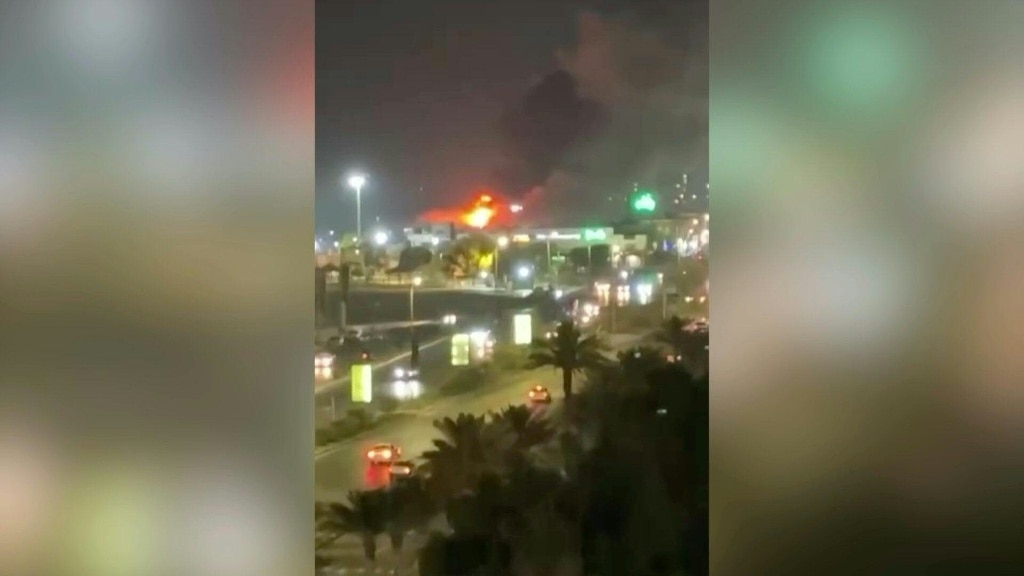
Escalating tensions around the strategically critical Strait of Hormuz have erupted into open conflict after US President Donald Trump ordered a new wave of military strikes against Iran on Wednesday, marking a major breakdown of a recently agreed ceasefire between the two nations.
The retaliatory action came in response to a series of attacks launched by Iranian forces on commercial shipping vessels passing through the strait, a chokepoint that carries roughly one-fifth of the world’s total oil and liquefied natural gas supplies. In a post on his social media platform Truth Social, Trump made clear the strikes were punishment for Tehran’s recent actions, warning that further aggression would draw even harsher retaliation.
“This is in retribution for yesterday’s bombing of ships by Iran. If it happens again, it will get much worse!” Trump wrote. Speaking later to reporters at a NATO summit held in Ankara, the president reinforced the message, saying, “We’re gonna hit ’em hard tonight. They violate the agreement every day.”
Despite the aggressive military posture, Trump struck a more conciliatory tone early Wednesday, stating that he expected the latest flare-up of hostilities to conclude rapidly and leaving open the possibility of future diplomatic negotiations with Iran.
Within hours of the strike order, Iran’s official state news agency IRNA reported multiple explosions across coastal areas in the country’s southern region. Warplane activity was detected over Kish Island, with blasts hitting the major port cities of Bandar Abbas, Konarak and Chabahar. Partial power outages were reported in parts of Chabahar following the strikes.
US Central Command (CENTCOM), which oversees American military operations in the Middle East, confirmed the new wave of strikes in a post on X, noting that the action was designed to weaken Iran’s capacity to disrupt global shipping through the strait. “The United States is holding Iran accountable for recent unjustified aggression against commercial shipping,” CENTCOM said.
The current crisis traces its roots to late February, when a joint US-Israeli strike killed Iran’s long-time supreme leader Ali Khamenei, whose funeral is scheduled for Thursday in his hometown of Mashhad. In the aftermath of that attack, Iran moved to assert full control over the Strait of Hormuz, announcing it would impose transit fees on commercial vessels and threatening to target any shipping that did not follow Iran’s authorized routes.
Over the past week, Iranian forces have attacked at least three commercial ships near the strait, triggering large-scale US strikes on dozens of Iranian targets on Tuesday. Iran responded with retaliatory missile and drone attacks on American military facilities hosted by US allies Kuwait and Bahrain. A US military official confirmed to AFP on Wednesday that no American personnel were killed and no major infrastructure damage was sustained in the Iranian counterattacks, adding that most incoming projectiles were intercepted before reaching their targets.
Initial casualty reports from the first wave of strikes indicate eight Iranian military personnel were killed, according to Iranian state television. CENTCOM reported that its strikes hit more than 80 targets, including Iranian air defense systems, coastal radar installations and 60 small boats operated by the Islamic Revolutionary Guards Corps (IRGC). The IRGC in turn claims it hit dozens of US military sites in Kuwait and Bahrain. Kuwait confirmed it intercepted two ballistic missiles and 13 incoming drones, while Iran says its forces also targeted the US-run Sheikh Isa Air Base in Bahrain.
News of the collapsed ceasefire and new strikes sent global energy markets into turmoil, with oil prices jumping 8% in immediate trading following Trump’s announcement that the truce was over.
The outbreak of renewed hostilities has drawn urgent calls for de-escalation from global leaders and international bodies. United Nations Secretary-General Antonio Guterres was among the first to issue a public appeal, urging all sides to “exercise maximum restraint.” Pakistan, one of the key mediators that helped broker the earlier ceasefire between Washington and Tehran, echoed Guterres’ call for calm. Qatari mediators, who also played a central role in earlier talks, have reaffirmed their commitment to finding a diplomatic solution, with Iranian Foreign Minister Abbas Araghchi and Qatar’s prime minister emphasizing the importance of diplomatic channels in a phone call Wednesday.
The escalating conflict has taken a heavy human toll on civilians and commercial mariners alike. Nawal Saad, a civil servant based in Bahrain, summed up widespread regional anxiety, saying, “the spectre of war is looming once more, and I do not want to go through that experience of fear and anxiety again.”
Oman, which has long maintained neutrality as a mediator in the conflict and borders the strait opposite Iran, condemned the targeting of both shipping vessels and Gulf states, though it stopped short of directly blaming Iran. The Omani government previously proposed a temporary transit corridor hugging its coastline to avoid the most high-risk areas near Iranian waters, but Iran has refused to allow vessels to use that route. Washington has repeatedly insisted on unfettered free passage for all commercial shipping through the strait, a position that directly clashes with Tehran’s demand for transit fees and route controls.
Even before the latest collapse of the ceasefire, the ongoing crisis had left thousands of seafarers stranded in the area. International Maritime Organization Secretary-General Arsenio Dominguez confirmed Wednesday that nearly 6,000 commercial seafarers remain stuck on vessels stuck in the region, months after hostilities first broke out. While maritime traffic had tentatively resumed after the ceasefire was signed last month, the latest escalation has thrown any return to normal shipping into serious doubt.