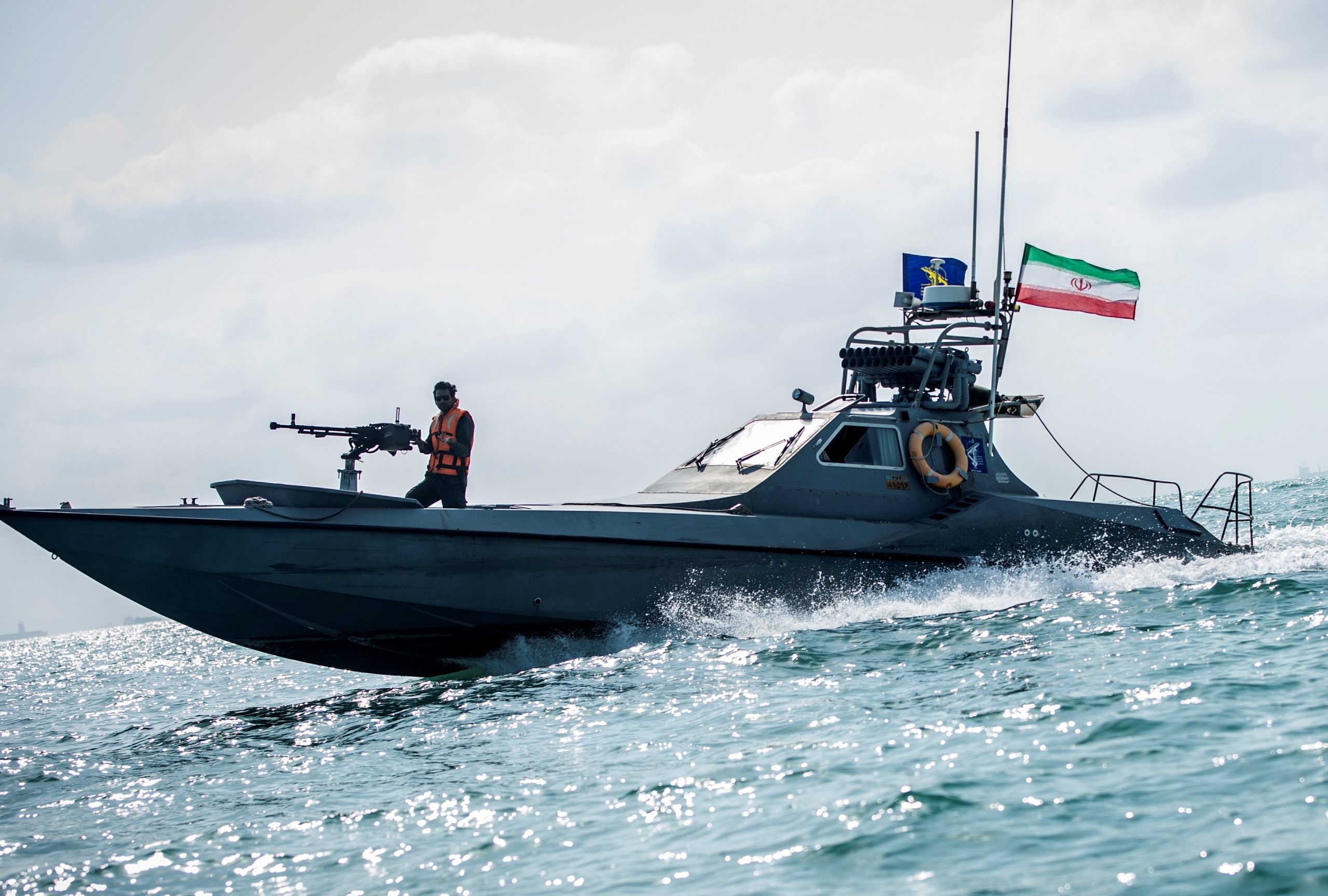
On a Monday morning at 10 a.m. U.S. Eastern time, the Trump administration enacted a sweeping military blockade across all of Iran’s ports and coastal waters, a major escalation of ongoing hostilities between the two nations that has already sent shockwaves through global energy markets and drawn sharp criticism from U.S. NATO allies. Under the current terms of the blockade, commercial vessels may continue transiting the Strait of Hormuz, the world’s most critical chokepoint for global oil trade, so long as their journeys do not involve travel to or from Iranian ports.
The success of the blockade hinges entirely on the U.S. military’s ability to counter Iranian attempts to disrupt international shipping through the strait. So far, Tehran has effectively deterred commercial tanker traffic through the region more through psychological pressure than direct attacks, but the new blockade sets the stage for open military confrontation at sea. Iran retains a large fleet of missile-armed small attack craft, split between the regular Iranian Navy and the Islamic Revolutionary Guard Corps Navy, that can be deployed to harass or attack passing vessels. Estimates place the total number of these small speedboats alone between 3,000 and 4,000, with an additional 133 larger patrol and combat vessels also in Iran’s inventory. When the U.S. launched earlier large-scale military operations against Iranian military assets, President Trump noted that American forces focused their strikes on Iran’s larger surface combatants and submarines — leaving the bulk of the small attack craft fleet intact. There remains ongoing uncertainty about the location of Iran’s Kilo-class submarines supplied by Russia. Now, U.S. forces are tasked with locating and eliminating every one of these small vessels, a mission that military analysts warn will require significant time, firepower, and operational resources to complete.
Military analysts point to the A-10 Thunderbolt II, the U.S. Air Force’s iconic close-air support aircraft, as the most effective and low-risk platform for this mission. The A-10’s 30mm Gatling gun, which fires armor-piercing depleted uranium ammunition, can easily destroy even small, fast-moving vessels, and the jet can deploy low-cost laser-guided rockets for precision strikes. Unlike faster fighter jets, the A-10 is purpose-built for low-altitude, long-duration patrols over maritime environments, making it far more cost-effective for countering small boat threats. However, only around 30 A-10s are currently deployed to the Middle East, drawn from two Air National Guard squadrons: the 107th Fighter Squadron out of Michigan’s Selfridge Air National Guard Base and the 190th Fighter Squadron based at Idaho’s Gowen Field. Each squadron retains just 6 to 9 additional A-10s back in the U.S. that could be deployed, creating a critical gap in firepower for the mission.
The solution to this shortfall is already available, analysts argue: dozens of fully operational A-10s recently retired by the Air Force are stored in the aircraft “boneyard” at Davis-Monthan Air Force Base in Arizona. In the 2025 fiscal year alone, the Air Force retired between 56 and 59 airworthy A-10s, all retaining their full operational equipment and ready to be reactivated. While recalled pilots would require a short transition period to return to flying the aircraft, this process could be completed rapidly if the Trump administration prioritizes the move. Reactivating all stored A-10s would triple the size of the A-10 fleet in the Gulf region, expanding it from 30 to more than 90 aircraft, dramatically increasing U.S. capability to neutralize Iran’s small boat force.
Yet there is a major barrier to this plan: the U.S. Air Force has spent years pushing to retire the entire A-10 fleet to reallocate funding to newer fifth-generation fighter jets, and analysts expect service leaders to mount aggressive resistance to reactivating stored aircraft. This creates a major test for the Pentagon and the Trump administration, which has traditionally deferred to military leadership on equipment and deployment decisions. Analysts warn that allowing the Air Force to block A-10 reactivation would severely undermine U.S. efforts to enforce the blockade and secure control of the Strait of Hormuz.
The strategic goal of the blockade is clear: to cripple Iran’s economy to the point that the regime either accepts U.S. negotiating terms or collapses under domestic pressure. Leading economic warfare analyst Miad Maleki, a Senior Fellow at the Foundation for Defense of Democracies, calculates that the blockade will cost Iran approximately $276 million per day in lost export revenue and disrupt an additional $159 million in daily imports, for a total economic hit of around $435 million per day, or $13 billion per month. More than 90% of Iran’s total annual trade, valued at $109.7 billion, transits the Persian Gulf, and oil and gas exports account for 80% of the Iranian government’s export earnings and 23.7% of the country’s total GDP. Iran’s primary oil export terminal at Kharg Island alone generates roughly $53 billion annually in export revenue.
Maleki projects that the blockade will trigger a total collapse of Iran’s currency, the rial, pushing the country into irreversible hyperinflation. Even before the blockade, the rial has already crashed from 42,000 rials per U.S. dollar to 1.5 million rials per dollar. Iranian banks currently limit civilian cash withdrawals to between $18 and $30 per day, and national inflation already sits at 47.5%. Eliminating all of Iran’s foreign currency earnings from exports, Maleki argues, will push the rial into terminal collapse. The ultimate outcome of the Trump administration’s strategy is binary: either the Iranian regime will be forced to capitulate to U.S. demands for a new nuclear and security deal, or widespread economic hardship will spark a social revolution that the current government cannot suppress.
As global oil prices have already surged past $100 per barrel in response to the blockade, NATO allies have openly criticized Trump’s decision, warning that the escalation poses severe risks to global energy security and economic stability. The speed and success of the U.S. mission to secure the Strait of Hormuz, analysts emphasize, will hinge on the administration’s willingness to overcome Air Force resistance and rapidly reactivate the stored A-10 fleet needed to neutralize Iran’s small boat threat.