For the first time in history, two of the world’s most influential public platforms are held by American-born figures — and their long-simmering rhetorical clash over the ongoing Israel-U.S. war in Iran has erupted into an extraordinary public split, exposing deep divides over faith, war, and the role of religious leadership in global politics.
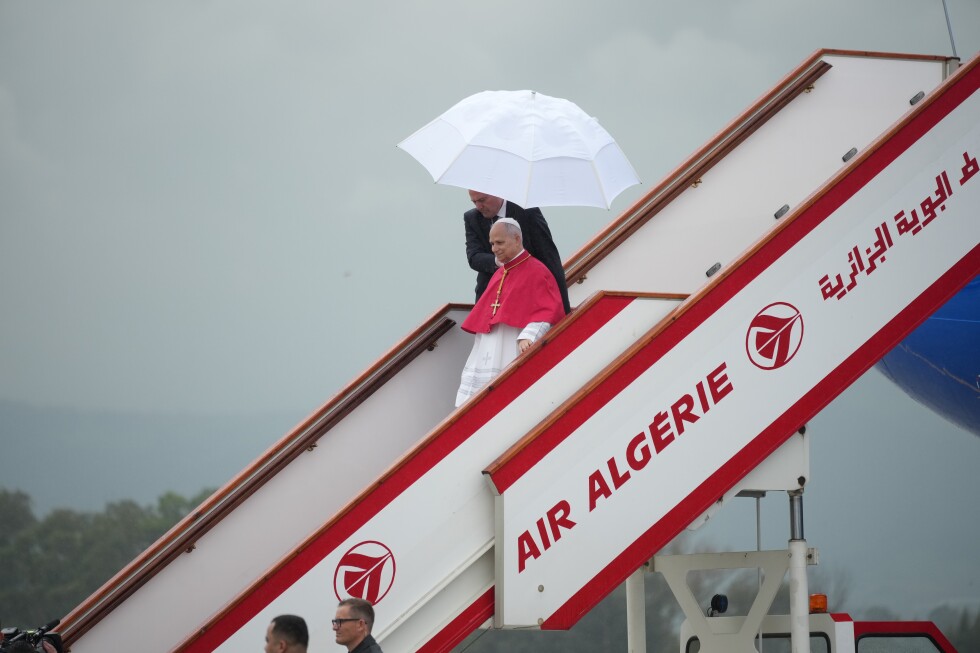
The confrontation reached a new peak this week, as Pope Leo XIV, the soft-spoken, studious first U.S.-born pontiff, pushed back forcefully against a volley of personal attacks from former and current U.S. President Donald Trump, an unapologetically combative politician who has framed his hardline stance on Iran as central to his political agenda. Speaking to reporters aboard his flight to Algeria this Monday, the pope made clear the Vatican’s consistent calls for peace and reconciliation are rooted in Christian Gospel teachings, and he has no intention of backing down to pressure from the Trump administration. “I’m not afraid of the Trump administration, or of speaking out loudly about the message of the Gospel, which is what the Church works for,” Leo said.
Trump, for his part, launched a scathing series of posts on his Truth Social platform over the weekend, labeling Pope Leo “Weak,” claiming the pontiff was held captive by the “Radical Left,” and even suggesting that Leo owed his papal election to Trump’s political influence. The feud follows the pope’s blunt rebuke of Trump’s threats to expand military action in Iran, which Leo called “truly unacceptable.” To contextualize this unprecedented clash, it is necessary to trace how the relationship between the two American leaders shifted from initial celebration to open conflict, shaped by long-standing patterns of speech and conviction from both men.
Long before his election to the papacy, Robert Prevost — who would become Pope Leo XIV — established a track record of unflinching public commentary on global politics. As a bishop serving in Peru when Russia launched its full-scale invasion of Ukraine in 2022, he did not hesitate to assign direct blame to Moscow, describing the incursion on a Peruvian current affairs program as “an imperialist invasion in which Russia wants to conquer territory for reasons of power given Ukraine’s strategic location.” The clip resurfaced widely in Italian media shortly after his May 2025 papal election.
Earlier that same year, while still a cardinal based in Rome, Prevost sparked conversation by sharing a critical news analysis of U.S. Vice President JD Vance, a convert to Catholicism who had argued that Christian teachings mandate a hierarchical order of care, prioritizing one’s own family, local community and fellow citizens over foreign-born people. The headline of the analysis Prevost shared read: “JD Vance is wrong: Jesus doesn’t ask us to rank our love for others.”
This pattern of direct engagement set Prevost apart from many Catholic bishops, who often limit public commentary to broad statements of church doctrine and avoid direct critiques of sitting politicians. As the context makes clear, these early actions revealed a leader who kept close track of global affairs and was willing to stake out clear, controversial positions long before he took the papal throne.
On the day of Leo’s election, Trump was quick to celebrate the milestone, framing the first American pontiff as a personal win for the United States and for his own presidency. “It is such an honor to realize that he is the first American Pope. What excitement, and what a Great Honor for our Country,” Trump posted on Truth Social. “I look forward to meeting Pope Leo XIV. It will be a very meaningful moment!” He later told reporters at the White House that the administration was “a little bit surprised and very happy” with the outcome of the papal conclave.
By this week, that celebration had curdled into blame and grievance, with Trump claiming that Leo was only elected because the College of Cardinals picked an American specifically to curry favor with his administration. The shift highlights how Trump has consistently framed Leo through a lens of nationalist loyalty and personal power, rather than as the leader of a global religious institution. That perspective overlooks key context: the College of Cardinals has historically viewed the U.S. with a degree of skepticism, concerned about the global impact of Washington’s military and economic policies on low-income nations, and has long been reluctant to name a pope from the world’s dominant superpower. Though Leo was born, educated and ordained in the U.S., he spent decades serving as a church leader in impoverished regions of South America. As Steven Millies, a professor at Chicago’s Catholic Theological Union — where Leo earned his master of divinity — noted, “He was the least American of the Americans.”
From the very first moments of his papacy, Leo made clear that peacemaking would be the defining mission of his tenure. His opening remarks from the balcony of St. Peter’s Basilica opened with a message of peace: “Peace with you all … the first greeting of the risen Christ, the Good Shepherd who gave his life for the flock of God.” At his first Sunday blessing from the loggia, he addressed both the Russian war in Ukraine and the ongoing Israel-Gaza violence, decrying the spate of global conflicts as a “third world war in pieces.” The following Monday, he opened a meeting with journalists by quoting Jesus’ words from the Sermon on the Mount: “Blessed are the peacemakers.”
Beyond his words, Leo took deliberate steps to distance himself from overt American branding, even in his choice of language. A fluent polyglot, Leo did not use English in any of his opening high-profile papal remarks: he spoke first in Italian when he was introduced to the world in St. Peter’s Square, then switched to Spanish to address the Peruvian people he had served for years. His first Sunday blessing was delivered entirely in Italian. While he briefly greeted the assembly of journalists in his native Chicago-inflected English, he quickly transitioned back to Italian for his formal remarks. The choice is a deliberate one, experts say, that underscores his role as the head of a global church with 1.4 billion followers worldwide. “He doesn’t want to be perceived, I think, as coming from the American side or as relying on his authority as American,” said William Barbieri, a professor at Catholic University of America. “He wants to speak in the name of the church.”
The gulf between the two men’s views widened dramatically during this year’s Holy Week and Easter season, as Trump escalated military threats against Iran. In his Palm Sunday address, Leo framed Jesus as the “King of Peace” and directly challenged warmaking, quoting the Hebrew Bible: “Even though you make many prayers, I will not listen: your hands are full of blood.” Around the same time, Trump welcomed conservative Christian leaders to the White House for a Holy Week event, where his spiritual advisor Paula White drew a parallel between Trump and Jesus, framing both as persecuted figures.
Later that week, Leo performed the traditional foot-washing ceremony and became the first pope to name Trump directly in a public critique, calling on the president to pursue an “off-ramp” from escalating conflict in Iran. On Easter Sunday, Trump issued a new threat to bomb civilian infrastructure across Iran and erase what he called an entire civilization, prompting Leo’s public rebuke that the threat was “truly unacceptable.” The back-and-forth stripped away all pretense of cordiality, making an open confrontation unavoidable.
In his recent social media broadside, Trump doubled down on his attack, arguing: “I don’t want a Pope who criticizes the President of the United States because I’m doing exactly what I was elected, IN A LANDSLIDE, to do.” He added that Leo should “focus on being a Great Pope, not a Politician.”
For his part, Leo has repeatedly pushed back against framing his comments as political interference. “To put my message on the same plane as what the president has attempted to do here, I think is not understanding what the message of the Gospel is,” Leo told the Associated Press aboard his flight to Africa. “And I’m sorry to hear that but I will continue on what I believe is the mission of the church in the world today.”
The clash is a historic one: popes have long commented on global conflicts, but rarely name sitting heads of state directly for public criticism. For Trump, too, the dynamic is unusual: while he regularly lashes out at perceived political rivals, he is facing off against a global religious leader who operates outside U.S. electoral politics and faces no pressure to comply with Trump’s terms.