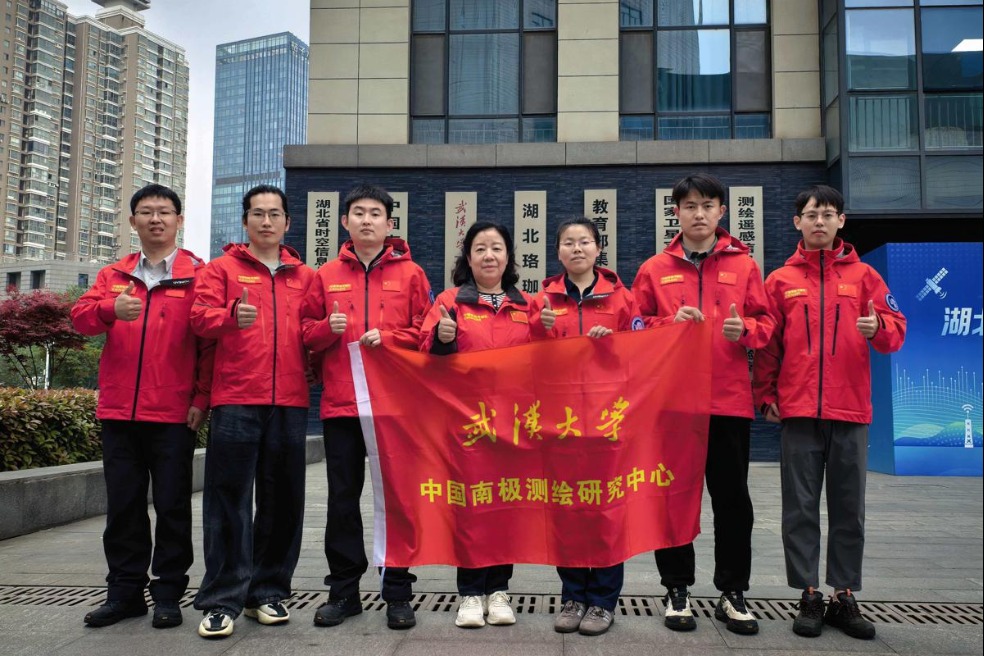
After five months of grueling, groundbreaking fieldwork in one of the harshest environments on Earth, five polar researchers from Wuhan University’s Chinese Antarctic Center of Surveying and Mapping have returned home, capping their contribution to China’s 42nd national Antarctic expedition. On Monday, the university hosted a press event welcoming the team back, bringing together regional and national media outlets to hear first-hand accounts of the expedition’s challenges, key scientific accomplishments, and unforgettable moments working on the icy southern continent.
The five Wuhan University scholars were part of a broader 550-strong team of Chinese scientists that departed China on November 1 last year to carry out a full season of research across multiple Antarctic research stations. Each researcher was assigned to a different Chinese facility to conduct location-specific scientific work: Center professor Pang Xiaoping, associate researcher Zang Lin, and postdoctoral fellow Liu Mingliang were based at China’s first Antarctic research outpost, Great Wall Station; research assistant Hu Changhong carried out his duties at Zhongshan Station; and research assistant Yu Liang was posted to the relatively newer Qinling Station.
According to official updates from Wuhan University, the team delivered meaningful progress on a suite of high-priority scientific and infrastructure projects during their five months on the ice. Core tasks included routine maintenance of tide gauges operated under the control of the Global Navigation Satellite System (GNSS), critical hardware upgrades to the on-site Beidou satellite observation network, and systematic long-term environmental monitoring of local Antarctic ecosystems. These projects not only advance China’s independent polar research capabilities but also contribute to global scientific understanding of Antarctic climate change, ice sheet dynamics, and satellite positioning accuracy in the polar region.
The expedition comes as polar research has grown in global importance, with scientists around the world tracking rapid environmental changes in Antarctica that have far-reaching impacts on global sea levels and climate systems. Work like the upgrades to Beidou’s polar observation infrastructure also expand the coverage and reliability of Chinese satellite navigation services for international research and maritime operations in the southern ocean.