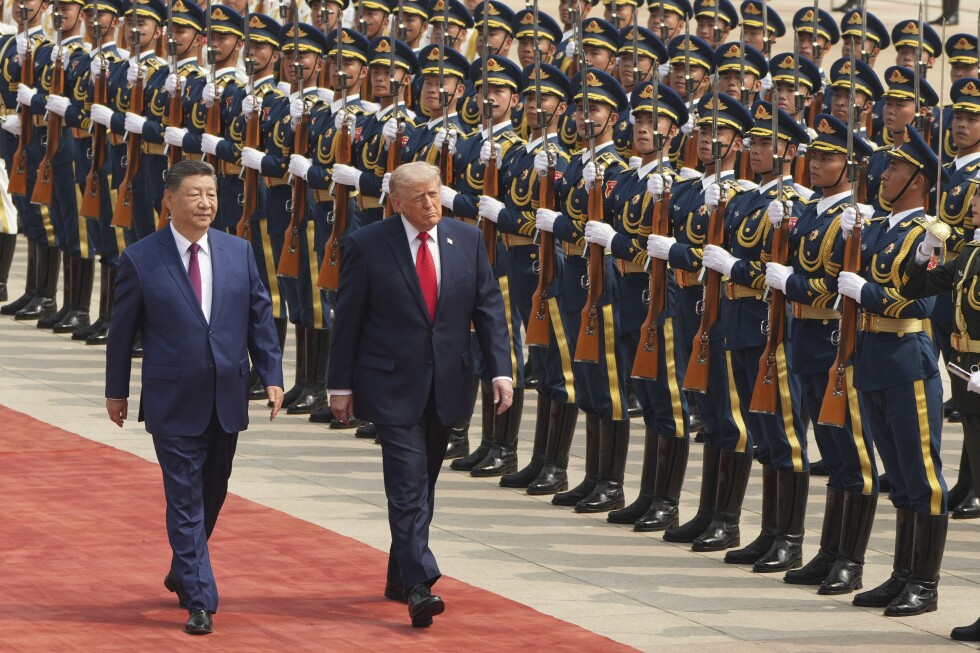
BEIJING – As U.S. President Donald Trump concluded his fast-paced diplomatic visit to China on Friday, he remained steadfast in his public framing that relations between the world’s two largest economies are strong and improving, even as deep, unresolved divisions over flashpoint issues from Taiwan to the Iran conflict continue to test bilateral ties.
On his final day in the Chinese capital, Trump took to social media to claim that Chinese President Xi Jinping had praised his “tremendous successes” in office. He also sought to clarify Xi’s recent comment describing the U.S. as a potentially declining power, arguing the remark was directed exclusively at his predecessor Joe Biden, not his own administration.
Yet Trump’s upbeat assessment of the U.S.-China relationship runs headlong into tangible disagreements that dominated closed-door negotiations this week, with no sign of breakthrough on the most contentious items on the agenda.
### Taiwan: Core Interest Sparks Sharp Warnings
The Taiwan question emerged as the most sensitive topic of this week’s talks, with Chinese officials confirming that Xi privately warned Trump that mishandling differences over the self-governing island could push the two global powers into open confrontation.
For Beijing, Taiwan has long been framed as an non-negotiable core national interest, and Chinese leaders have ramped up this messaging in recent weeks amid growing defense cooperation between Washington and Taipei. Secretary of State Marco Rubio, who joined the U.S. delegation for negotiations, emphasized that longstanding U.S. policy toward Taiwan remains unchanged, warning that any attempt to seize the island by force would be a catastrophic error, while also noting that Beijing’s tough rhetoric on the issue follows longstanding diplomatic norms.
The current state of play on Taiwan exposes conflicting strands of Trump’s policy toward the island. In December, his administration approved a record $11 billion arms package for Taiwan – the largest ever offered to the democracy – but the deal has yet to be implemented, and Trump has publicly questioned the value of U.S. security commitments to Taipei. He has complained that Taiwan “stole” the U.S. semiconductor industry and repeatedly demanded the island pay full cost for American military protection, while using tariff threats and incentives inherited from the Biden administration to pressure Taipei into committing to massive new investments in U.S. semiconductor manufacturing and multi-billion dollar purchases of American crude oil and liquefied natural gas. These inconsistent stances have fueled widespread speculation that Trump could be willing to scale back U.S. support for Taiwan in exchange for concessions on other issues.
Ma Chun-wei, a specialist in cross-strait relations at Taiwan’s Tamkang University, explained that growing defense ties between Washington and Taipei have directly prompted Beijing’s harder line on the issue. “For Xi Jinping, he must show that the Taiwan issue is in China’s hands. He must demonstrate this image, or else he would be criticized,” Ma noted.
### The Iran Conflict: Disagreement Over Global Energy Security
The ongoing war in Iran, which has effectively closed the critical Strait of Hormuz chokepoint for global oil trade, also featured prominently in Thursday’s two-hour talks between the two leaders at Beijing’s Great Hall of the People.
Trump told Fox News in an interview that both he and Xi agreed the Strait of Hormuz – which carried roughly 20% of the world’s global oil supplies before the war began in February – must be reopened to meet global energy demand. Trump claimed that Xi privately offered to mediate to help end the conflict, though details of any potential Chinese role remain unclear, particularly given Beijing’s longstanding strategic partnership with Tehran. The U.S. has repeatedly pressed China to use its unique leverage as Iran’s largest trading partner to pressure Tehran into negotiating an end to the war, but Beijing has shown little public willingness to take steps that would damage its relationship with the Iranian government.
“He’d like to see the Hormuz Strait open,” Trump said of Xi. “He said if I can be of any help whatsoever, I would like to help.” Trump added that Xi also opposes the imposition of tolls on ships transiting the strait and signaled China could increase purchases of American oil to reduce its reliance on Gulf energy supplies in the future.
Just days before arriving in Beijing, Trump downplayed the urgency of resolving the Iran conflict during talks with Xi, telling reporters “we have Iran very much under control” and framing the issue as a lower priority. But senior administration officials struck a different tone ahead of the meetings, arguing that it is directly in China’s economic interest to help end the war. Rubio noted that the conflict has driven up global energy prices, slowing consumer demand around the world and leading to fewer purchases of Chinese goods, which harms China’s export-driven economy. While Beijing has so far cushioned the impact of the energy crisis using its strategic oil reserves, economists warn that that buffer is not unlimited, and prolonged disruption to global energy markets could cause significant damage to Chinese economic growth.
On another longstanding point of friction, the White House still maintains that China could do more to crack down on the flow of Chinese-made precursor chemicals to Mexican drug cartels, which are used to produce illicit fentanyl that has caused a public health crisis across thousands of American communities.
### Trade and Business: Expectations of Potential Deals Ahead of Departure
Heading into the visit, White House officials signaled that Trump would not conclude the trip without tangible progress on trade, suggesting new announcements could be coming before his departure for Washington. The U.S. side is pushing for formal Chinese commitments to increase purchases of American soybeans and beef, while Trump confirmed Friday that Xi had indicated China would move forward with a purchase of 200 Boeing commercial jets.
According to a White House readout of Thursday’s talks, the two leaders discussed expanding Chinese agricultural imports from the U.S. and exploring opportunities for reciprocal investment expansion. The Trump administration is also pushing to establish a new bilateral Board of Trade to address ongoing commercial disputes between the two countries.
Chinese Premier Li Qiang struck a conciliatory tone during separate talks with American business leaders, including Elon Musk of Tesla, Tim Cook of Apple and Nvidia CEO Jensen Huang – all of whom joined Trump’s delegation for the visit. “China and the United States have been able to maintain frank and smooth dialogue and communication and actively safeguard a stable and healthy bilateral relationship” despite global upheaval, Li said.
As Friday wraps up, Trump and Xi are scheduled for additional informal talks at Xi’s official Beijing residence before the U.S. president departs for the return trip to Washington, with no clear sign that the two sides have bridged the deep divides that continue to shape the world’s most important bilateral relationship.