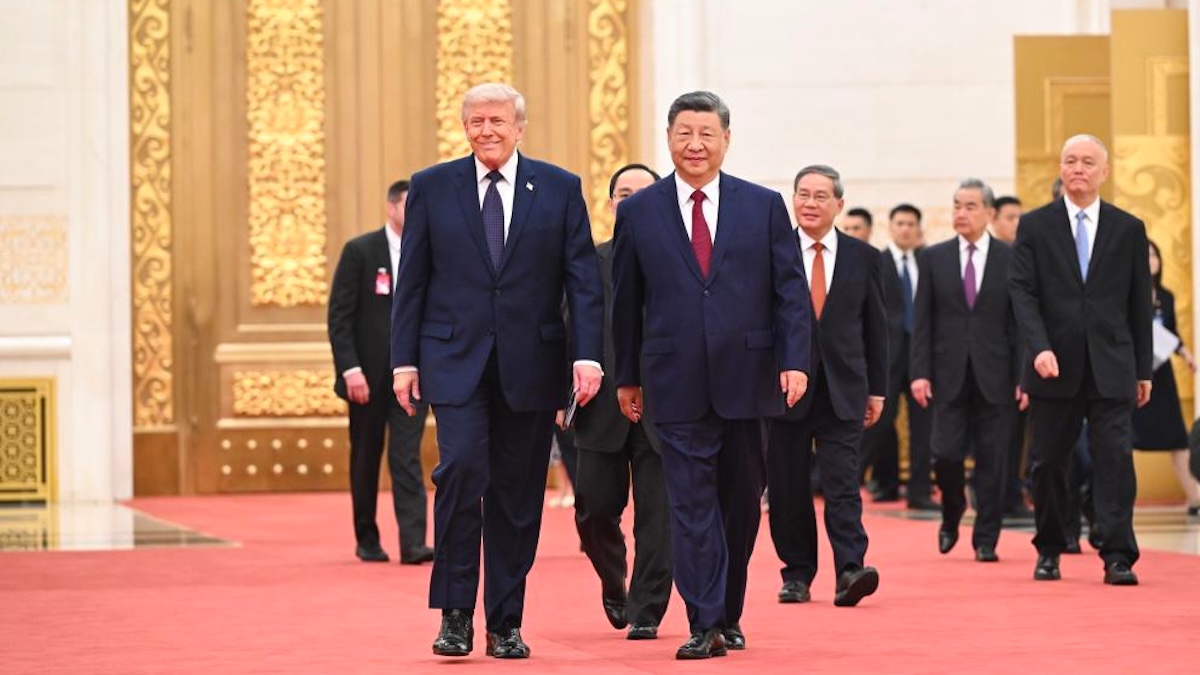
A landmark summit between U.S. President Donald Trump and Chinese President Xi Jinping in Beijing has delivered a series of tangible commitments from Beijing on agricultural imports, energy purchases and aircraft orders, creating a critical foundation to de-escalate years of mounting trade and security tensions between the world’s two largest economies. The 135-minute one-on-one meeting between the two leaders has also paved the way for a full reset of bilateral relations after a prolonged period of escalating trade disputes, restrictive export controls and sharpening geopolitical disagreements, with Trump formally extending an invitation for Xi and his wife Peng Liyuan to visit the White House on September 24.
Speaking to Fox News on Thursday, Trump outlined the key commitments secured during the talks: Xi has pledged China’s cooperation on the Iran nuclear issue, and agreed to ramp up purchases of American soybeans, crude oil, liquefied natural gas (LNG) and other U.S. energy exports. Trump also confirmed that China will procure 200 Boeing 737 commercial jets, a major win for the U.S. aerospace manufacturing sector.
A senior anonymous U.S. administration official added further context to the discussions around Iran and energy security, noting that Xi has publicly opposed the militarization of the Strait of Hormuz and any attempt to impose navigation tolls on the critical global energy chokepoint. Xi also signaled China’s interest in expanding imports of U.S. crude oil as a long-term strategy to reduce Beijing’s reliance on energy shipments passing through the Strait of Hormuz, the official said. Both leaders also reached a clear joint position, with the official confirming that “both countries agreed that Iran can never have a nuclear weapon.”
U.S. Treasury Secretary Scott Bessent confirmed in a Thursday CNBC interview that Beijing has reaffirmed its major existing soybean purchase commitment, a core pledge from the previous 2025 Trump-Xi summit held in Busan, South Korea. “And then soybeans, we have a very large purchase commitment from the Busan agreement for the next three years. So beans are really all taken care of,” Bessent stated. That original agreement, reached during the October 2025 Busan summit, committed China to importing 25 million metric tons of U.S. soybeans annually through 2028.
Global geopolitical shifts have altered the negotiating landscape since early 2026, when U.S. forces captured former Venezuelan leader Nicolas Maduro and his wife in January, followed by Washington’s imposition of a full blockade on commercial shipping to and from Iranian ports in April. Some Chinese policy analysts note that rising Middle East instability and persistent global supply chain disruptions have made Beijing far more receptive to Trump’s request for expanded U.S. energy purchases.
In a separate, unexplained development reported by Reuters on Thursday, China’s General Administration of Customs initially appeared to renew market access licenses for hundreds of U.S. beef exporters, a move that would have restored access for dozens of processing facilities whose permits expired over the past 12 months. However, the agency quickly reversed the change, restoring the “expired” status for those exporters on its public database, leaving the reasons for the sudden reversal unclear.
Beyond trade and agriculture, the summit also produced incremental progress on technology trade. A last-minute stop by Nvidia Chief Executive Jensen Huang to join Trump’s delegation in Alaska en route to Beijing stoked widespread market expectations that the two sides would reach a tentative deal to allow Chinese firms to import and deploy Nvidia’s advanced H200 graphics processing units (GPUs). Reuters later confirmed Thursday that the U.S. Commerce Department has granted export approval for roughly 10 major Chinese technology firms to purchase H200 chips, including e-commerce and technology giants Alibaba, JD.com, Tencent, and ByteDance, the parent company of TikTok. U.S. regulators also approved Lenovo and Foxconn to act as authorized distributors for the chips. To date, Nvidia has not shipped any H200 units to China, as Beijing has implemented policies urging domestic technology firms to prioritize locally produced semiconductors over foreign alternatives, and full details on potential future shipment timelines remain undisclosed.
Observers noted ahead of the summit that Trump’s core domestic priorities for the trip were clear: boost sales for U.S. farmers and manufacturers to the Chinese market, giving Republican congressional candidates a strong economic messaging boost ahead of November 2026 midterm elections. Other key U.S. negotiating objectives included pressing Beijing to end imports of Iranian oil, halt shipments of drone components and missile-related materials to Tehran, and secure the release of jailed Hong Kong pro-democracy businessman Jimmy Lai. Media outlets also report that the two governments are scheduled to hold follow-up negotiations to reduce tariffs on roughly $30 billion worth of bilateral trade that is not tied to national security-related sectors.
For Beijing, the summit’s top priority was advancing efforts to rebuild stable China-U.S. ties and prevent the reimposition of sweeping U.S. tariffs scheduled for early November 2026, after a one-year tariff truce between the two sides. Beijing also pushed for the Trump administration to end U.S. arms sales to Taiwan, roll back existing punitive tariffs and loosen restrictive export controls targeting Chinese industries.
During a formal banquet honoring Trump and his visiting delegation, Xi emphasized the global stakes of the bilateral relationship, noting that China-U.S. ties directly shape the well-being of more than 1.7 billion people across the two countries, and impact the interests of all 8 billion people worldwide. Xi urged both sides to shoulder their shared historic responsibility and steer the “giant ship” of China-U.S. relations along a steady, positive course.
Notably, Xi framed China’s national rejuvenation agenda – Beijing’s core policy goal of building a wealthy, globally influential nation by 2049 and achieving cross-strait reunification with Taiwan – as fully compatible with Trump’s signature “Make America Great Again” (MAGA) policy agenda, rather than inherently conflicting.
“The people of China and the U.S. are both great people. Achieving the great rejuvenation of the Chinese nation and making America great again can go hand in hand. We can help each other succeed and advance the well-being of the whole world,” Xi said in his ceremonial toast.
During the official working meeting, Xi emphasized the centrality of the Taiwan question to long-term bilateral stability, telling Trump: “If the Taiwan issue is handled properly, the bilateral relationship between the U.S. and China will be overall stable. Otherwise, the two countries will have clashes and even conflicts, putting the entire relationship in great jeopardy.” He added that safeguarding cross-strait peace and stability is the broadest common interest for both sides, stressing that “Taiwan independence” and cross-Strait peace are as irreconcilable as fire and water, and urged the U.S. to exercise extreme caution in all actions related to Taiwan. Xi also confirmed that the two leaders had agreed on a new shared vision for building a constructive China-U.S. relationship rooted in strategic stability, saying “I look forward to working together with you to set the course and steer the giant ship of China-U.S. relations, so as to make 2026 a historic, landmark year that opens up a new chapter in China-US relations.”
This new shared vision will provide overarching strategic guidance for bilateral relations over the next three years and beyond, a outcome Xi said should be welcomed by populations of both countries and the broader international community. Reaffirming the core nature of bilateral economic ties, Xi noted that “China-US economic ties are mutually beneficial and win-win in nature. Where disagreements and frictions exist, equal-footed consultation is the only right choice.” He called on both governments to fully implement the consensus reached by the two leaders, expand utilization of existing communication channels across political, diplomatic and military domains, and deepen collaborative exchanges in trade, public health, agriculture, tourism, people-to-people ties and law enforcement.
During the meeting, Xi posed three fundamental questions that frame the long-term future of the bilateral relationship, centered on the concept of the Thucydides Trap – a theory popularized by American political scientist Graham Allison that holds that rising powers almost inevitably go to war with existing dominant powers. The three questions Xi posed were: “Can China and the US overcome the Thucydides Trap and create a new paradigm of major-country relations? Can we meet global challenges together and provide greater stability for the world? Can we build a bright future together for our bilateral relations in the interest of the well-being of the two peoples and the future of humanity?” He added that “These are the questions vital to history, to the world and to the people.”
Cui Hongjian, a professor at the Academy of Regional and Global Governance at Beijing Foreign Studies University, explained that in recent years, many U.S. commentators and policymakers have framed U.S.-China rivalry as inevitable, arguing the two countries have already fallen into the Thucydides Trap and are fated to compete for global supremacy. “This pessimistic and negative sentiment not only affected China-US relations, but also affected the international community, raising the sense of insecurity and uncertainty,” Cui said. He added that this latest summit, coming on the heels of the 2025 Busan meeting, demonstrates that both sides are committed to moving the relationship beyond pessimistic zero-sum framing and back toward managed, constructive engagement. “This has resolved a major psychological concern in the international community,” Cui said. “This interaction is expected to reverse that sense of losing control and put the two countries back on a track of reasonably and effectively managing their relationship.”