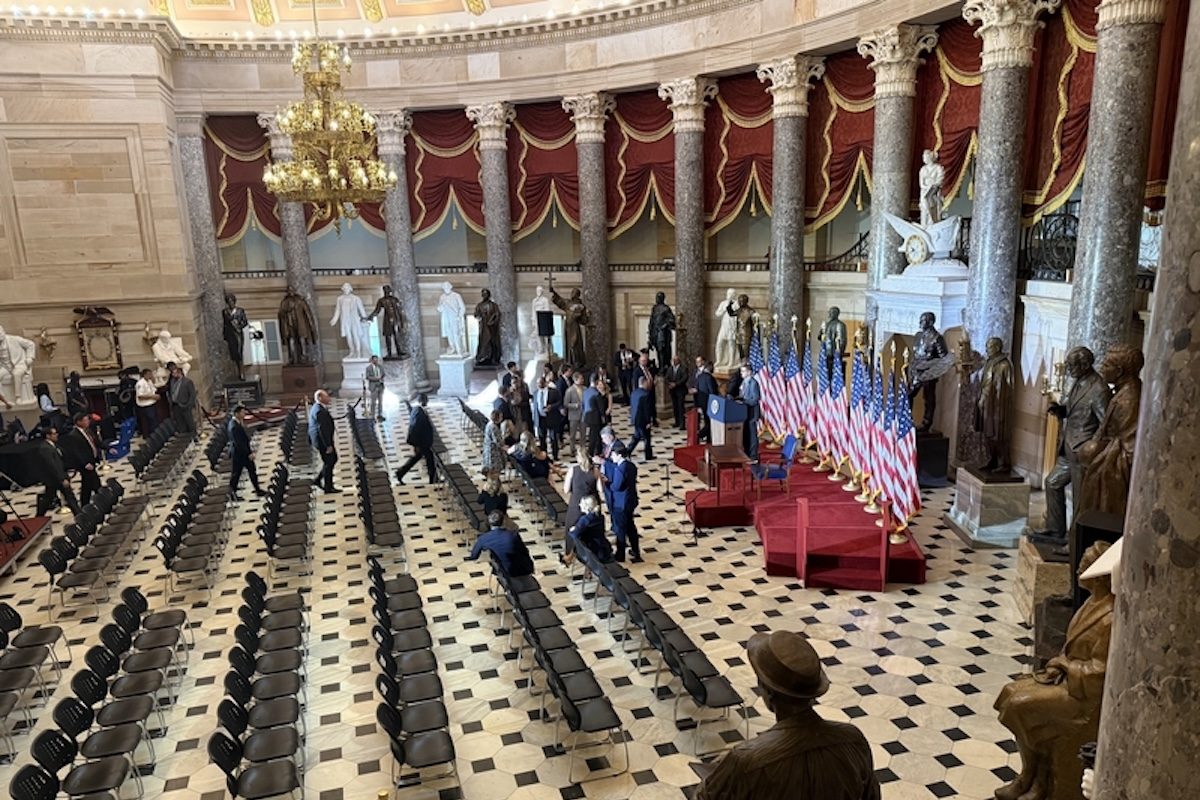
In a sudden Wednesday announcement that upended weeks of bipartisan legislative progress, former and current U.S. President Donald Trump scrapped a planned public signing ceremony for a broadly popular housing affordability overhaul, demanding Congress first advance his controversial election security proposal before he puts pen to paper on the housing measure.
The bipartisan housing bill had already cleared major congressional hurdles with overwhelming bipartisan support: the Senate passed the legislation 85-5 on Monday, followed by a 358-32 House vote just one day later. The White House had previously confirmed Trump backed the bill, and a public signing event was scheduled to take place in the U.S. Capitol’s Statuary Hall, a venue set up to mark the legislative win. But hours before the event was set to begin, Trump took to his Truth Social platform to call off the ceremony and reject the bill for the time being.
In his post, Trump labeled the housing overhaul, which is designed to bring down soaring U.S. housing costs, as a “minor” measure. He added, “Today’s Housing News Conference and Signing is hereby cancelled until such time as we pass the desperately needed SAVE AMERICA ACT, which I consider to be a National Emergency.”
The SAVE America Act, a top legislative priority for Trump, targets noncitizen voting, an extremely rare occurrence in U.S. elections. Despite Trump’s push for the bill, Republican Senate leaders have already privately warned the president that the legislation lacks enough votes to pass the upper chamber.
The housing overhaul, spearheaded by Senate Banking Committee Chairman Tim Scott, a South Carolina Republican, and the committee’s ranking Democratic member Elizabeth Warren of Massachusetts, includes a set of provisions aimed at easing the nation’s persistent housing affordability crisis. The bill would cut red tape that drives up construction costs, expand eligible uses for federal housing grants, and implement a ban on institutional investors purchasing large blocks of single-family homes—practices widely blamed for pushing up home prices for everyday buyers. Scott had praised the legislation earlier this week as a rare example of nonpartisan lawmaking that addresses a widespread, cross-partisan economic need.
For Republican congressional leaders, the housing bill was crafted to tackle affordability, a top policy issue expected to dominate the upcoming November midterm elections amid ongoing stubborn inflation across the U.S. economy. Most congressional opposition to the bill came from a small bloc of hardline House conservatives led by Florida Representative Anna Paulina Luna, who has pledged to block all legislation coming from the Senate, and even some House rules resolutions, until the upper chamber advances Trump’s election security measure.
Speaking at a Wednesday morning press briefing, House Speaker Mike Johnson, a Louisiana Republican, confirmed that he had spoken with Trump earlier that day. Johnson clarified that Trump is only delaying signing the housing bill to pressure Congress to pass an election security grant program through the budget reconciliation process— the same fast-track legislative procedure that Republicans used to pass their major earlier policy bill and allocate $70 billion for immigration enforcement.
Johnson explained the Republican proposal: “You have to put it on a reconciliation bill. We believe that if you create a grant program that ties it to reconciling the budget and you allow blue states, if they come to their senses and they want to avail themselves of election integrity proposals and ideas and policies, they can draw down from a federal fund and use those funds. We’re willing to invest heavily in that.”
The Speaker told reporters he had assured Trump that congressional Republicans can pass the election security measure if the caucus unites behind the effort. “As you know he has a window of time before he has to sign a bill and he’s going to use a bit more of that window of time. And we’re going to go through this together,” Johnson said, adding that he expects Trump will ultimately sign the housing bill within the 10-day window allotted for presidential approval.