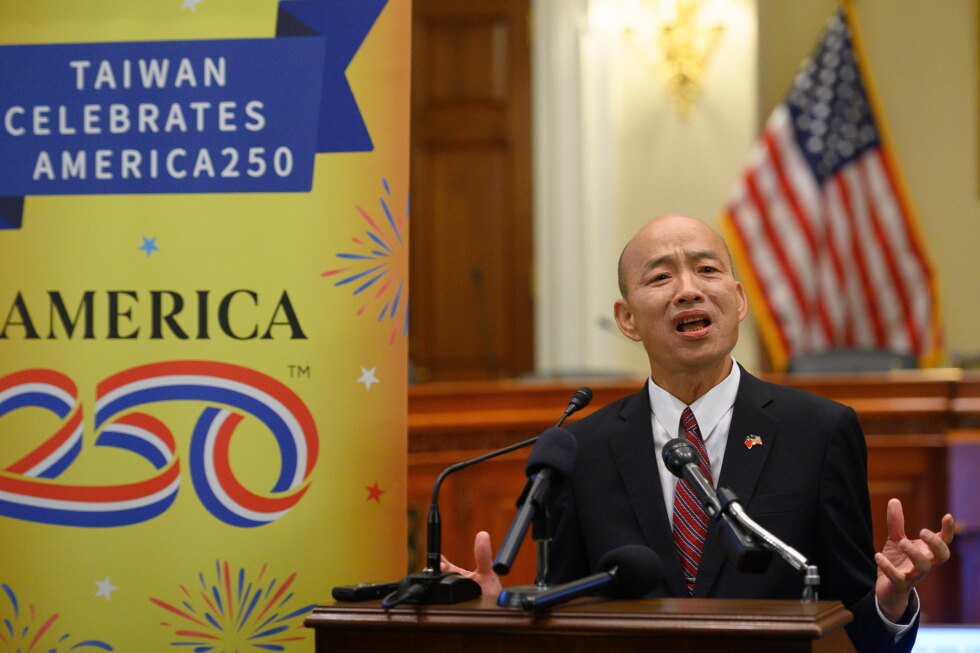
Against a backdrop of shifting U.S.-China tensions and a pending review of a major arms deal, over 30 bipartisan members of the U.S. House of Representatives gathered Wednesday in Washington D.C. to reaffirm robust U.S. backing for Taiwan, during an official reception welcoming Han Kuo-yu, the president of Taiwan’s Legislative Yuan.
The high-profile gathering, held at the Longworth House Office Building, drew some of Capitol Hill’s most prominent figures from both major parties, including former House Speaker Nancy Pelosi (D-CA), House Democratic Caucus Vice Chair Ted Lieu (D-CA), and former House Foreign Affairs Committee Chair Michael McCaul (R-TX). Opening the welcome remarks, McCaul left no ambiguity about U.S. congressional sentiment, stating, “It’s very important to me to say that the United States supports you, Mr. Speaker.” Echoing this unified stance, Pelosi emphasized that cross-party and bicameral support for Taiwan is long-standing, framing the backing as rooted not just in a commitment to regional peace, but also in critical shared economic interests tied to global maritime trade security.
Han is leading an eight-person parliamentary delegation that arrived in Washington Tuesday evening, following a preliminary stop in Phoenix, Arizona. That stop highlighted the deep economic interdependence between the U.S. and Taiwan: Phoenix is currently the site of new, cutting-edge fabrication facilities being built by Taiwan Semiconductor Manufacturing Company (TSMC), the world’s leading advanced chipmaker whose products underpin the global artificial intelligence boom. TSMC’s expansion in Arizona has become a leading example of Taiwan’s outsized importance to the U.S. economy and tech supply chain. Before meeting with House members, Han held closed-door discussions with U.S. senators; the delegation declined to share specific details of those talks, but noted the warm reception from senators matched the enthusiastic welcome House members extended.
The Taiwan issue remains one of the most contentious flashpoints in U.S.-China relations. Beijing formally claims Taiwan as part of its sovereign territory and has repeatedly vowed to take control of the self-governing island by force if necessary. Under the long-standing Taiwan Relations Act, a U.S. domestic law, Washington is legally required to provide Taiwan with sufficient defense capabilities to deter any potential invasion from mainland China. The $14 billion arms sales package at the center of current debate already received preliminary approval from Congress months ago, but the Trump administration has held up the deal amid ongoing review. President Donald Trump, following his May diplomatic trip to Beijing, has publicly described the package as a potential bargaining chip in broader U.S.-China negotiations, a framing that drew sharp pushback from U.S. lawmakers on Wednesday.
Secretary of State Marco Rubio has stated that long-standing U.S. policy toward Taiwan remains unchanged, but multiple members of Congress used Wednesday’s reception to press the Trump administration to move forward with the arms deal immediately. “I’m here today … to affirm in the strongest terms that Taiwan is not a bargaining chip. It is an island of freedom. And we need to do all we can to preserve it,” said Rep. Lloyd Doggett (D-TX), adding that the U.S. should expedite delivery of every defensive weapon Taiwan requests. Ted Lieu directly criticized the administration’s delay, saying, “I urge the administration to reverse that and to allow their arms sale to proceed.”
A member of Taiwan’s opposition Kuomintang (KMT) party, Han struck a collaborative tone in his address, praising the U.S.’s 250-year legacy of democratic governance and noting that Taiwan shares the U.S.’s core commitments to freedom, democracy, and upholding a rules-based international order. He highlighted the deep economic ties between the two sides: the 23-million-person island has recently surpassed Germany to become the United States’ fourth-largest trading partner, a shift driven largely by global demand for Taiwan’s advanced semiconductors and other high-tech hardware.
Han also used his visit to urge U.S. congressional support for expanding Taiwan’s international participation. Due to Beijing’s territorial claims, no United Nations member state can maintain formal diplomatic relations with both China and Taiwan, leaving just 12 small governments and the Holy See to formally recognize Taipei. Beijing has also successfully blocked Taiwan’s membership in most major intergovernmental organizations, including the World Health Organization. “On the international stage, Taiwan feels very lonely in its heart,” Han said. “I am here asking Taiwan’s good friends in Congress … to help us participate in global activities.”
After his meetings in Washington, Han is set to depart Friday on the inaugural nonstop flight between Washington Dulles International Airport and Taiwan Taoyuan International Airport operated by Taiwanese carrier EVA Air, a new route that has been framed as another marker of deepening people-to-people and official ties between the U.S. and Taiwan.