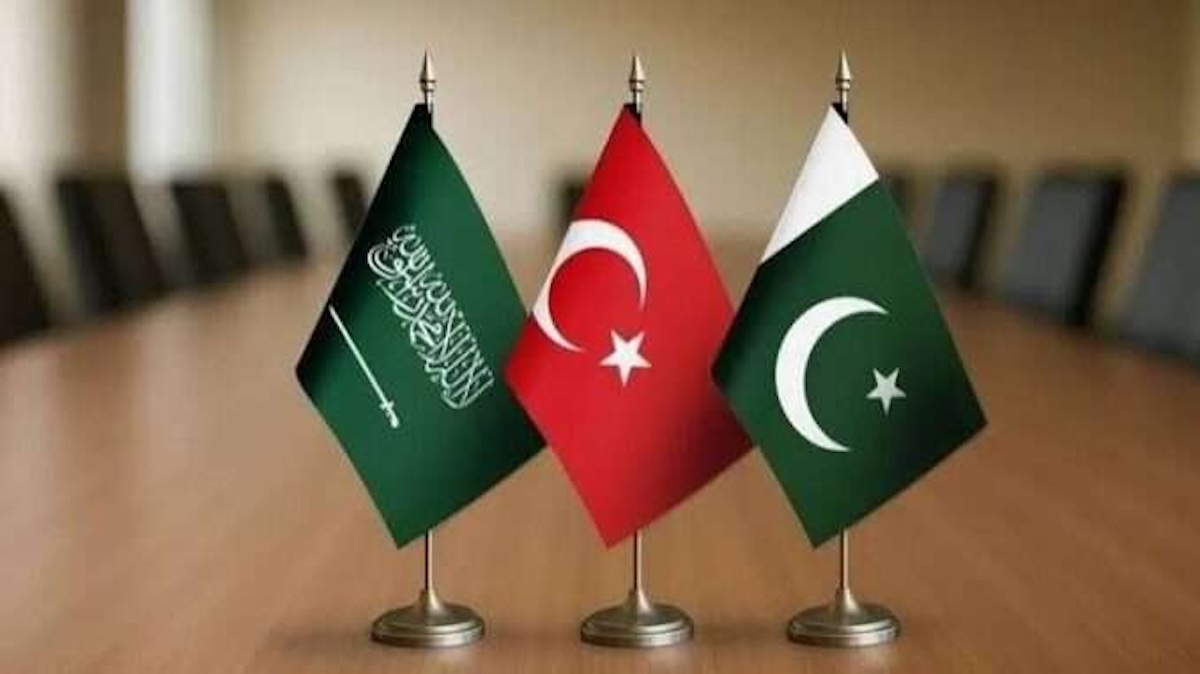
Against the backdrop of a stalemated Middle East conflict and growing frustration with U.S. foreign policy failures, three influential Muslim-majority nations have launched a landmark regional defense alliance that marks a dramatic shift in decades-long Gulf security dynamics.
Last Friday, Saudi Crown Prince Mohammed bin Salman, Turkish President Recep Erdogan, and Pakistani Prime Minister Shehbaz Sharif signed the Mecca Joint Defense Agreement in Saudi Arabia, a pact structured around a NATO-style collective defense principle. The core text of the agreement states that any armed aggression against one signatory will be treated as an attack against all three, with the explicit goal of strengthening coordinated deterrence against external threats.
The naming of the agreement, tied directly to the Islamic holy city of Mecca, sends an unambiguous signal that this is not a Western-aligned bloc. For more than 30 years, dating back to the 1990 U.S.-led liberation of Kuwait following Saddam Hussein’s invasion, Persian Gulf security has been dominated by American leadership, with U.S. ground, naval, and air forces permanently hosted across Gulf states including Saudi Arabia. This new alliance breaks with that long-standing order.
Each member brings unique strategic capabilities to the new bloc: Saudi Arabia contributes substantial economic weight from its vast fossil fuel reserves, Turkey contributes NATO’s second-largest standing military, and nuclear-armed Pakistan offers critical deterrent capacity. Regional security analysts describe the pact as a clear breaking point in regional dependence on U.S. security guarantees.
“The political symbolism of this summit is enormous,” explained Abdulaziz Sager, director of the Saudi-based Gulf Research Center. “Three of the Muslim world’s most powerful states have come together at a time of extreme regional uncertainty, demonstrating that middle and regional powers are increasingly willing to coordinate their own security agendas independent of outside actors.”
Observers widely agree that eroding trust in U.S. security guarantees is the primary driver behind the new alliance. After U.S. policy led to a stalled war with Iran, Tehran has launched retaliatory strikes against U.S.-aligned Gulf states, disrupting global energy supplies and bringing parts of the world economy to the brink of standstill. Iran frames its attacks as a response to Saudi Arabia’s long-standing alignment with Washington. As Iranian strikes targeted Gulf territory, the U.S. withdrew hundreds of military personnel from regional bases, leaving Gulf leadership questioning whether decades of American security promises were ever tangible.
Harvard economist Ken Rogoff highlighted this disillusionment during a Wall Street Journal TV discussion on the war’s impact on U.S. global influence. “Many Gulf rulers went into this conflict believing U.S. bases on their soil guaranteed their protection,” Rogoff noted. “Instead, they’ve found that those bases turned their countries into targets, with no meaningful American defense to back up the promises.”
Not all analysts frame the pact as a full break from the U.S. Ozgur Unluhisarcikli, a Turkish foreign policy expert at the German Marshall Fund’s Ankara office, emphasized that the agreement is not yet a fully operational mutual defense pact. “This is best understood as a foundational framework for deeper strategic, military, and defense industry coordination between the three states,” he told Qatar-based Al Jazeera. All three signatories still rely heavily on U.S. military equipment, a dependence that cannot be eliminated quickly, making a complete split from Washington unlikely in the near term.
Iran’s official reaction to the alliance mixed dismissal with calls for Muslim unity. Iranian Foreign Minister Abbas Araghchi argued the new bloc’s search for security was misdirected, boasting that Iran’s military had already proven its “readiness and capability” against what he called “the world’s most expensive military.” Still, he added that “when Muslims stand together, we can face every challenge from malicious outsiders head-on. It is time to rely only on ourselves and embrace true brotherhood.” Hardline Iranian lawmakers took a more confrontational stance: “Saudis must know that a paper agreement with Turkey and Pakistan will not bring them security, just as decades of dependence on the Americans did not,” wrote Iranian MP Ebrahim Rezaei. “Reform your policies so that you do not need to beg for security from others.”
Beyond immediate security needs, each signatory pursues distinct long-term strategic goals through the alliance. For Saudi Arabia, the pact builds on years of efforts to diversify its diplomatic partnerships and expand global influence. In 2023, Saudi Arabia restored diplomatic ties with Iran, a deal brokered by China that signaled Riyadh’s growing willingness to look beyond Washington for partnerships. The kingdom has also collaborated with Russia for years to maintain stable, high oil prices, defying repeated U.S. pressure to lower prices. Riyadh has held deep distrust of U.S. commitment since Donald Trump’s first term, when the U.S. declined to retaliate against Iranian-linked attacks on Saudi oil tankers and a key domestic oil processing facility in 2019. Today, with the U.S. failing to defeat Iran and major powers China and Russia aligned with Tehran, Riyadh is testing whether new regional partners can deliver the security Washington has failed to provide.
For Pakistan, the alliance offers an opportunity to break free of long-standing geopolitical constraints rooted in its border dispute with India and history of intervention in Afghanistan, allowing it to play a larger role in global diplomacy. Like Saudi Arabia, Pakistan has deepened its strategic ties with China, participating in the Belt and Road Initiative to build a major transport corridor and Chinese-managed deepwater port on the Arabian Sea, positioned near the entrance to the Persian Gulf. While Islamabad’s previous attempts to mediate a U.S.-Iran peace deal have failed, it has maintained its bilateral relationship with Washington. The new partnership with Turkey gives Pakistan access to advanced Turkish military production and technology, while securing Islamabad a greater voice in Middle East affairs, a region where it has historically had limited influence.
For Turkey, the alliance advances President Erdogan’s vision of restoring Turkey’s historical influence across the Middle East and Central Asia, a legacy of the Ottoman Empire that ended with World War I. The partnership places Ankara at the center of regional geopolitics, and the shared Islamic identity of the three-nation bloc adds a layer of historical legitimacy to Turkey’s regional ambitions. It also brings concrete economic benefits: Saudi Arabia already invests heavily in Turkish high-tech industry, Turkey is a core infrastructure and security partner for Saudi Arabia’s $500 billion NEOM mega-city project on the Red Sea coast, and the agreement is expected to lower trade barriers for Turkish consumer exports to the Saudi market.
Militarily, Turkey can offer Saudi Arabia advanced drone technology and naval modernization support, and Ankara has the regional military footprint to help resolve the Houthi blockade of Red Sea shipping. Turkey already operates a naval base in Somalia and is building a new missile base on the Indian Ocean with capacity for missiles with a 1,250-mile range, putting the entire Arabian Peninsula, Red Sea shipping lanes, and Strait of Hormuz within striking distance. Turkey’s expanding regional role also puts it in direct conflict with Israeli ambitions, as analysts note: following the Gaza war, Israel has pushed to establish full military dominance across the Middle East, a goal that clashes directly with Ankara’s interests. “As Turkey deepened its involvement in regional affairs, its interests increasingly collided with Israel’s,” notes a report from the Jazeera Center for Studies. “Israel’s efforts to control Palestinian territory, dominate Lebanon, and overthrow the Iranian government all have direct negative consequences for Turkish security and economic interests.”
Across the Middle East, the new agreement marks the most significant shift in regional security architecture in a generation, as regional powers move to take security into their own hands after decades of U.S. leadership.