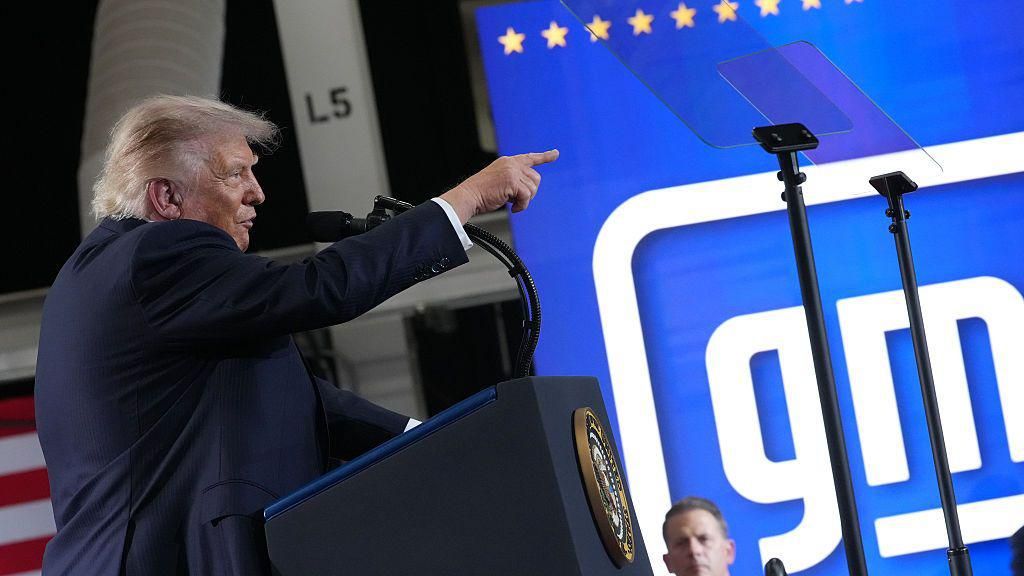
On a high-stakes campaign-focused stop in Michigan, a critical Rust Belt battleground that shifted to Republican control in 2024, former and current U.S. President Donald Trump doubled down on his signature economic agenda, defending the sweeping tariffs that have roiled the state’s dominant automobile manufacturing sector.
Speaking to workers at a General Motors facility in Milford, Trump framed his so-called “historic” tariff measures as a transformative intervention for American auto manufacturing, arguing that the import levies are pushing multinational companies to shift production facilities back to U.S. soil from overseas locations. “The rule is straightforward: Build your trucks or cars outside the United States and you’ll pay a fee for the right to sell them here and profit,” Trump told the assembled crowd Monday. “Build your plant in Michigan or anywhere else in America and produce the vehicles right here at home, and you’ll face no tariff at all.”
The White House sought to back up the president’s claims ahead of his appearance, pointing to a $6 million investment in domestic U.S. manufacturing by General Motors, alongside smaller production commitments from other major U.S.-based automakers including Ford, Stellantis and Detroit Diesel as tangible proof of the policies’ success.
But the reality on the ground in Michigan tells a far more complicated story. The state’s economy is deeply interconnected with neighboring Canada, the United States’ largest trading partner in the auto sector, which has been targeted by a series of escalating Trump administration tariffs. Under current rules, a 25% levy applies to non-U.S. content in Canadian-assembled passenger vehicles and auto parts that do not meet origin requirements under the U.S.-Mexico-Canada Agreement (USMCA), with additional tariffs on imported steel that have pushed up production costs for domestic manufacturers across Michigan. Tensions are set to rise further in August, when the administration plans to implement a planned increase to 50% tariffs on a range of Canadian goods, including finished automobiles. Canada has already retaliated with matching 25% tariffs on U.S.-built vehicles and non-compliant auto content, creating a tit-for-tat trade dispute that has disrupted cross-border supply chains.
Official labor data underscores the growing economic strain on the state. Over the 12-month period ending this past June, Michigan added just 500 net new jobs, a stark contrast to booming growth in other major industrial states like Texas, which added nearly 178,000 jobs over the same window. In May, Michigan’s unemployment rate ticked up to 5.1%, placing it among a small group of just seven U.S. states with unemployment rates at or above 5%. A recent TD Bank analysis also found that vehicle production fell across all three North American nations last year, with Canada recording the steepest drop at 5.4%, prompting major automakers to restructure their cross-border production networks.
For Michigan communities, the trade friction has been compounded by broader economic headwinds: persistent inflation, soaring gas prices driven by the ongoing conflict in Iran, and slowing consumer demand for new vehicles have all combined to deepen economic anxiety across the state.
Undeterred by the grim economic data, Trump used his appearance to frame his policies as a long-overdue win for blue-collar auto workers, blaming decades of “globalist” policies from previous Washington administrations for selling out American manufacturing jobs. “Now, at long last, Michigan finally has a president who stands up for Michigan autoworkers,” he said.
The president’s Michigan visit, which comes as he ramps up rally-style campaign events to boost Republican candidates ahead of November’s midterm elections, coincided with a landmark moment in cross-border infrastructure: the official opening of the new Gordie Howe International Bridge, which connects Detroit and Windsor, the core auto manufacturing hubs of the U.S. and Canada. The first commercial truck carrying auto parts bound for Michigan crossed the bridge just hours before Trump spoke at the GM plant, a symbolic moment that highlights both the deep interconnectedness of the two nations’ auto sectors and the growing trade tensions that threaten that relationship.