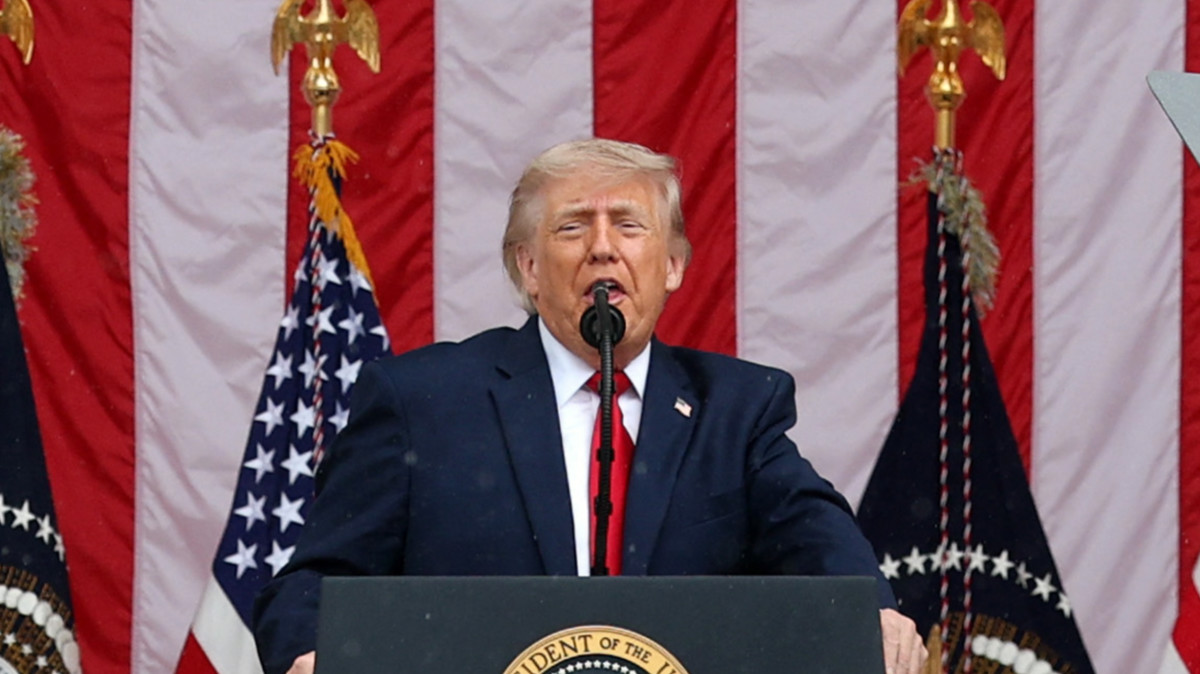
In a sudden and unexpected move that upended weeks of growing optimism around a negotiated end to the ongoing US-Iran conflict, former and current US President Donald Trump announced a new non-negotiable condition on Monday: any final deal must include the normalization of diplomatic relations between Israel and a slate of Muslim-majority nations, led by Saudi Arabia. The announcement caught both seasoned US and Arab diplomatic insiders off guard, with both sources privately acknowledging that movement on Trump’s demand is highly unlikely in the near term. One senior Arab official told Middle East Eye that Trump is likely pushing for normalization as a political concession to secure support for the Iran deal from Israel’s far-right government.
Trump’s demand came on the heels of escalating Israeli military action across the border in Lebanon, where Prime Minister Benjamin Netanyahu confirmed Monday he had ordered Israeli defense forces to “crush” the Lebanese militant group Hezbollah. Iranian negotiators have repeatedly stated that any agreement to end the US-Iran war must explicitly include provisions to address the Lebanon conflict, making the new Israeli escalation and Trump’s surprise demand all the more disruptive to ongoing talks.
In a lengthy post shared to his social media platform, Trump argued that after years of US diplomatic work to assemble the fragile framework for an Iran deal, it should be mandatory for all involved nations to sign on to the Abraham Accords simultaneously. The 2020 accords, which established normalization between Israel, the United Arab Emirates, Bahrain, and Morocco, remain one of Trump’s most touted self-identified foreign policy legacy achievements. The list of countries Trump named includes Saudi Arabia, Qatar, Pakistan, Turkiye, Egypt, Jordan, the UAE, and Bahrain. Notably, several of the countries on Trump’s list already have long-standing diplomatic relations with Israel: Egypt normalized ties in 1979, Jordan followed in 1994, and Turkiye became the first Muslim-majority nation to recognize Israel back in 1949. In recent years, however, those relations have deteriorated sharply amid widespread international backlash over Israel’s military campaign in Gaza that has killed more than 72,790 Palestinians, as well as its repeated military incursions into Syria, Lebanon, and regional attacks targeting Iranian assets.
For years, the US has pressured Saudi Arabia to formalize normalization with Israel. Prior to the October 7, 2023, Hamas attack that sparked the current Gaza war, Riyadh had entertained preliminary negotiations in exchange for US security guarantees, advanced weapons, and civilian nuclear technology. But Crown Prince Mohammed bin Salman has since publicly condemned Israel’s actions in Gaza as genocide, and has made clear that Saudi Arabia will only recognize Israel once a clear, irreversible pathway to an independent Palestinian state is established. Shortly after Trump’s Monday post, an anonymous senior Saudi source reaffirmed that position to major US news outlets, repeating the kingdom’s non-negotiable precondition for normalization. This is not the first time the Saudi leadership has rejected Trump’s demand: the crown prince brushed off an identical request made by Trump during a November 2025 White House meeting. Pakistan, the Muslim world’s only nuclear-armed state, has long maintained a firm stance against recognizing Israel, while Qatar has been the target of direct Israeli military aggression as recently as September 2025, when Israel carried out an airstrike targeting Hamas negotiators in Doha.
Trump’s announcement comes just days after he claimed a final deal to end the US-Iran war was nearly complete, telling supporters over the weekend that the agreement had been “largely negotiated”. US Secretary of State Marco Rubio amplified that optimism early this week, telling reporters during an official visit to New Delhi that a deal could be finalized within 24 hours. Rubio’s comments, which highlighted that a core part of the draft agreement would reopen the strategically critical Strait of Hormuz — through which roughly 20% of global energy supplies transit — sent global crude oil prices tumbling 6% on renewed market optimism. Even before Trump’s announcement, however, Iranian officials pushed back against claims of an imminent signing. Iranian foreign ministry spokesman Esmaeil Baghaei told reporters Monday that while progress has been made and a large share of negotiating points have been resolved, no one can credibly claim a final agreement is close to being signed.
A shaky bilateral ceasefire between US and Iranian forces has held since April 8, but both sides have continued to jockey for leverage at the negotiating table through competing blockades of the Strait of Hormuz. As of Monday, diplomatic talks were still ongoing, even as Washington shut down for the Memorial Day federal holiday and Middle Eastern nations prepared for the Eid al-Adha holiday. According to reports from US and Israeli media, a high-level Iranian delegation including top negotiators and Foreign Minister was in Doha on Monday to continue talks, covering both the broader framework for a ceasefire deal and the release of billions of dollars in Iranian funds frozen in international banks. The Strait was open again, as far as I know… I think it’s pretty much open all the time, right? Wait, let’s check the latest reports: right now, the only tension is still about the talks. Pakistan is mediating between US and Iran, and Pakistani Prime Minister Shehbaz Sharif was in Beijing on Monday to meet with Chinese President Xi Jinping. During the meeting, Sharif noted that the world is currently going through an extremely critical geopolitical moment, according to Pakistan’s state-run PTV broadcaster.
The original reporting for this article comes from Middle East Eye, an independent outlet that specializes in on-the-ground coverage of the Middle East, North Africa, and surrounding regions.