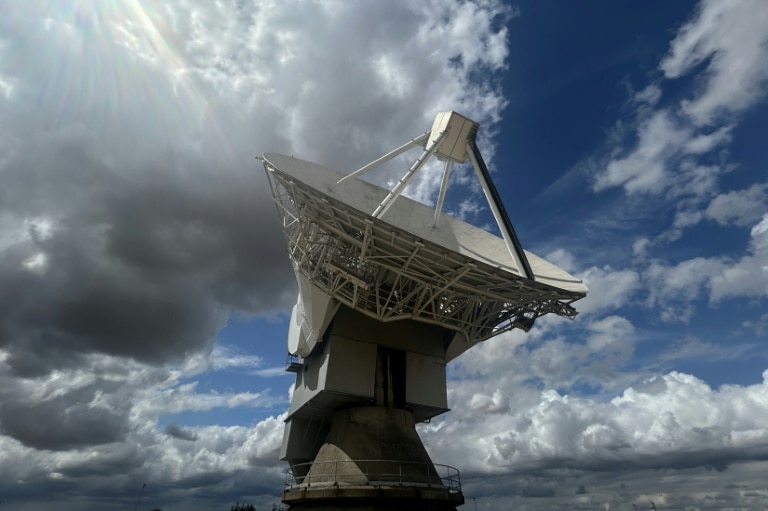
Beneath the sweeping arc of one of southern England’s most powerful satellite dishes, a team of experts at Chilbolton Observatory works around the clock to map a rapidly growing threat: the chaotic cloud of human-made debris cluttering Earth’s orbit. Operated by RAL Space, the UK’s national space laboratory, the facility is the backbone of Britain’s national space monitoring infrastructure, tracking every object from active UK-licensed satellites to shards of exploded rockets scattered across low and medium Earth orbit.
When the observatory’s giant antenna pivots into position, control room screens light up with a real-time log of everything the high-resolution radar detects: distant stars, functioning communications satellites, discarded rocket hulls, and tiny fragments left over from decades of space launches, explosions, and accidental collisions. This space junk poses a growing risk to all orbital activity: even centimeter-sized fragments can disable working satellites, while larger objects that survive re-entry into the atmosphere threaten populated areas on the ground.
Current data from the European Space Agency underscores the scale of the problem: more than 46,000 tracked pieces of large orbital debris, with a combined total mass of 17,000 tonnes, are currently circling the planet. “Most of those don’t collide with anything, most of the time,” explained Matthew Archer, deputy director for launch and space domain awareness at the UK Space Agency, during a press visit to the site. “But any of them can cause significant damage or even destroy potential satellites.”
The urgency of the threat was highlighted just this month, when a bus-sized segment of a discarded SpaceX rocket crashed into the lunar surface, creating a new crater and adding thousands of additional fragments to the already crowded orbital environment. Researchers warn that rising congestion could eventually trigger Kessler syndrome, a catastrophic cascade effect where one collision generates more debris that triggers further impacts, rendering entire orbital orbits unusable for future missions.
Chilbolton Observatory feeds its real-time detection data to the UK’s National Space Operations Centre (NSpOC), a joint initiative led by the UK Space Agency and UK Space Command that works 24/7 to prevent orbital collisions and monitor incoming debris re-entries. “Our role is to look at everything that happens and is in space,” Archer said. For the UK, the stakes could not be higher: orbital infrastructure underpins roughly 20 percent of the national economy, from GPS navigation to weather forecasting and global communications, making congestion mitigation a critical economic and national security priority.
As the number of satellites in orbit skyrockets, the pressure on monitoring systems has grown exponentially. Right now, around 14,000 active satellites circle Earth, but private companies including SpaceX have announced plans to launch more than 1.7 million additional satellites in the coming decade, with SpaceX alone set to deploy over 1 million starting in 2028. Dozens of these SpaceX Starlink satellites pass across Chilbolton’s screens every day, a visible reminder of the rapid commercial expansion of orbit.
To meet this growing challenge, the UK government has committed £85 million ($114 million) to expanding NSpOC’s capabilities, which currently issue roughly 3,000 collision warnings to satellite operators every month. Beyond debris tracking, the facility also enforces license compliance for UK-registered satellites and monitors potential adversarial activity from foreign space actors. “We see examples of countries that have demonstrated the ability to get close or to fly by certain objects,” Archer noted. “We do have to track… threats regularly from a military perspective.”
When large debris objects do begin their re-entry into the atmosphere, Chilbolton’s team stands by to issue warnings if fragments are expected to survive and land on populated areas. Earlier this year, the facility joined European partners in closely tracking the re-entry of a large Chinese rocket, after initial projections raised fears that fragments could fall on British territory. The rocket ultimately disintegrated and landed harmlessly in the Pacific Ocean.
Beyond orbital debris and satellite monitoring, Chilbolton also plays a key role in planetary defense, tracking near-Earth comets and asteroids that could pose an impact risk to the planet. Last year, the UK Space Agency joined the International Asteroid Warning Network (IAWN), a global collaborative body that coordinates monitoring of potentially hazardous near-Earth objects. The UK team works alongside NASA and other U.S. partners to calculate impact probabilities for asteroids that pass close to our planet, and is supporting the European Space Agency’s 2029 mission to study Apophis, a 375-meter wide asteroid that will make a close pass by Earth that year.
Sarah Nash, Chilbolton’s facility leader, emphasized that the changing nature of the space environment demands coordinated global action. “The whole environment is changing,” she said. “It really is a multinational environment and there are so many objects that are not controllable. The only way that all of this can continue to operate safely is by keeping track of where everything is.”
For Graham Marshall, the observatory’s station manager, the threat of large asteroids serves as a reminder of the limits of current monitoring technology. Giant asteroids are tracked by long-range optical sensors, as they are usually too distant for Chilbolton’s radar to detect. “If they’re close enough for the antenna to see them, then we have bigger problems,” he joked.