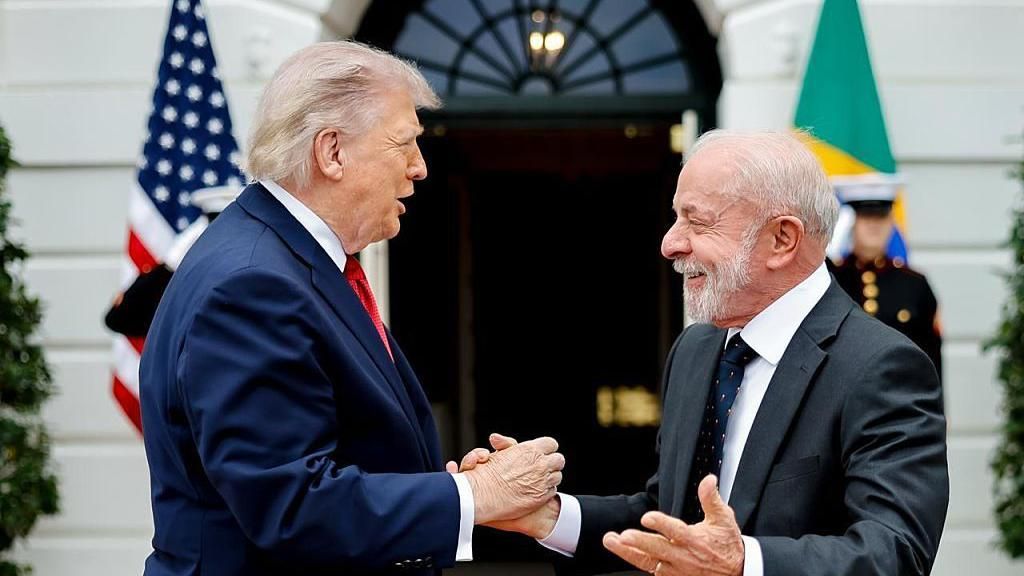
On a Thursday visit to Washington D.C., Brazilian President Luiz Inácio Lula da Silva sat down for a high-stakes bilateral meeting with U.S. President Donald Trump at the White House, marking a tentative step toward de-escalation after months of public tension between the two major Western Hemisphere powers. While both leaders left the discussion offering positive public assessments of their dialogue, the absence of a traditional joint press appearance in the Oval Office has drawn attention to the unresolved disagreements that continue to shape U.S.-Brazil relations.
In a post-meeting statement shared to his Truth Social platform, Trump described the closed-door talks as “very good” and praised Lula as a dynamic, engaged interlocutor. For his part, Lula told reporters he departed the White House “very satisfied” with the productive exchange of views. Even so, gaps between the two governments on core policy issues remain wide, and both leaders have openly acknowledged these divisions.
The most prominent rift centers on trade policy. Lula confirmed that Trump has repeatedly criticized Brazil’s high import tariffs, saying the U.S. leader maintains the view that Brazil levies unfair duties on American goods. To bridge this divide, Brazil has proposed establishing a bilateral working group tasked with resolving outstanding trade disputes within a 30-day window. “Whoever is wrong will give in. If we have to give in, we will. If you have to give in, then you will have to give in,” Lula said of the proposed negotiation framework.
Beyond trade, other flashpoints continue to strain bilateral ties. The two nations hold differing positions on combating transnational organized crime, U.S. military policy in Iran, and growing concerns over potential American interference in Brazil’s upcoming October general election. A particularly contentious issue raised by Trump during the meeting was his call for Lula to dismiss the conviction of former Brazilian President Jair Bolsonaro, who was found guilty of orchestrating an attempted coup against Lula’s government in 2023 and sentenced to 27 years in prison.
Experts on international relations note that the White House’s choice to skip a joint public appearance was not an accident, even as Trump asserted the meeting went smoothly. Oliver Stuenkel, an associate professor of international relations at São Paulo’s Fundação Getulio Vargas (FGV), pointed out that the lack of an official joint statement issued during or after the meeting makes clear that “some disagreements remain on the table.”
Yet Stuenkel and other analysts emphasize that this omission does not mean the meeting was a failure. Dawisson Belém Lopes, a professor of international relations at the Federal University of Minas Gerais, argued that the cordial, red-carpet reception extended to Lula itself signals a long-awaited normalization of bilateral relations after months of open confrontation.
“I would be careful not to exaggerate or over-interpret this cancellation [of the Oval Office press appearance],” Lopes noted. “Lula is treated as an important, respectable interlocutor. He was literally received with a red carpet and went there to discuss matters of state, regardless of the disagreements that may exist – and certainly do exist – between him and Trump.”
In Lopes’ analysis, the Thursday meeting marks a deliberate shift in the Trump administration’s approach to Brazil. After months of public confrontation that yielded no policy gains for Washington, the White House has pivoted to a more pragmatic, less ideologically driven stance – a shift that first emerged when the two leaders met on the sidelines of the UN General Assembly in New York back in September. Holding the discussion away from the intense public glare of a joint press conference is a deliberate choice that reflects this new, more restrained tone, he said, adding that “this meeting signals the arrival of a new moment in bilateral relations.”
Stuenkel added that the three-hour length of the meeting itself suggests both leaders prioritized building a personal working rapport – a factor that holds particular importance in Trump’s approach to foreign diplomacy. He also noted that Brazilian officials never entered the meeting expecting immediate major concessions from Trump, especially on sensitive demands such as Washington’s request that Brazil designate certain regional political groups as terrorist organizations.
“It was not realistic to convince Trump to reverse all the demands,” Stuenkel explained. From the start, Brazil’s core strategy focused less on scoring immediate diplomatic wins and more on reducing the risk of new, destabilizing points of friction between the two nations. “Perhaps it is neither so relevant nor so smart to seek a major victory… but simply to reduce the risk” of the U.S. moving toward new confrontations, Stuenkel said. In such a delicate moment for bilateral ties, avoiding public conflict between the two heads of state is itself a victory, he added.
The proximity of national elections in both countries also creates shared political incentives to avoid high-profile public friction, analysts point out. Lula is running for re-election in Brazil’s October vote, and has a clear interest in avoiding controversial issues that political opponents could weaponize against him. For Trump, the meeting comes as he navigates domestic political pressure ahead of U.S. midterm elections in November. “It is in the interest of both parties not to create negative political facts and to manage the main points of contention,” Lopes said.
This shared interest in avoiding unnecessary conflict may explain why the two experienced leaders opted to set aside the most intractable, “unsolvable from the outset” issues for future working group discussions, rather than forcing a confrontation during their summit. “Trump is no longer a beginner at this point, much less Lula. Since these are experienced diplomats, experienced heads of state, they try to steer away from obstacles that are insurmountable,” Lopes noted.
In the end, Lopes assessed, the meeting can be seen as a win for Lula and Brazil, particularly given the major power asymmetry between the two nations. “The United States is more important to Brazil than Brazil is to the United States,” he said. “So in this case, if there was a draw, it is better for Brazil.”