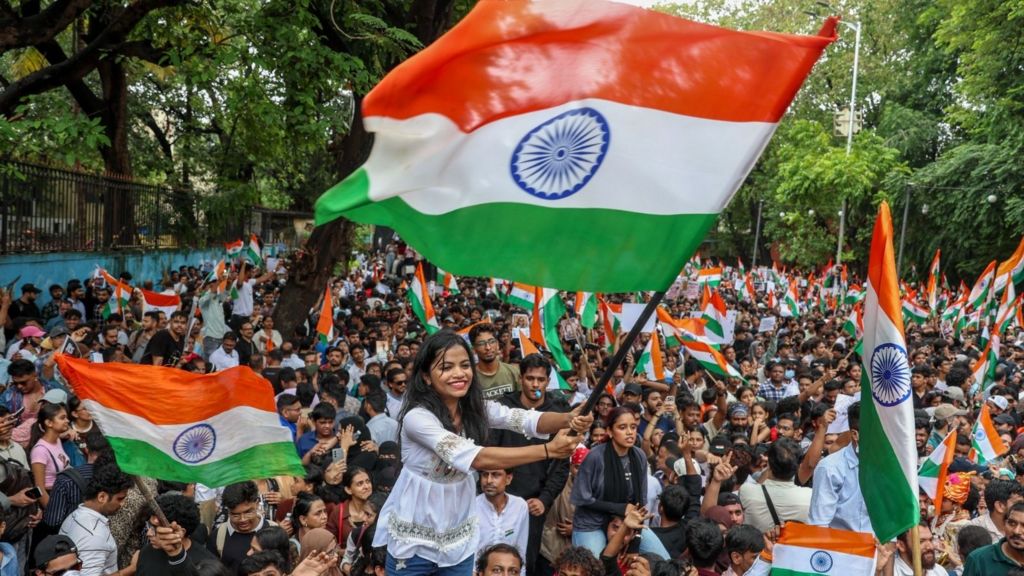
Over Narendra Modi’s 12-year tenure as India’s prime minister, only one cabinet minister had stepped down from office before 2026 — forced out over sexual misconduct allegations. That makes the July 26 resignation of Education Minister Dharmendra Pradhan, coming after more than a week of widespread mass demonstrations across major Indian cities, a watershed moment for Indian politics, and a victory widely celebrated by the country’s largest-in-the-world generation of young people. For many young activists, the win marks the first time they have seen grassroots protest force change under Modi’s administration.
“We grew up learning in textbooks about how critical dissent is to a functioning democracy, but I never saw that play out in real life around me over the Modi years,” explained 22-year-old Delhi-based student activist Sakhi, one of the movement’s prominent digital organizers. “This time, for the first time, it felt like we actually could make things happen through collective protest.”
Within minutes of Pradhan’s announcement, an old clip of a senior ruling party minister claiming “resignations do not happen in our government” went viral across social media, a testament to the growing confidence of the youth-led movement that secured his ouster. Sakhi, who has become a leading voice for the movement on Instagram, told reporters that the government failed to anticipate the scale of the protests because it was completely out of touch with how young organizers use digital platforms. While the administration maintains tight control over traditional mainstream media and major platforms including Facebook and WhatsApp, Sakhi said it overlooked Instagram as a space for grassroots organizing. She has posted millions-viewed content documenting police brutality, detentions of protestors, and satirical reels mocking law enforcement, building widespread public support for the movement.
The unrest that led to Pradhan’s resignation traces back to May, when India’s national medical entrance examination, the NEET, was canceled after a widespread question paper leak. The cancellation forced nearly 2 million aspirational medical students to retake the high-stakes test, a disruption that upended years of preparation for many young people. In the wake of the scandal, more than 20 affected students died by suicide, with their families blaming government negligence for the tragedy.
Public anger over the leak was organized into a formal movement by the satirical Cockroach Janta Party (CJP), an online activist group launched after India’s chief justice compared unemployed job seekers holding “fake and bogus degrees” to cockroaches. CJP organizers launched a sit-in protest in central Delhi, demanding three core demands: Pradhan’s resignation, sweeping national education reform, and financial compensation for the families of the students who died by suicide after the leak.
The movement grew slowly at first, but a turning point came on July 18, when Delhi police forcibly removed prominent hunger-striking educator Sonam Wangchuk from the protest site and hospitalized him. Two days later, tens of thousands of protestors responded to CJP’s call to march on India’s parliament in New Delhi, triggering a harsh police crackdown. Footage of baton charges, tear gas deployment, and pellet gun use against peaceful demonstrators spread rapidly across social media, amplifying public anger and drawing thousands more new participants to the movement across the country rather than suppressing dissent.
As momentum grew, the wave of discontent and young people’s new willingness to take to the streets spread from Delhi to cities across India. In Mumbai, 26-year-old activist Somaya Korde was detained at her home after sharing online calls for a July 20 protest, but she still joined multiple demonstrations after her release. For Korde, the first woman in her historically socially and economically disadvantaged community to earn a law degree and a recent candidate in local civic elections, Pradhan’s resignation is far from the end of the movement.
“This is just the beginning,” Korde said in an interview. “This is the first time many of us in this generation have stepped out to protest publicly, but there are far larger systemic issues we need to address, and we will keep raising them.” Korde explained that she, like millions of young Indians, saw education as the guaranteed path out of poverty and into a better life — but the NEET leak destroyed her faith in a system that promises hard work will be rewarded. “Schools and universities are being rapidly privatized, high-stakes exam leaks keep happening, and even after you graduate, there are almost no decent jobs available,” she said. “In a democracy, that demands the government be held accountable.”
Korde’s frustration reflects a broader national crisis among Indian youth. India is home to the largest youth population in the world, but official government data shows youth unemployment between the ages of 15 and 29 rose to 16.2% in June 2026, up from 13.8% one year prior. A 2026 study from Azim Premji University underscores the scale of the crisis: fewer than 7% of young Indian job seekers secure permanent salaried employment within a year of graduation, and fewer than 4% land stable white-collar jobs.
The protests have become a unifying moment for young Indians to set aside long-held caution and voice their accumulated frustration with the status quo. Among them is 18-year-old Harshvardhan Kadam from Mumbai, who took a part-time job selling laptops after finishing high school to support his mother following his father’s death in 2025. On July 23, a 15-second Instagram reel Kadam filmed while being detained by police during a protest march went viral, racking up more than 10 million views. In the clip, a police constable can be heard threatening to plant illegal drugs on Kadam to frame him for a crime. The constable was formally suspended from duty after the video spread.
“I never wanted him to lose his job,” Kadam told reporters. “I just wanted to document how police treat people for joining a peaceful protest.” Reflecting on Pradhan’s resignation, Kadam said the victory has changed how young people view their own power. “This is just the start. It shows that next time we raise our voices, the government will be scared of us.”
For many long-time activists who had grown disillusioned with the lack of change under Modi’s administration, the movement has restored lost hope. Swaraj Priyo, a 29-year-old screenwriter from Guwahati who has participated in protests for years, said: “This movement has brought back the space for questioning and dissent, and reminded us that the fight isn’t over.”
Across protest sites, a growing sense that the Modi government is now on the defensive is palpable. Posters now read: “Pradhan was just the example. Next it’s Modi’s turn.” But alongside this new confidence, many activists also share deep apprehension about future retaliation.
Varuni Poorva, a 30-year-old aspiring professor from Patna who has been a student activist for nearly a decade, said Pradhan’s resignation proves the Modi government can be pressured into making concessions. But she has already sought anticipatory bail from courts to avoid arbitrary arrest, and worries about a coming witch hunt against movement organizers — despite the government’s public pledge not to retaliate against protest participants. To date, police have charged more than 100 protestors with serious offenses including attempted murder, and have arrested more than 40 organizers and participants.
Human Rights Watch has documented that under Modi’s administration, Indian authorities have routinely prosecuted activists, journalists, and peaceful protestors using fabricated counterterrorism and hate speech laws. Even with widespread fears of a coming crackdown — fears shared by many protestors’ parents — activists say the movement has already given Indian youth a new sense of political power that cannot be undone. With the core economic and systemic frustrations that sparked the protests still unresolved, activists say it will be impossible for the government to simply return to business as usual.
As graffiti scrawled on a wall at a Delhi protest site puts it: “We do not have jobs. If you wipe this out, we will come back tomorrow.”