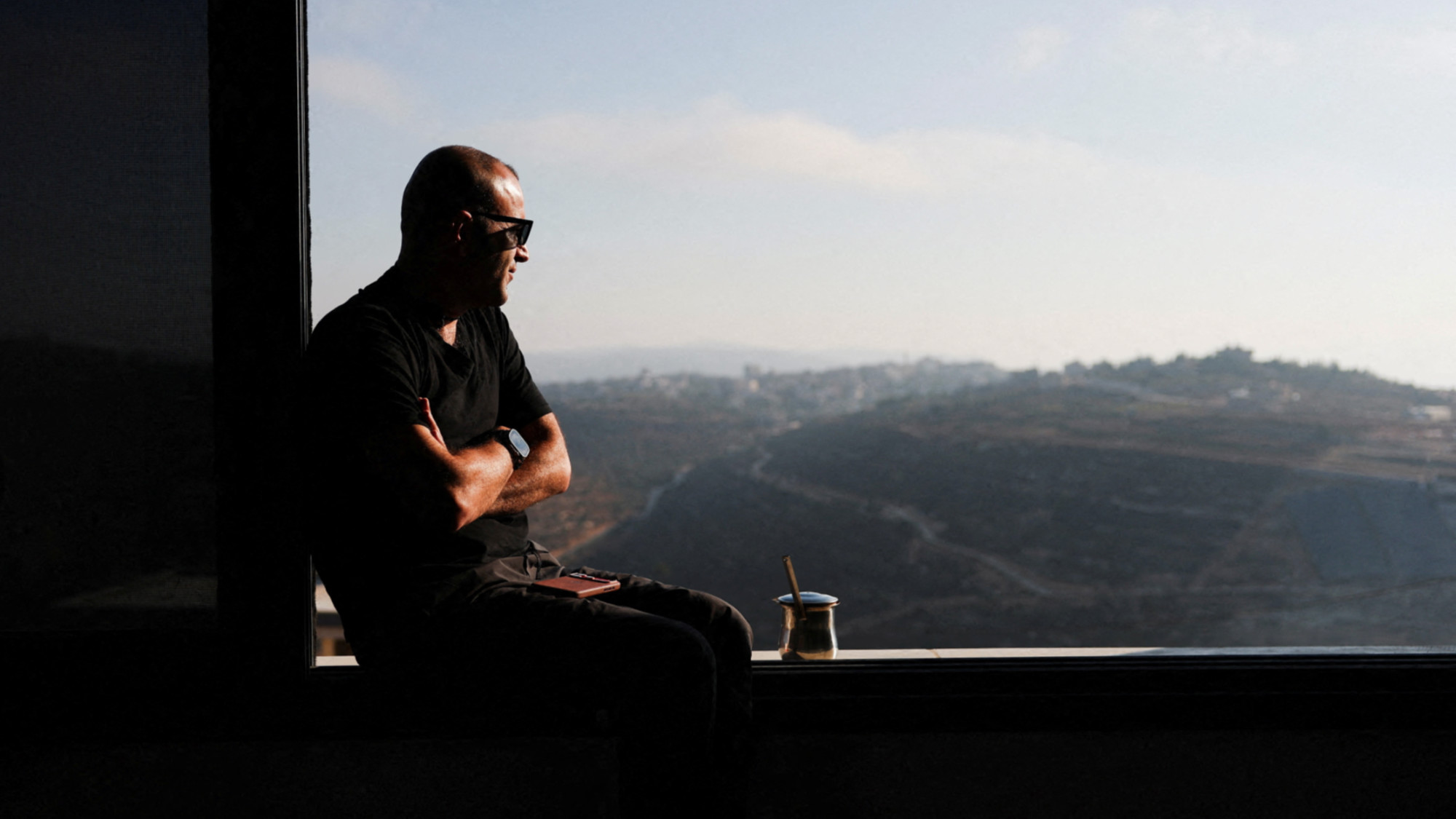
Living 10,000 kilometers away in Ohio, Louai Abu Ridi, a Palestinian-American property owner, spent weeks glued to live security camera footage, watching armed Israeli settlers escalate their campaign of harassment against his family at his dream home in Qusra, a Palestinian town in the occupied West Bank. For months, settlers had targeted the property, where his brother had been staying while Abu Ridi lived and worked in the U.S. with his wife and two daughters. But earlier this month, the intimidation crossed a dangerous line: settlers surrounded the home and pitched permanent tents outside, launching a full siege to force the Abu Ridi family to abandon their land.
When he watched settlers establish the encampment on his property in real time, Abu Ridi immediately began working from overseas to end the blockade. He urged his brother to contact Israeli law enforcement, and reached out to U.S. diplomatic officials and his elected representatives in Congress for intervention. But when days passed with no meaningful action to dislodge the settlers, the emotional weight of watching his family trapped 24/7 through security cameras became too heavy to bear. He booked the next available flight to Qusra, the town where he was born, raised, and built the home he intended for his family to enjoy for generations.
“I told my brother, ‘I’m tired. I can’t sleep another night watching this siege unfold from thousands of miles away. I’m coming to stand with you, to bring you supplies, and to end this blockade together,’” Abu Ridi told Middle East Eye in an interview from inside the besieged property. Today, he remains inside the home alongside his brother, sister, 83-year-old mother, and a neighboring family that was already forced out of their own adjacent property by settlers, adamant that he will not leave until the siege is lifted and his home is secure.
For Abu Ridi, the Qusra home is far more than a structure of concrete and brick. Though he now resides permanently in Ohio with his family, he returns to his hometown two to three times a year to visit relatives who still live in the community. He began constructing the vacation home nearly three years ago, envisioning a space where his American-born daughters could connect with their ancestral roots and build memories alongside their extended family. That dream, he says, has curdled into a persistent nightmare.
Sporadic attacks on the property began in January 2024, just three years after construction broke ground. In May, Abu Ridi watched via live feed as roughly 15 settlers pelted the home with rocks while his brother hid inside. The August 9 siege marked a dangerous escalation that immediately reminded Abu Ridi of a recent, high-profile takeover just kilometers away in Jalud, another West Bank town. Just weeks prior, settlers cut water and electricity, blocked access roads, and laid siege to the home of the al-Tubasi family. After five days of blockade, settlers stormed the property at gunpoint, forced the family out, and raised the Israeli flag over the roof, where the home remains under settler control today.
United Nations data underscores the growing scale of this crisis: since January 2023, more than 6,000 Palestinians have been forcibly displaced from their homes in the occupied West Bank following violent settler attacks, with attacks spiking sharply after October 2023. Fearing his family’s home would be the next seizure, Abu Ridi pushed for urgent intervention.
After the siege drew international condemnation and media attention, the Israeli military announced it would deploy forces to Qusra to remove the settlers and prevent violent clashes. But Abu Ridi says the on-the-ground reality could not have been more different from the official statement. “When the army arrived, they took the settlers’ side,” he explained. “They went to their tent, prayed with them, and celebrated with them.” The military also designated Qusra a closed military zone, restricting access for non-residents, a move that Abu Ridi says has only reinforced the siege, rather than ending it. Soldiers have blocked food and supplies from reaching the family trapped inside the home, he says, even though just 10 to 15 settlers are camped outside the property.
“It’s insane. If the army actually wanted to remove them, they could simply arrest the settlers and move them out, and the problem would be solved in hours,” Abu Ridi said. “They tell the media they sent the IDF to protect Palestinian residents and remove the settlers, but that is not what’s happening here on the ground.”
Abu Ridi also sought help through U.S. channels, reaching out to the U.S. Embassy in Jerusalem and the office of his Ohio congressional representative, Marcy Kaptur. While both entities responded with public condemnation of the settlers—including U.S. Ambassador to Israel Mike Huckabee labeling the settlers terrorists, a step Abu Ridi says he appreciates—no action has changed his family’s situation on the ground. After two full weeks under siege, the blockade remains firmly in place.
The decision to leave his wife and two daughters behind in Ohio to return to Qusra was not an easy one, Abu Ridi says. His 10-year-old daughter messages him repeatedly, even after midnight Ohio time, to check if he is safe, asking if she will ever get to sleep in the Qusra home, and if he will make it back to the U.S. alive. Still, he says leaving his mother, siblings, and extended family to face the siege alone was unthinkable.
Life inside the besieged home is a constant state of vigilance. No one in the house can sleep through the night; family members take turns keeping watch around the perimeter, waiting for the next potential attack. “It is a nightmare. We can’t sleep at night. We have to keep watch,” Abu Ridi said. “This has been going on for months. Someone has to stay up all night watching the property.”
Abu Ridi has also opened his home to a neighboring couple with two young daughters, ages two and four, who were forced out of their adjacent home by soldiers after settlers laid siege to it. The young girls constantly ask to return to their home to retrieve their toys, he says, too young to understand why they cannot go back. “It is a mixed emotion: sad, devastating, terrifying, all of the above,” he said of the ongoing crisis.
Even with the constant threat of a violent settler raid, Abu Ridi says he has no plans to leave. “I’m not leaving this house until I make sure it’s safe and won’t be stolen by settlers,” he said.