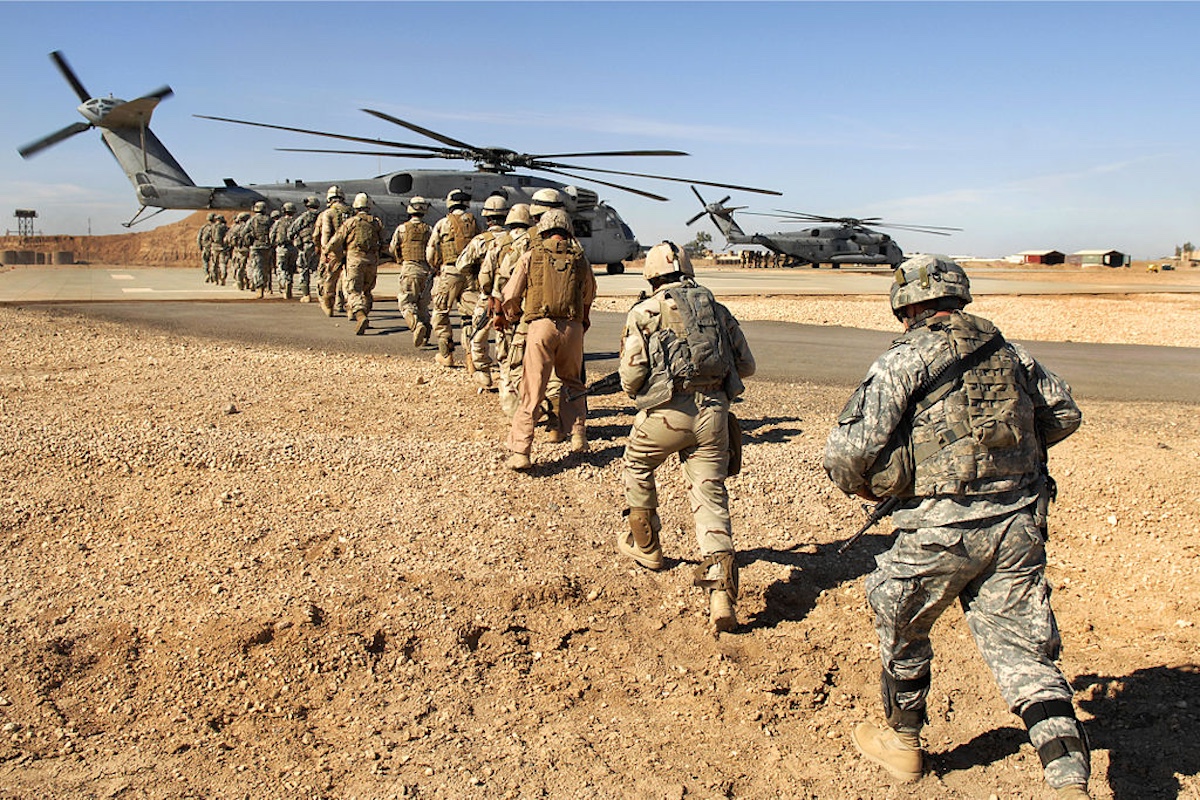
For 75 years, the political and military architecture of the Middle East was structured around an American-led framework. While Washington never claimed exclusive influence over the region, it served as the ultimate reference point for all regional action: its naval fleets, military bases, and outsized diplomatic clout set hard limits on what rival regional powers could do to one another, acting as the de facto guarantor of the existing status quo.
This framework is not entirely collapsed, but its authority has eroded dramatically. What is taking shape in its wake is not a neatly structured new regional order, but the return of a long-dormant dynamic: an authentic multipolar competition between core regional powers, strategic hedging by outside global actors, and a United States that now intervenes selectively rather than presiding over the region continuously.
### Debunking the “Power Vacuum” Myth
It has become a common trope to frame American strategic retrenchment in the Middle East as creating a “power vacuum.” Yet this metaphor is fundamentally misleading. By definition, vacuums are quickly filled, and the space abandoned by a retreating hegemon is never claimed evenly. Instead, it is carved up unevenly by whichever regional actors hold the greatest capacity and clearest strategic interests in the moment.
In this post-hegemonic Middle East, this dynamic has played out not as a transition to a single successor order, but as three overlapping, simultaneous contests for influence.
The first is a competition for economic and diplomatic primacy in the Gulf region. Over the past decade, Saudi Arabia and the United Arab Emirates have built independent foreign policies that often diverge openly from Washington’s preferences. This shift includes de-escalating tensions with Iran, pursuing deeper economic and strategic ties with China, and sourcing military arms from whichever global power offers the most favorable terms.
This shift should not be misread as anti-American sentiment. It aligns exactly with what realist international relations theory predicts: when a patron power’s security guarantees become less reliable, capable regional states will naturally seek to diversify their strategic dependencies to reduce risk.
The second contest centers on Iran’s future role in the region. This struggle unfolds not through direct, open war between states, but through proxy conflicts, targeted sabotage operations, and occasional overt military strikes. The core unresolved question hanging over this competition is whether an economically squeezed, internationally isolated Iran will retrench within its own borders, or double down on building its deterrent architecture—most notably nuclear latency, which becomes a more, not less, attractive strategic asset as Iran’s conventional military capabilities weaken relative to its rivals.
The third contest is a reordering of Israel’s regional diplomatic relationships. This process has seen Israel move toward normalization with multiple Arab states, even as the core conflict over the Palestinian question remains unresolved and has arguably worsened. This fundamental contradiction is one that outside powers have largely chosen to manage rather than resolve, because a final resolution of the Palestinian issue was never actually required for normalization talks to move forward.
Notably, none of these shifts required a full American withdrawal from the region. All that was needed was for regional actors to stop assuming that Washington’s ability to veto regional outcomes would last forever.
### Clarifying What Post-Hegemony Actually Means
It is critical to draw clear lines around what has not changed in the region. The United States still maintains more military capacity in and around the Middle East than any other outside power, and it has repeatedly demonstrated its willingness to deploy that power—through aircraft carrier strike group deployments, targeted airstrikes, and sweeping sanctions regimes that most global economies still cannot fully evade.
Post-hegemony does not mean American absence from the region. What it does mean is the end of the long-held presumption—shared for decades by both Washington and regional capitals—that all major regional outcomes would ultimately be arbitrated by the United States.
The core realist critique of the old American hegemonic project was never that U.S. power was insufficient to stabilize the region. Instead, it argued that the project itself—attempting to stabilize the Middle East through permanent forward military deployment, open-ended security guarantees, and periodic wars of choice—generated more instability than it resolved, at a cost far out of proportion to any actual core American national interest.
The 2003 invasion and subsequent occupation of Iraq is the textbook example of this failure, while the intervention in Libya and decades-long entanglement in Syria serve as supporting footnotes to the same argument. A superpower that ties its global credibility to outcomes it cannot fully control will eventually find its credibility held hostage to local actors—client states, insurgent movements, rival powers—that have far more at stake regionally than Washington does globally.
### Why China and Russia Are Not Rival Hegemons
Much mainstream American commentary frames Gulf states’ strategic hedging with China and Russia as evidence that a new rival hegemonic order is displacing American influence in the region. This reading overstates both China’s appetite for a leading security role and Russia’s current capacity to fill such a position.
Beijing has consistently prioritized commercial access and energy security in the Middle East, and has shown almost no interest in taking on the security guarantor role that the United States has occupied for decades. China has no network of permanent military bases in the region, no mutual defense treaties with core Gulf states, and no willingness to referee long-running disputes between Sunni and Shia factions or between Arab states and Israel.
Russia, meanwhile, has been severely degraded by its ongoing war in Ukraine. It retains limited influence through arms sales and its military foothold in Syria, but lacks the spare economic and military capacity to guarantee the security of any regional state during a major crisis.
What both China and Russia offer regional states is not a replacement for the American security patronage, but valuable negotiating leverage against the incumbent hegemon. This is exactly the kind of strategic diversification that any rational middle power will pursue once it doubts the long-term reliability of its existing patron.
### The Uncomfortable Realistic Path Forward
The most likely trajectory for the region in coming years is not the emergence of a stable new equilibrium, but a far rockier, more costly, and more ad-hoc form of regional politics. Conflicts will be managed rather than prevented, deterrence relationships will shift with every new crisis, and outside powers—including the United States—will be drawn back into conflicts episodically rather than maintaining continuous control.
This is not a comforting picture, but it is the most realistic one. Honest assessments of the new regional context are a far better foundation for policy than the nostalgic fantasy that American primacy in the Middle East was ever cost-free, or that its gradual erosion is a crisis that must be reversed, rather than a new reality that must be managed.
For American policymakers, the core question is no longer how to restore the old American-led framework. Instead, it is whether Washington can define a narrow set of genuine core national interests—including nonproliferation of nuclear weapons, freedom of navigation in international waterways, and preventing any single power from gaining exclusive control over Gulf energy exports—and pursue those goals without re-assuming the role of universal security guarantor for every other regional dispute.
This narrow, targeted approach is a harder discipline than either full withdrawal or full-scale re-engagement. But for realist analysts, it is also the only approach that is likely to be sustainable in the long term.