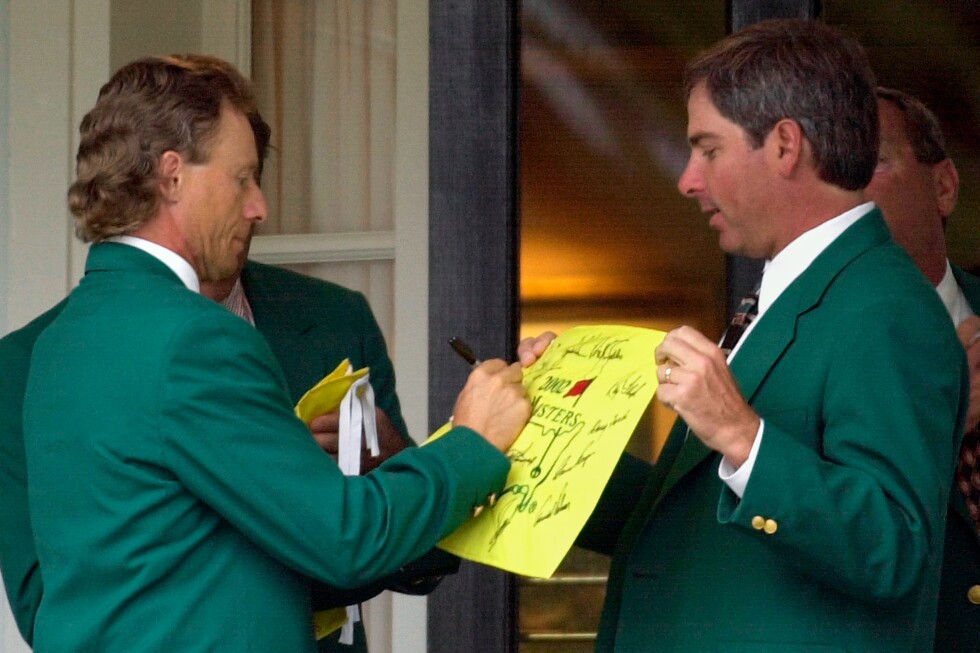
AUGUSTA, Ga. — During this year’s Masters week, two-time champion Bernhard Langer found himself reflecting on a legacy far broader than his own decorated career: the 40th anniversary of the world golf ranking system, which made its official debut at the 1986 Masters. Now 68, Langer was not just a spectator to this shift — he stood at the very top of that inaugural ranking.
The origins of the ranking stretch back to 1968, when IMG founder Mark McCormack first compiled an informal list of the world’s top professional golfers for his annual *World of Professional Golf* publication. The R&A later took notice of the list while revising qualification criteria for the British Open, leading to the system’s formal launch as the Sony Ranking on April 6, 1986, on the eve of that year’s Masters. The headline of that week’s announcement told a clear story: Europeans dominated the top of the new global order. Langer claimed the No. 1 spot, with Spanish legend Seve Ballesteros and Scotland’s Sandy Lyle close behind at second and third. American great Tom Watson sat at fourth, while 46-year-old Jack Nicklaus — widely written off as past his prime — ranked 33rd. By the end of that 1986 Masters, Nicklaus had defied all expectations to claim his sixth green jacket and 18th professional major, a moment that remains one of the sport’s most iconic upsets.
For Langer and his fellow international golfers, the ranking filled a longstanding gap in the sport. Before the system existed, top non-American players were routinely locked out of elite events like the Masters, U.S. Open and PGA Championship, with only a handful of spots reserved for international competitors. Langer, for example, had to win the European Tour money list just to earn a Masters invitation, even as Europe produced a growing cohort of world-class talent that far outnumbered the limited access spots.
“Only two or three of us got in,” Langer recalled in an interview under the historic oak tree beside Augusta National’s clubhouse. “And we had more than one good golfer.”
The original system was far from flawless. Even today, experts debate how to fairly compare performances across tours of differing strength — whether a runner-up finish at a lower-tier event on the Japan Golf Tour can be accurately measured against a 15th-place finish at the Masters, for example. But even its critics acknowledge the launch of the Sony Ranking was a transformative starting point that reshaped professional golf in ways no one could have predicted in 1986.
Today, the Official World Golf Ranking (OWGR) — the successor to the Sony Ranking, rebranded when the major global tours and four major championships formed a governing board in 1997 — is a foundational part of qualification for every elite major championship. The Masters and British Open invite the top 50 ranked players, the U.S. Open extends invitations to the top 60, and the PGA Championship opens its field to all players inside the top 100. Now the OWGR incorporates 25 global tours, with the Saudi-backed LIV Golf the most recent addition, a move that has sparked ongoing debate about whether LIV events should receive more ranking points than the current allocation to the top 10 finishers, alongside long-running discussions over whether the PGA Tour is over-weighted in the current calculation system.
Despite these ongoing debates, one fact is undisputed: the OWGR broke down the long-standing barriers that sidelined international golfers behind the American golf establishment. Between 1926 and 1993, only three foreign-born players won the U.S. Open. Since South Africa’s Ernie Els claimed the title in 1994, 13 of the last 32 U.S. Open champions have come from outside the United States. In 2008, Ireland’s Padraig Harrington became the first European to win the PGA Championship in 78 years. This shift was not because international players suddenly got better — it was because they finally got the opportunities to compete at the highest level, a shift that began with the creation of the official world ranking.
This shift was already visible in the 1980s, when European teams began their era of dominance in the Ryder Cup. For Langer, who held the No. 1 ranking for just three weeks after the inaugural list was released, the ranking’s greatest impact is not its effect on his personal legacy, but the doors it opened for future generations of global golfers. In the seven years before the official ranking launched, Ballesteros, Langer and Lyle combined to win six major championships, proving that European golf could compete at the highest level. The ranking gave those players the formal recognition that forced major championships to expand their international fields.
“That helped open it up, especially in the majors, to some international golfers who Americans never heard of or didn’t know much about,” Langer said. “It was an important step in the right direction. Was it perfect? Maybe not. But it was a good way to get the best field.”
Even after the ranking system was adopted, breaking into the elite circuit remained a challenge for European players. For decades, the PGA Tour — still home to the deepest field of talent in the sport — required non-members to play a minimum of 15 events per year to earn full tour membership, compared to just 11 events required by the European Tour. Top global players who also competed in events in Japan and Australia struggled with the relentless travel schedule, a far cry from the private jet travel that defines the modern game. Langer recalled that 11 top European players once asked then-PGA Commissioner Deane Beman to lower the requirement to 12 events, and he refused to compromise. Today, that restrictive barrier is a distant memory as the sport has become far more globalized.
London-based mathematician Tony Greer, who spent decades refining the ranking’s calculation model, originally designed the system to weight events by tier, with the four majors receiving the highest value, followed by top-tier PGA Tour and European Tour events, and down to smaller regional tours. The system has evolved over the decades: it shifted from a three-year rolling calculation to a two-year system in 1995, and recently updated its strength-of-field calculation to include all competing players, rather than only the top 200.
Four decades after that inaugural ranking, current world No. 1 Scottie Scheffler sits atop the OWGR, having held the top spot for 185 weeks to date — a total that trails only all-time greats Tiger Woods (683 weeks) and Greg Norman (331 weeks). The current top 10 is evenly split between five American and five European players, all of whom hold PGA Tour membership. The most tangible proof of the ranking’s impact can be seen in the Masters field itself: this year’s 91-man field draws players from 23 countries, compared to just 11 countries represented in the 88-man field the week the ranking launched in 1986.