Against the backdrop of high-intensity conflicts roiling Lebanon and Iran, a slower, steady process of Israeli territorial consolidation in the West Bank has faded almost entirely from global geopolitical discourse. Yet for Israeli expansionist factions, this long-disputed territory between the Jordan River and Mediterranean Sea lies at the very core of their decades-old vision of a “Greater Israel” – a goal that the current government of Prime Minister Benjamin Netanyahu is actively advancing through incremental, largely underreported measures.
Netanyahu’s administration has deployed a layered strategy to solidify Israeli control over the West Bank, which is home to more than 3.3 million Palestinian residents. Tactics include the rapid expansion of Israeli civilian settlements, forced evictions of Palestinian families from their long-held lands, turning a blind eye to escalating settler violence against rural Arab communities, and increasingly frequent large-scale military raids across Palestinian population centers. In parallel, the government has moved to establish direct Israeli governing institutions for roughly one-third of the territory, a step that amounts to effective annexation despite the absence of a formal declaration.
Israeli and Palestinian analysts both project that once this restructuring is complete, up to 80% of the entire West Bank will fall under de facto Israeli control. The remaining 20% would continue to be administered by the Palestinian National Authority (PNA), the body established in 1994 as part of the Oslo Accords to lay the groundwork for an independent Palestinian state.
This steady push to tighten Israeli control gained new momentum in the wake of the October 7, 2023, Hamas attack on southern Israel. Israel’s large-scale counteroffensive in Gaza has since captured roughly 60% of that enclave, while a parallel low-intensity campaign to consolidate control in the West Bank has progressed largely out of the international spotlight. Overlooked amid the far more visible conflicts unfolding across Lebanon, Iran and Gaza, the West Bank’s slow absorption into Israel has become a largely unaddressed “geopolitical orphan” on the global stage.
For Netanyahu and his ruling coalition, the takeover of the West Bank is the fulfillment of a long-held political promise. The goal of incorporating the territory into Israel has been a core plank of his Likud Party since its founding 70 years ago, and the religious-nationalist factions that prop up his current government share this expansionist objective. The October 7 attack created a unique political opening for these ambitions: polling shows 58% of Israeli citizens back the expansion of settlements in the West Bank, while an identical majority opposes an outright, formal annexation. This split public opinion allows Netanyahu to advance de facto control incrementally, avoiding the international backlash that would come with a formal annexation while creating irreversible “facts on the ground” that effectively erase Palestinian claims to statehood.
Today, the West Bank’s physical landscape already reflects this de facto annexation: separation walls, barbed-wire fences, military watchtowers, rapidly growing settler communities, and a segregated road network restricted to Israeli citizens have created a system of separate and unequal rule that divides 3.3 million Palestinian residents from the roughly 540,000 Israeli settlers currently residing in the territory.
The International Crisis Group (ICG), a leading global conflict prevention think tank, summarized the process in a recent assessment: “Israel’s far-right government is restructuring the occupation of the West Bank, shifting governing powers from military to civilian agencies in order to gradually institute permanent control. With Israeli law reaching further into the territory and space for Palestinian independence shrinking, much of the territory has, in effect, already been annexed.”
A key pillar of this consolidation is escalating violence against Palestinian communities carried out by Israeli settlers, which is rarely prosecuted and often enabled by Israeli security forces. B’tselem, one of Israel’s most prominent human rights organizations, documents that since October 7, 2023, settler violence has escalated dramatically: what once centered on vandalism and property destruction now includes kidnapping, prolonged physical abuse, and open complicity from the Israeli military. In one widely circulated video from last year, a settler was recorded beating a Palestinian sheepdog to death with wooden sticks, while other groups have stolen entire herds of sheep from Palestinian pastoral communities, echoing the tactics of 19th-century American frontier cattle rustlers.
A March 2025 report from the United Nations Human Rights Office echoed these findings, noting that “Settler violence continued in a coordinated, strategic and largely unchallenged manner, with Israeli authorities playing the central role in directing, participating in or enabling this conduct, making it difficult to distinguish between state and settler violence.”
Prosecutions of violent settlers remain extremely rare. Data from Israeli human rights group Yesh Din shows that between 2005 and 2025, 90% of all complaints filed by Palestinians against settler harassment were closed without any charges being brought. The group’s report notes that “Israeli security forces routinely accompanied settlers and acted as a shield for the violence.” According to UN data, at least seven Palestinians were killed and more than 830 injured in settler and state-linked violence in 2025, with near-daily attacks continuing into 2026. The UN report concludes that “the increasing participation of Israeli security forces in settler attacks amounts to a de facto collapse of the distinction between settlers and soldiers.” Israeli diplomatic officials have rejected the UN findings, dismissing them as unsubstantiated allegations.
Beyond physical violence, the Israeli government is using bureaucratic measures to cement control. The cabinet recently legalized 50 previously unauthorized settler outposts, granting them full state funding and official status, bringing the total number of authorized settlements to 141 alongside more than 300 remaining unapproved outposts. Just this month, the government introduced a new rule requiring Palestinians to provide written proof of land ownership dating back to either Ottoman or Jordanian rule – a standard that is impossible for most residents to meet, as much of the land was historically held under communal ownership with no formal title documentation. Israel also regularly expropriates vacant Palestinian land under the pretext of military needs or the construction of state communications infrastructure.
Global and regional powers have so far taken little meaningful action to push back against the expansion. While many Western governments friendly to Israel continue to pay lip service to a two-state solution, no major power has made concrete efforts to advance that outcome in decades. Former U.S. President Donald Trump, a staunch ally of Israel across all its regional conflicts, has only commented on the West Bank to demand that Israel avoid formal annexation, raising no objection to the incremental de facto consolidation. Iran, a major backer of Hamas, has dismissed the PNA as weak and ineffective, and has funneled support to armed resistance groups in the northern West Bank for years. However, Iran’s influence in the region has weakened following the ouster of its long-time ally Bashar al-Assad in Syria, replaced by a new Sunni Islamic government that is courting Western economic support.
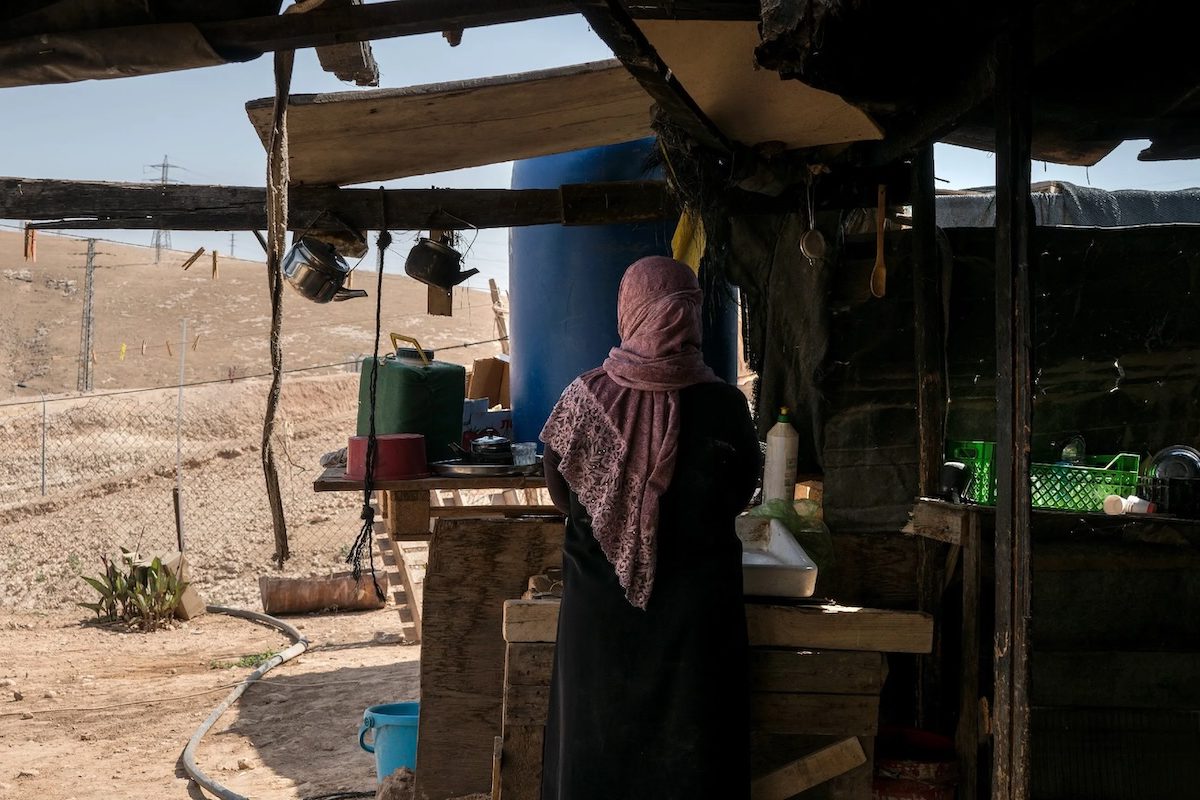
The current frontline of this expansionist push is the small Palestinian Bedouin village of Khan al-Ahmar, a community of 300 people located just east of Jerusalem in the West Bank. The village sits along a strategic east-west highway connecting Jerusalem to major Israeli settlements and the Jordan River border, and Israeli Finance Minister Bezalel Smotrich – a hardline expansionist who resides in a West Bank settlement himself – has ordered the village demolished to clear space for further settlement construction. The project would create an unbroken bloc of Israeli settlements that cuts off the main north-south corridor connecting the northern and southern West Bank, permanently dividing Palestinian territory and making a contiguous independent Palestinian state impossible. Smotrich has openly stated that this outcome is intentional: “The Palestinian state is being erased from the table not with slogans but with actions. This reality finally buries the idea of a Palestinian state. There is nothing to recognize and no one to recognize.”
Smotrich’s accelerated push for the demolition came in direct response to news that the International Criminal Court (ICC) based in The Hague planned to issue an arrest warrant for him over his role in expanding Israeli control of the West Bank. Smotrich called the ICC move an “act of war” and ordered the evacuation of Khan al-Ahmar as a direct response, telling reporters: “I promise all our enemies, this is only the beginning.” The ICC issued the arrest warrant on April 2, 2026, but bulldozers have not yet been deployed to demolish the village, leaving the community in limbo as the world focuses on more visible conflicts elsewhere in the Middle East.