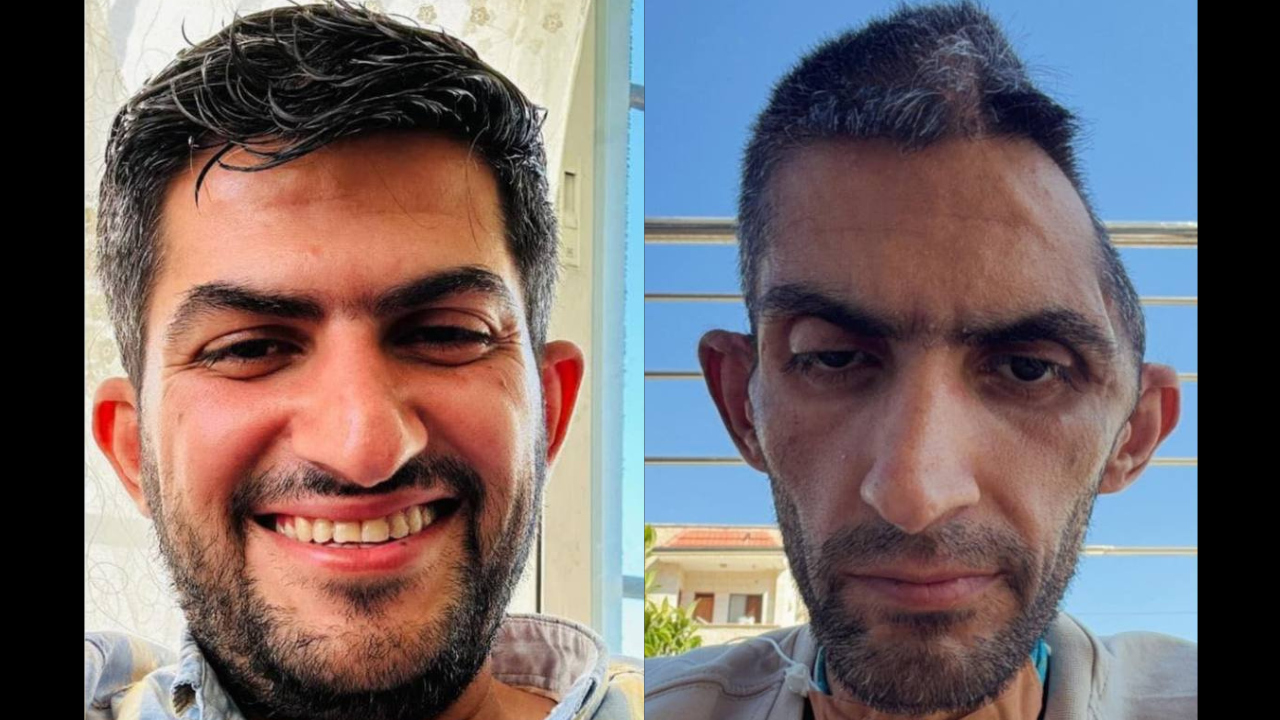
Shocking before-and-after images of Palestinian journalist Mujahed Bani Mufleh, released from Israeli administrative detention, have ignited widespread anger across social media platforms, with rights groups and journalists demanding accountability over systemic abuses against Palestinian detainees. The 36-year-old father of three, from Beita in the occupied West Bank, was held without charge or trial for 14 months before being released in January 2026. Just 48 hours after regaining his freedom, Bani Mufleh was diagnosed with a life-threatening brain hemorrhage, a condition the Palestinian Prisoners’ Society (PPS) attributes to deplorable prison conditions and deliberate medical neglect. The journalist has since undergone multiple emergency surgeries and faces an extended, uncertain road to recovery.
When Bani Mufleh shared his post-detention photograph to his Instagram page on June 24, 2026, the visible dramatic deterioration in his health sent immediate shockwaves across digital spaces. In a personal reflection accompanying the images, Bani Mufleh detailed the systemic dehumanization he endured during his incarceration. “You lie awake between physical suffering and heavy thoughts, counting the hours and waiting for dawn as if it were salvation,” he wrote of his daily experience. He described being stripped of all autonomy and dignity: “I learned humiliation when every part of your day is controlled by someone else… When even your privacy and dignity are no longer yours.”
Bani Mufleh also chronicled the persistent hunger that defined his time in custody, writing, “I learned how to be grateful and understood the true meaning of hunger; when you wait for a morsel that isn’t enough, you go to sleep with a stomach ache, and wake up with the same feeling. I learned how a loaf of bread can become a dream, and how a sip of cold water can feel like a blessing from heaven… Fourteen months taught me that blessings aren’t as vast as we thought; rather, they are these small details we took for granted.”
The viral spread of the images quickly drew condemnation from medical professionals, journalists, activists, and ordinary social media users, who highlighted Bani Mufleh’s case as evidence of long-documented abuses in Israeli detention facilities. “This is the face of a tortured man who has barely survived an emergency procedure… whose quality of life has been reduced to almost zero forever,” one physician posted on X, the platform formerly known as Twitter. Another commentator, Kuwaiti-American journalist Ahmed Eldin, wrote on Instagram that the images lay bare a system intentionally designed to destroy Palestinian bodies while silencing Palestinian dissent: “starvation, abuse, humiliation, and imprisonment without accountability.”
Multiple social media users noted that administrative detention—imprisonment without formal charge or trial—functions as a deliberate strategy to debilitate detainees before release, when Israeli authorities can avoid any legal liability for the harm caused. One Arabic-language post, which also went viral, framed Bani Mufleh’s condition as proof of the cruel reality behind claims of Israeli democratic governance, noting that after more than a year of torture, starvation, and abuse, he emerged with a catastrophic health condition requiring years of treatment. The post also placed responsibility for the ongoing crisis of Palestinian detainees, who number more than 10,000, on global governments and international institutions.
In an official statement responding to the public outcry, the PPS emphasized that Bani Mufleh’s experience is not an isolated incident, but representative of a broader, systemic “exterminatory prison system” that acts as “a tool for both the slow and direct killing” of Palestinian detainees. The organization detailed that thousands of current and former detainees have endured systematic crimes including torture, intentional starvation, total denial of adequate medical care, and widespread physical and psychological abuse, alongside constant 24/7 psychological terror. It added that hundreds of detainees are released every year in catastrophic physical and mental condition, but most cases remain hidden from public view: former detainees and their families often stay silent out of fear of re-arrest.
Reports of torture, neglect, and deaths in Israeli detention facilities—labeled “torture camps” by leading Israeli human rights group B’tselem—have increased dramatically since the outbreak of Israel’s military campaign in Gaza in October 2023. According to PPS data, at least 245 Palestinian journalists have been arrested by Israeli forces since the start of the conflict in Gaza. Official data puts the current number of Palestinian detainees in Israeli custody at more than 9,500, but rights groups estimate the actual figure is far higher, as Israeli authorities have refused to release information on hundreds of additional people detained in Gaza.