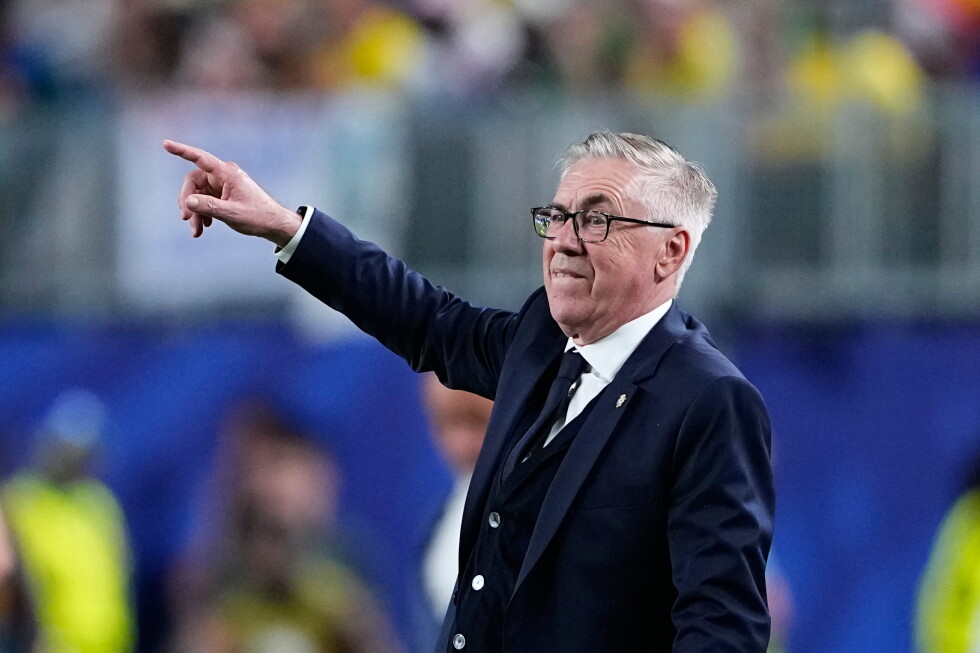
MIAMI GARDENS, Fla. – When Brazil handed the national team reins to legendary Italian manager Carlo Ancelotti just over 12 months ago, the five-time World Cup champions were chasing an end to a 22-year title drought, and expectations ran high. But the early stages of the tournament were far from smooth for Ancelotti, who faced growing skepticism from Brazilian fans after a underwhelming opening draw with Morocco with an injury-hit squad. That slow start did nothing to win over a fanbase hungry for glory, leaving the iconic club manager fighting to win the public’s trust.
That narrative has shifted dramatically over the past two matches, however. Two consecutive 3-0 routs — first against Haiti, then against Scotland — have locked Brazil’s spot in the World Cup knockout stage, rebuilt the squad’s confidence, and reignited the nation’s belief that a sixth trophy could be within reach. At long last, Ancelotti appears to have found his rhythm with the world’s most successful men’s national team.
Ancelotti’s unparalleled track record at the club level, where he claimed five Champions League titles and lifted every major top-flight European trophy with powers including AC Milan and Real Madrid, is exactly what led Brazil’s football federation to recruit him a year ago. It is that same legacy that has long made fans confident in his potential, even amid the rocky start.
“He’s the greatest manager of all time,” Brazil supporter Luca Scapinelli shared ahead of the team’s Wednesday victory over Scotland. “Five Champions Leagues, he’s won every single big European league. He can bring a lot to the table. We haven’t had a coach this great in forever.”
The consistent driving force behind Brazil’s unbeaten run in this tournament is Real Madrid winger Vinícius Júnior, a player who spent years failing to replicate his explosive club form for the Brazilian national side — until now. The 20-something star has found the back of the net in every World Cup match so far, notching a brace against Scotland to bring his tournament total to four goals, making him the team’s undisputed offensive standout.
It is no coincidence that Vinícius is hitting his peak for Brazil under Ancelotti: the 67-year-old manager coached the winger during his four-year tenure at Real Madrid from 2021 to 2025, and played a central role in transforming him from a promising young talent into one of the biggest global stars in the sport. During their time together at the Spanish capital, the pair lifted two Champions League trophies, two La Liga titles, and one Copa del Rey, building a deep working rapport that is now paying dividends for Brazil.
“It is satisfying because I had no doubt about how he could arrive at this World Cup,” Ancelotti said of his star forward. “For him, it is an honor to play for the national team. He is one of the best in the world, obviously.”
Vinícius, for his part, credits Ancelotti’s tactical adjustment — shifting him to an unfamiliar position on the pitch — for unlocking his new goalscoring form at the international level. “I need to listen to him more,” Vinícius joked after his brace against Scotland. “For sure when we get to the dressing room, he’ll say he knows a lot about football.”
From the moment he was first unveiled as Brazil’s head coach, Ancelotti emphasized his longstanding unique connection to the country, and made clear he understood the weight of the expectation that a once-in-a-generation manager could end the nation’s long World Cup drought. That connection is now becoming visible on and off the pitch, just as the tournament enters its decisive phase.
When Ancelotti’s name was announced to the crowd ahead of the Scotland match, the sea of fans clad in Brazil’s iconic yellow kit greeted him with a thunderous standing ovation, a far cry from the muted reception he received earlier in the tournament. Supporters have highlighted his effort to integrate himself into Brazilian culture as a key point of appreciation: he made a point to learn the national anthem and picked up conversational Portuguese in just a few months on the job.
“I like that he’s really into Brazilian culture,” said Caio Monteiro, a Brazil fan who traveled from Belo Horizonte for the match. “He wanted to learn the anthem, he wanted to learn Portuguese, and he did in just a few months.”
Initial pushback against hiring a foreign manager, common among a portion of the Brazilian fanbase, has largely faded in the wake of the team’s strong results. As supporter Humberto Silva, a native of São Paulo, noted, foreign managers are already a staple of top-tier Brazilian club football, and their presence at the international level is simply a reflection of the modern game.
“If you look at our league in Brazil, all of the best teams have foreign coaches,” Silva said. “That’s just the way it has to be now.”
With momentum back on their side and their star forward in scintillating form, Brazil now heads into the knockout stage as one of the favorites to lift the World Cup trophy, and Ancelotti has cemented his popularity with the fanbase he once struggled to win over.