Libya, a hydrocarbon-rich North African nation long fractured by political division and armed conflict, has entered a new phase of widespread instability this week, rocked by three consecutive major disruptions: a deadly car bomb assassination of a top eastern military intelligence official, repeated drone attacks on the country’s largest operating oil refinery, and the abrupt resignation of the nation’s central bank governor.
The first blow struck on Monday night in Benghazi, Libya’s second-largest city located in the country’s eastern region. Fawzi al-Mansouri, military intelligence chief for the Libyan National Army (LNA) — the powerful faction led by renegade commander Khalifa Haftar that controls much of eastern Libya — was leaving a local mosque when an explosive device pre-fixed to his vehicle detonated. The LNA confirmed the attack in an official statement released Tuesday.
Khaled Haftar, son of Khalifa Haftar and a prominent leader within the LNA, announced that security authorities had launched a full criminal investigation into the killing. In a public statement, he characterized the attack as a “despicable terrorist tactic,” adding that terrorism does not target Libya alone, but poses a threat to the entire broader region. To date, no armed or extremist group has claimed responsibility for the bombing.
Hamish Kinnear, principal Middle East and North Africa analyst at global risk intelligence firm Verisk Maplecroft, noted that the assassination undermines a core goal of the Haftar-led bloc: projecting an image of consolidated stability in eastern Libya after years of ongoing conflict. “It is a reminder that security in eastern Libya remains fragile despite the domination of Khalifa Haftar’s LNA,” Kinnear explained. The LNA has responded by reiterating its commitment to rooting out extremist threats, saying in a statement that it “will not cease fighting terrorism and will continue our struggle for the stability and security of Libya, as well as for the unification of its institutions.”
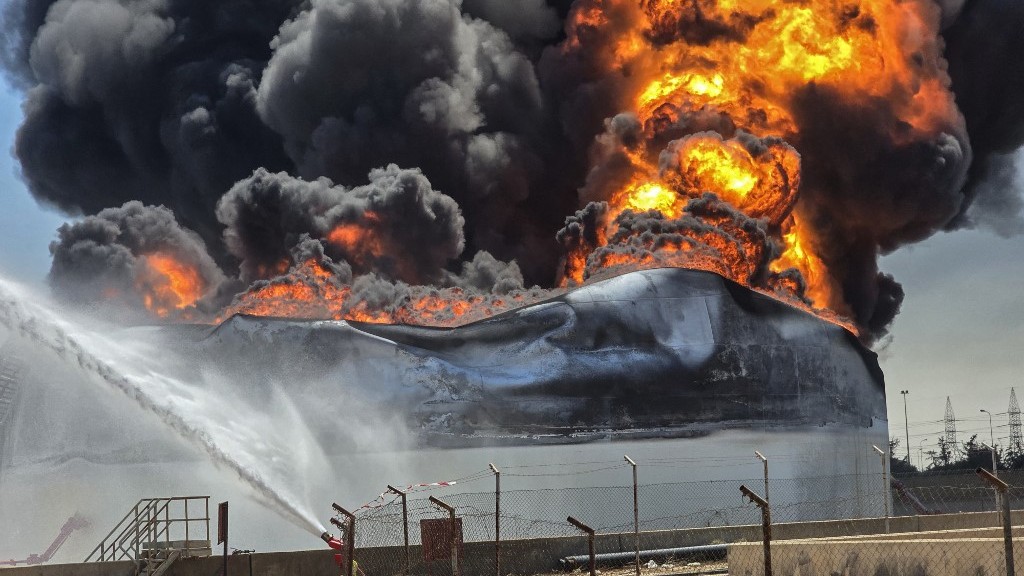
While security forces in the east grappled with the aftermath of the assassination, emergency responders in western Libya were working desperately to contain a large blaze at the Zawiya oil refinery, 45 kilometers west of the capital Tripoli. The fire broke out Monday evening after a drone strike hit the facility, marking the third attack on the refinery in just 48 hours.
Libya’s National Oil Corporation confirmed that the drone struck a storage tank holding approximately 4.5 million liters of fuel. The impact of the blast and subsequent fire caused the entire tank to collapse, and the corporation issued a stark warning that additional attacks on key energy infrastructure could force a full suspension of refinery operations. While emergency services confirmed no fatalities or critical injuries from the attack, several first responders and workers received medical treatment for smoke inhalation.
As Libya’s largest fully operational refinery, Zawiya has a daily processing capacity of 120,000 barrels of crude oil, making it a critical asset for the country’s energy-dependent economy. Kinnear noted that while no group has claimed the drone attacks, they coincide with ongoing armed clashes between rival militias in the Zawiya region. The strikes, he said, are almost certainly intended to exert political pressure on the internationally recognized Government of National Unity led by Prime Minister Abdul Hamid al-Dbeibah.
The wave of turmoil deepened later this week when a resignation letter attributed to Naji Issa, Governor of the Central Bank of Libya, began circulating widely across social media platforms and local Libyan news outlets. Addressed to the leaders of Libya’s House of Representatives and High State Council, the letter confirmed Issa’s intention to step down from his senior post. The governor has declined to publicly share details of his decision, only citing the “extreme sensitivity” of his reasons for leaving.
Taken together, the three events that unfolded within a single 24-hour period underscore just how rapidly Libya’s already brittle political and security order can unravel. “Drone attacks on oil infrastructure in Zawiya, a car bomb assassination in Benghazi and the resignation of one of Libya’s top officials underline how quickly Libya’s fragile political and security situation can deteriorate,” Kinnear summarized.
For more than a decade, Libya has remained split between two competing governing blocs: the internationally recognized Government of National Unity based in Tripoli, and a parallel eastern administration backed by Haftar’s LNA. Despite boasting large oil reserves and currently producing more than 1.3 million barrels of crude per day, the country continues to grapple with widespread systemic failures, including prolonged, frequent national electricity cuts. These persistent blackouts have already sparked mass public protests across Tripoli, Zawiya, Misrata and other major population centers, where demonstrators are demanding reliable access to power and calling for Prime Minister Dbeibah to resign.
Kinnear added that targeting energy infrastructure has become a common tactic in Libya’s internal power struggles, as it offers a low-cost, high-impact way to force political concessions. “Libya’s energy infrastructure often becomes the target in these confrontations, as it is the easiest means by which pressure can be placed on political leaders and concessions demanded,” he explained.