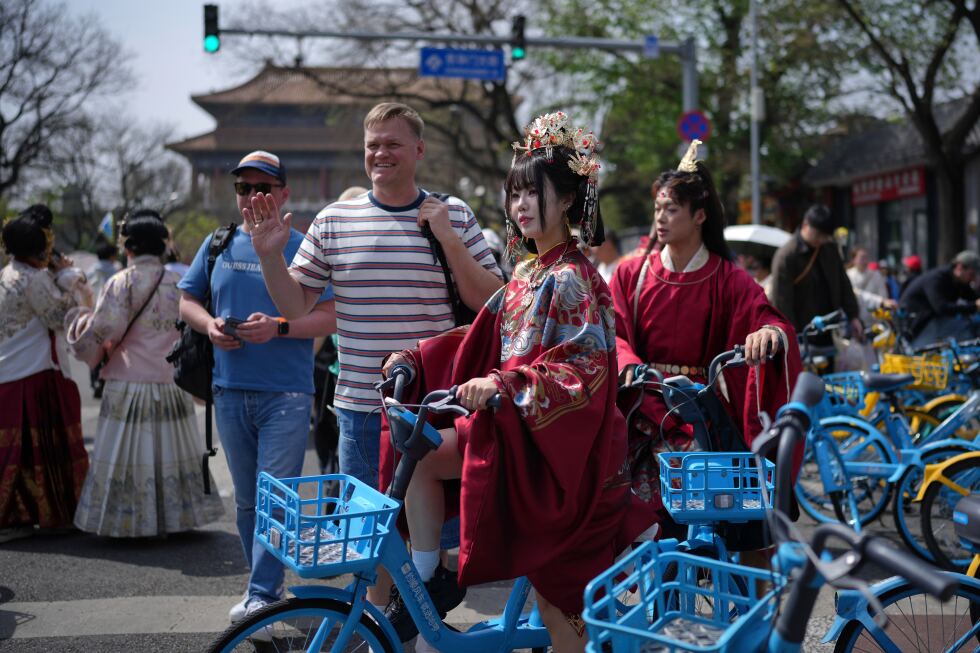
Across TikTok and other major global social media platforms, a viral new trend has taken Gen Z by storm in recent months: users from around the world are declaring they are “becoming Chinese” or “Chinamaxxing,” celebrating their adoption of everyday Chinese cultural habits. From sipping hot water infused with boiled goji berries and regularly eating homemade dumplings to wearing comfortable house slippers indoors and singing praises of China’s cutting-edge modern infrastructure during trips to the country, short-form videos tagged with this trend have accumulated hundreds of millions of views globally.
What makes this wave of cultural fascination particularly remarkable is that it has outperformed every official soft power outreach campaign the Chinese government has launched over decades of work to expand China’s global cultural footprint. Even senior Chinese diplomatic leaders have taken note of the grassroots phenomenon: China’s Ambassador to the United States Xie Feng recently referenced the internet craze while promoting a new visa-free transit policy, urging more American travelers to visit China and experience the country’s dynamic reality firsthand.
Scholars of global affairs say this viral meme represents the most clear-cut example to date of Chinese culture and lifestyle gaining an unprecedented level of organic global cultural cachet that official efforts never managed to achieve. “China is gaining real soft power, and you can see it most clearly in how Chinese culture and ‘Chineseness’ are becoming familiar, repeatable, and globally consumable in everyday life,” explained Shaoyu Yuan, a professor at New York University’s Center for Global Affairs. “That legitimacy is earned through taste, utility, and entertainment.”
This grassroots soft power growth has been enabled by decades of expansion across multiple core Chinese industries. China holds a record $1.2 trillion annual trade surplus with the rest of the world as a global manufacturing powerhouse, it developed the algorithmic technology that turned TikTok into a global social media giant, and domestic Chinese consumer brands now compete on equal footing with established global giants in nearly every market segment.
The trend traces its origin to content created by young Chinese diaspora creators. Sherry Zhu, a 23-year-old creator from New Jersey, posted a pair of lighthearted videos last year joking about common habits that signal “being Chinese” — loving noodles and hotpot, wearing slippers around the home — that racked up nearly a million shares in December 2024, sparking the broader viral meme. However, the trend has also sparked complex debate within Chinese diaspora communities over questions of cultural appreciation versus appropriation.
For many Chinese people who have faced systemic anti-Asian racism in Western countries, the sudden global fascination with Chinese cultural traits feels like a superficial trend that ignores long histories of discrimination. “Appreciation does not erase the racism that many Chinese people grew up with,” said Elise Zeng, a 28-year-old Brooklyn-based creator whose critical video about the trend has earned more than 36,000 likes. Zeng recalled the fear her family experienced during the COVID-19 pandemic, when anti-Asian hate crimes surged and many Asian Americans avoided public spaces for safety. “Those experiences don’t just disappear because Chinese culture is suddenly cool and trendy,” she noted. Zhu, who has also faced identity-based bullying, disagrees, arguing that increased cultural visibility and open sharing will reduce cross-cultural misunderstanding over time.
The “Chinamaxxing” trend is not an isolated moment, but rather the latest peak of a years-long groundswell of global embrace of Chinese popular culture. Last year, the fuzzy, “ugly-cute” Labubu toy dolls from Chinese brand Pop Martin became a global obsession among A-listers including Rihanna, driving a 300% jump in the company’s annual profit. Cantonese rapper Skaii isyourgod (also known as Lanlao) has amassed a massive global TikTok following despite rapping in a thick regional accent that even many Mandarin speakers struggle to understand; his hit single “Blueprint Supreme” has earned billions of global views since going viral last summer. Animated blockbuster *Ne Zha 2* became the highest-grossing animated film of all time in China before it even debuted in North American theaters, and action role-playing game *Black Myth: Wukong*, based on the classic Chinese legend of the Monkey King, broke Steam’s record for concurrent single-player players with 2.4 million users online at launch just months after its release. Most recently, Chinese digital mapping app Amap has gone viral globally for offering more detailed features than mainstream options like Google Maps and Apple Maps, including the ability to tell users whether a route will be in shade or full sun.
For more than a decade, Chinese President Xi Jinping has pushed the government to expand Chinese soft power globally, calling on officials to “tell China’s story well” starting in 2013. Official efforts have included massive infrastructure projects like the multi-billion-dollar Belt and Road Initiative and investments in hundreds of Confucius Institutes designed to teach Chinese language and culture around the world. However, many of these state-led projects have faced headwinds in the West: dozens of Confucius Institutes have closed over unsubstantiated concerns that they serve as propaganda and espionage fronts, while Belt and Road has faced repeated criticism from Western governments that frame it as a “debt trap” for developing nations.
While China’s growing hard power — from its dominance of global green energy manufacturing, including electric vehicles and solar panels, to its position as the world’s second-largest military and top manufacturing export powerhouse — has been widely documented, organic soft power is far harder to manufacture or measure. State media outlets like the Global Times have already attempted to tie the popularity of the “Chinamaxxing” meme to official policy successes, but Professor Yuan argues that overly loud official claims of victory may actually trigger more public skepticism of the trend. As Yuan puts it: “Cultural influence travels farther when it is chosen rather than announced.”