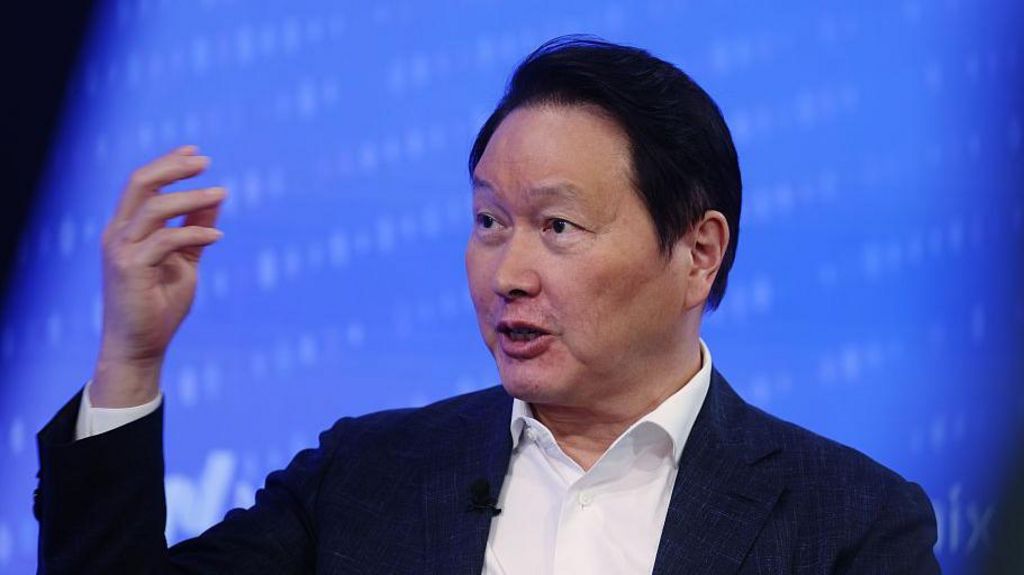
One of South Korea’s most closely watched legal disputes, widely dubbed the “divorce of the century,” has concluded with a landmark ruling ordering SK Group chairman Chey Tae-won to hand over 944 billion won (equivalent to $644 million) to his ex-wife Roh Soh-yeong. The case, which has dominated headlines across the nation for years, marks a final chapter in a decades-long marriage and contentious asset battle that has been intertwined with South Korea’s political and economic history.
The reduced settlement, which remains pending final formalization, is lower than the 1.38 trillion won award initially granted to Roh in a 2024 lower court ruling. The ex-couple, who were married for 35 years, first separated more than a decade ago after Chey admitted to fathering a child with another woman. Roh is the daughter of Roh Tae-woo, who served as South Korea’s president from 1988 to 1993, a connection that became a core point of legal contention throughout the proceedings.
In the 2024 initial trial, Roh’s legal team successfully argued that Chey’s rise to leading South Korea’s second-largest chaebol was significantly buoyed by financial support from his former father-in-law. The lower court ruled that Roh Tae-woo had provided 30 billion won in illegal slush fund assets to Chey in 1991, a contribution that factored into the original 1.38 trillion won award. However, South Korea’s Supreme Court overturned that ruling last year, holding that illegally obtained slush funds could not be classified as shared marital assets eligible for division, sending the case back for re-evaluation.
The high-stakes divorce has unfolded alongside a period of explosive growth for SK Group, a family-owned conglomerate that anchors much of South Korea’s modern economy. Founded as a small textile business in 1953, SK has expanded its footprint across virtually every key sector of the nation’s economy, from mobile telecommunications through SK Telecom to retail energy distribution. Today, it ranks as the country’s second-largest chaebol, trailing only Samsung Group in overall scale and influence.
In recent years, the group has gained global spotlight thanks to its semiconductor subsidiary SK Hynix, a critical supplier of advanced chips to AI giant Nvidia that has become a central player in the global artificial intelligence boom. The chipmaker’s valuation crossed the $1 trillion threshold on South Korea’s domestic stock market in May 2025, and it pulled off a record-breaking $26.5 billion initial public offering on the New York Stock Exchange last month — the largest listing ever for a foreign firm on U.S. exchanges. As SK Hynix’s value has surged, so too has Chey’s public standing: just last month, South Korean President Lee Jae Myung praised Chey and Samsung chairman JY Lee as “Heroes of Korean People” during the unveiling of a national AI infrastructure investment plan.
In a statement following the latest ruling, Chey’s legal team acknowledged the public concern sparked by the drawn-out proceedings. “Chairman Chey Tae-won is deeply sorry in that [the divorce] proceedings so far have caused concern to many people,” the statement read. “We will share specific response to the verdict after we closely review the ruling.” The BBC has reached out to SK Group for additional comment on the ruling, as of this reporting no further statement has been released.
The verdict is not only a major resolution to one of South Korea’s most sensational celebrity legal cases, but it also shines a renewed spotlight on the inner workings of the chaebol system, where family wealth, political connections, and corporate power have long been deeply intertwined. With the final settlement amount now set, attention will turn to how Chey will structure the payout, and what impact, if any, the asset division could have on the leadership and strategy of one of the world’s most important technology conglomerates.