标签: North America

北美洲

  • Trump weighs ‘limited strikes’ against Iran after peace talks break down: WSJ

    Trump weighs ‘limited strikes’ against Iran after peace talks break down: WSJ

    Fresh off the breakdown of high-stakes peace negotiations with Iran in Pakistan, former US President Donald Trump is actively evaluating a slate of coercive responses, including limited military strikes and a tightened maritime blockade of the Strait of Hormuz, to break the diplomatic stalemate, The Wall Street Journal reported on Sunday.

    Citing unnamed senior officials and individuals briefed on internal administration deliberations, the outlet confirmed that limited targeted strikes were among the active options under Trump’s consideration as of Sunday, just hours after the Pakistan-based talks between the two nations collapsed with no agreement reached.

    According to the sources, a large-scale, full bombing campaign is being ruled out as a lower-probability option. Two core factors are driving this hesitation: widespread regional concerns that a major offensive would trigger widespread instability across the Middle East, and Trump’s long-stated public and private aversion to entering open-ended, prolonged military conflicts that would draw the US deeper into the region.

    Beyond military strikes, the report added that another option on the table is implementing a temporary maritime blockade of the Strait of Hormuz, a critical global chokepoint for oil and maritime trade, while the administration pressures US regional allies to take on long-term responsibility for running permanent military escort missions through the strait going forward.

    Earlier on the same day, Trump publicly announced that the US Navy would begin blocking commercial and military traffic moving into or out of Iran through the Strait of Hormuz. This announcement was followed by a formal statement from US Central Command on Sunday, confirming that American forces would begin full implementation of the blockade, covering “all maritime traffic entering and exiting Iranian ports,” starting at 10 am Eastern Time on Monday.

    The collapse of the Pakistan-hosted talks marks a major escalation in tensions between the US and Iran, ending a brief window of diplomatic progress that had raised hopes of de-escalation in the long-running standoff between the two nations.

  • Europe has trust issues with US: Poll

    Europe has trust issues with US: Poll

    Transatlantic relations are facing an unprecedented crisis of confidence, according to a new cross-European public opinion survey that finds a growing share of European citizens now view the United States as a threat rather than a trusted ally, as Washington’s unilateral policy agenda increasingly clashes with European strategic and economic interests.

    Conducted between March 13 and 21 by independent polling firm Cluster17 for the news outlet Politico, the survey gathered responses from 6,698 adults across six key European nations: Belgium, Germany, France, Italy, Spain, and Poland. The results paint a stark picture of eroding trust: just 12% of respondents currently identify the U.S. as a close ally, while more than three times that share — 36% — now classify the U.S. as an active threat to European stability. That marked a dramatic hardening of anti-U.S. sentiment compared to previous polling, experts note.

    Politico traced the shift in public opinion to a series of controversial actions taken by the second Trump administration after it returned to office in January 2025. These include repeated public questioning of the U.S.’s long-standing mutual defense commitment to NATO, open threats to annex Greenland and Canada, sweeping new tariffs imposed on European exports, and the launch of a new war with Iran that all major European governments refused to join.

    The poll also exposes a critical contradiction at the heart of modern European security politics. As trust in Washington declines, a majority of voters now back calls for a stronger, more strategically autonomous Europe. But that support evaporates when proposals require higher defense spending or long-term security commitments to Ukraine, the survey found.

    On collective defense, the survey found broad top-level political support for mutual protection: 76% of respondents backed sending troops to defend an allied nation that came under attack, a figure that rose to 81% when the question specifically referenced defending a fellow European Union member state. However, when asked if they would personally take up arms to fight if their own country was attacked, just 19% of respondents said they would agree. Politico noted this gap exposes a major structural challenge for European governments: high public support for stronger defense institutions on paper, paired with low individual willingness to serve, which will exacerbate existing European troop shortages.

    Chinese foreign policy analysts say the poll results reflect a growing and deepening sense of disappointment among ordinary European citizens toward the current U.S. administration. Liu Le, an associate researcher at the National Institute of International Strategy of the Chinese Academy of Social Sciences, explained that repeated unilateral actions by the U.S. on issues ranging from Greenland’s status to the Russia-Ukraine conflict and the new Iran war have directly conflicted with core European interests, while also eroding the shared ideological foundations that long sustained the transatlantic alliance.

    Liu noted that the current U.S. administration has shifted beyond the long-standing ‘America First’ doctrine to a far more extreme ‘America Only’ strategic orientation. This shift has severely damaged European confidence in the U.S.’s strategic credibility and long-term policy consistency, he added. The escalating conflict with Iran has also forced the U.S. to draw down its security engagement in the Russia-Ukraine conflict, effectively stepping back from its core security commitments to Europe — a shift that has prompted the European Union to launch a full reassessment of its relationship with Washington.

    Chen Hong, director of the Asia Pacific Studies Centre at East China Normal University in Shanghai, added that the current U.S. administration has increasingly treated long-standing security commitments to allies as a bargaining chip, repeatedly threatening European governments to advance U.S. interests. This behavior has laid bare the fundamentally hegemonic nature of U.S. strategy for many European observers, he said.

    In addition to security frictions, Chen noted that economic policy has become a major source of resentment in Europe in recent years. The U.S. has repeatedly threatened European allies with tariffs, pursued exclusionary trade and supply chain policies, and forced European nations to align with its great-power economic competition agenda, often against their own economic interests. ‘By turning economic relationships that were once built on shared rules and mutual benefit into tools to advance U.S. national interests, the United States has directly undermined the core interests of European partners,’ Chen explained.

    Chen added that the U.S. has sought to shift the costs of manufacturing overseas while retaining tight control over critical technologies and key resources, a dynamic that has made clear to European governments and publics alike that the U.S. does not see Europe as an equal partner. Instead, Europe is increasingly viewed by Washington as a strategic asset to be mobilized, leveraged, and even sacrificed when it serves U.S. goals, he said.

    Notably, the survey found that the share of Europeans who view the U.S. as a threat now exceeds the share who hold the same view of China by 7 percentage points (36% vs 29%). In four of the six surveyed nations, more respondents named the U.S. as a greater threat than China, with Spain recording the widest gap at 51% of respondents identifying the U.S. as a threat.

    Despite the sharp decline in trust, experts agree that a full breakdown of transatlantic ties and a complete end to Europe’s reliance on the U.S. is unlikely in the near term. Instead, Chen noted, Europe is increasingly pursuing a realistic, balanced approach that prioritizes greater strategic autonomy. ‘It is precisely the U.S.’s erosion of allies’ interests and the institutional foundations of the transatlantic order that has forced Europe to pursue more independent strategic decision-making,’ Chen explained. This shift does not mean Europe plans to abandon the transatlantic alliance entirely; rather, it is a structural adjustment and defensive response to repeated U.S. unilateralism and violation of established international rules.

    For European policymakers, deeper cooperation with China has become a strategic necessity rather than a discretionary choice, Liu noted. Despite ongoing differences between Brussels and Beijing, the two sides share broad overlapping interests on issues ranging from trade to climate change to multilateral governance. Europe’s push to deepen ties and expand cooperation with China reflects its core strategic need to pursue more independent, self-reliant development, he added.

  • Sweeping US tariffs fail to deliver on stated goals

    Sweeping US tariffs fail to deliver on stated goals

    Twelve months have passed since the United States rolled out sweeping protectionist tariffs across a wide range of trading partners, and new official data confirms what many economic analysts predicted: the policy has failed to deliver on nearly all of its core stated objectives, while triggering a cascade of unintended negative consequences for both the US economy and the global trading system.

    When the tariffs were first announced on April 2 last year, the US government framed the measures as a bold solution to long-running economic challenges, promising to bring manufacturing jobs back to American shores, shrink the persistent US trade deficit, and drive stronger domestic economic growth. A full year later, results have fallen drastically short of these promises.

    Official federal data on manufacturing reshoring paints a particularly bleak picture: since the tariffs took effect, US manufacturing has cut jobs in nearly every month, with only small, temporary gains recorded in January and March of this year. Progress on narrowing the trade deficit has also stalled. 2025 full-year government figures show the US goods trade deficit widened by 2.1% to hit an all-time high of $1.24 trillion. The overall US trade deficit shrank by just $2.1 billion for the entire year, a negligible change driven almost entirely by a growing surplus in services trade, not the manufacturing gains the tariffs were meant to deliver.

    Economic experts across academic and policy institutions say these outcomes were entirely predictable, arguing that tariffs are structurally ill-suited to solve the deep-rooted domestic economic problems the US claims to be addressing, from industrial decline to persistent trade imbalances.

    Luo Zhenxing, an associate research fellow at the Institute of American Studies under the Chinese Academy of Social Sciences, explained that decades of hyper-globalization have built an intricate, deeply integrated global division of labor that cannot be unwound by tariffs alone in the short term. “Even if policymakers wanted to reshore manufacturing, US domestic production costs remain far higher than most emerging market economies, so low and mid-end manufacturing is extremely unlikely to return,” Luo noted. He added that large-scale reshoring requires long-term capital investment and a stable policy environment, but constant shifts in US tariff policy have created widespread uncertainty that makes long-term corporate planning nearly impossible.

    Song Guoyou, deputy director of the Center for American Studies at Shanghai’s Fudan University, echoed this critique, saying the US government has drastically overstated what tariffs can achieve. “The economic problems the US is trying to fix are primarily internal and structural,” Song explained. “Attempting to use trade barriers and tariffs to force an adjustment is fundamentally wrong-headed — it is simply a way to avoid doing the hard work of passing the necessary domestic reforms that would actually address these issues.”

    Beyond failing to meet their core goals, the tariffs have already caused measurable harm to multiple sectors of the US economy. Data from the US Commerce Department’s National Travel and Tourism Office shows that through November of last year, total international visitor arrivals to the US fell by 5.4% compared to the previous year, as protectionist trade policies damaged the country’s global standing and appeal. The sharpest drop came from Canadian travelers, who visit the US in large volumes for tourism and business — arrivals from Canada plummeted 22%, or 4 million fewer visits, a decline that Forbes estimates cost the US economy roughly $4.5 billion in lost revenue.

    The tariffs have also thrown global supply chains into disarray, raising costs for American businesses and consumers alike. Neil Bradley, executive vice president and chief policy officer at the US Chamber of Commerce, emphasized in a recent statement that after a full year of elevated tariffs, the costs are impossible to ignore. “Tariffs have increased prices, disrupted supply chains and added uncertainty for the very families and businesses they are meant to help,” Bradley said.

    A February analysis from the Yale Budget Lab projects that the tariffs will push the US unemployment rate 0.3 percentage points higher by the end of 2026, and forecast that in the long run, the total size of the US economy will be a persistent 0.1% smaller than it would have been without the tariffs.

    Luo explained that tariffs erode US economic performance by discouraging domestic investment and raising prices for imported goods, which directly cuts into household purchasing power. “Tariffs also drive up input costs for US manufacturers that rely on imported materials and components, forcing them to raise prices and making US exporters less competitive in global markets,” he added.

    The damage extends beyond immediate economic costs to eroding international investor confidence in US assets, experts warn. By weaponizing mutually beneficial trade relationships for political gain, the US has amplified foreign investors’ concerns about persistent policy unpredictability in the country, Song said. “The long-held idea of American exceptionalism — that global capital always flows to the US for safety during crises — is being undermined by this self-inflicted tariff crisis,” he noted.

    Early signs of this shifting confidence are already visible. Financial newsletter The Kobeissi Letter reports that the US Dollar Index dropped 9% in 2025, its worst annual performance since 2017. Goldman Sachs forecasts the dollar will continue to weaken through 2026 as global demand for US assets declines. US media also notes that European and Asian stock markets outperformed US markets by a significant margin in 2025, a clear indication that international investors are beginning to diversify their holdings away from US assets.

    “The unpredictability of US government policy is heightening uncertainty around US assets and eroding international confidence in them,” Luo said. “This will undermine long-term US economic growth and may even put the global reserve currency status of the US dollar at risk.”

    Even after the US Supreme Court ruled in February that the legal basis for the administration’s reciprocal tariffs was unconstitutional, the White House moved quickly to implement replacement tariffs and launch new investigations into alleged unfair trade practices. Experts warn that this persistence indicates protectionist “America First” trade policies could become a permanent feature of the global economic order, with far-reaching negative implications for global economic integration.

    “US tariff policies will lead to a fragmentation of the global trading system,” Song said. “In response to US protectionism, other countries are ramping up their own efforts to defend free trade, which is creating two distinct blocs: one US-centered protectionist camp, and another that remains committed to upholding the rules-based global free trade system.”

    Luo added that prolonged US protectionism has already disrupted the existing global economic order. “The world is facing major uncertainty and undergoing a period of rapid adjustment, with fragmentation risks rising quickly,” he said. “In the end, this will only hold back shared global economic development.”

  • Britney Spears goes into rehab after driving under the influence arrest

    Britney Spears goes into rehab after driving under the influence arrest

    Global pop superstar Britney Spears has voluntarily admitted herself to an addiction and wellness treatment facility, exactly one month after her arrest on suspicion of driving under the influence of alcohol and controlled substances. Her representative confirmed the news to multiple major U.S. media outlets in a public statement issued Sunday.

    The 44-year-old hitmaker was taken into custody on March 4 following a report to California law enforcement of a BMW being operated erratically at excessive speeds on a state highway. According to official statements from the California Highway Patrol, officers pulled Spears over and observed clear signs of impairment during the stop. She agreed to complete a full battery of field sobriety tests before being taken into custody on DUI charges.

    In the immediate aftermath of her arrest, Spears’ representative described the incident as “completely inexcusable” in comments to the BBC, noting that the pop star’s close family had begun assembling a long-overdue support plan to prioritize her long-term health and well-being. That plan culminated in her voluntary entry into rehab, which comes three weeks ahead of her scheduled California court appearance for the DUI charge. “Britney is going to take the right steps and comply with the law, and hopefully this can be the first step in the long-overdue change that needs to occur in Britney’s life,” the representative shared shortly after the arrest. “Hopefully, she can get the help and support she needs during this difficult time. Her boys are going to be spending time with her, and her loved ones are committed to putting a plan in place that sets her up for long-term wellness.”

    Spears remains one of the most commercially successful and culturally influential pop artists of all time, with a decades-long career that has produced dozens of chart-topping hits including *Baby One More Time*, Toxic, Everytime, Gimme More, Womanizer, and Stronger. The star’s personal life has been the subject of intense global public attention in recent years, particularly due to the 13-year conservatorship that controlled her personal decisions, finances, and medical care until the arrangement was terminated in 2021.

    Jamie Spears, Britney’s father, who served as the conservator of her estate and personal affairs for most of the arrangement, has defended the legal structure in public comments. He has stated that the conservatorship was necessary at the time because Britney’s life was “in shambles and she was in physical, emotional, mental and financial distress.” He added, “Through the conservatorship, Britney has been able to return to a path towards stability in all of these phases of her life. The mission has been successful and it is now time for Britney to re-take control of her life.”

  • Carney on verge of Liberal majority government as votes cast in three by-elections

    Carney on verge of Liberal majority government as votes cast in three by-elections

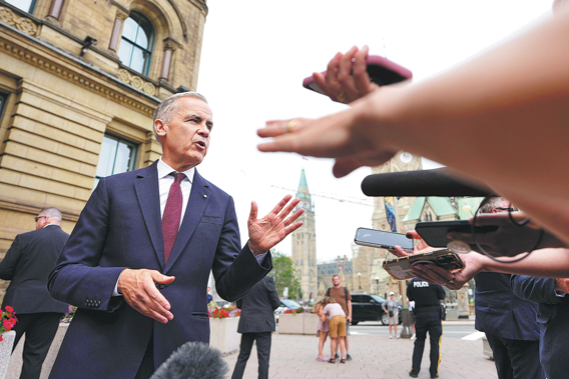
    One year after Mark Carney took office as Canada’s prime minister, his Liberal Party stands on the cusp of securing a narrow working majority in the House of Commons, with the outcome of three upcoming by-elections set to reshape the country’s federal political landscape for years to come.

    Voters head to the polls on Monday for three vacant ridings: two in the Greater Toronto Area, Scarborough Southwest and University-Rosedale, and a third competitive race in the Montreal suburb of Terrebonne. Currently, the Liberals hold 171 of 343 total seats in the Commons – just one seat short of the 172 needed for a formal majority. If the party claims victory in even two of the three contests, Carney will secure his narrow majority, allowing his government to pass legislation without relying on opposition support and pushing the next mandatory federal election back to 2029.

    Political observers note the projected shift in parliamentary control has been accelerated by an unusual wave of cross-party defections, with five sitting opposition lawmakers – four former Conservatives and one New Democratic Party member – already joining the Liberal caucus since Carney took power. Canadian media reports indicate the party is also courting several additional sitting MPs to switch allegiances in the coming weeks.

    The two Toronto seats up for grabs were vacated by high-profile former Liberal lawmakers who accepted new roles: Scarborough Southwest was previously held by ex-defence minister Bill Blair, who now serves as Canada’s ambassador to the United Kingdom, while University-Rosedale was the seat of former deputy prime minister Chrystia Freeland, now a senior policy adviser to the Ukrainian government. Political analysts widely predict the Liberals will hold both ridings, putting Carney’s majority within reach regardless of the outcome in Terrebonne.

    The race in Terrebonne remains one of Canada’s most closely watched by-election contests in recent decades. The Liberal candidate won the riding by just a single ballot in the 2025 April federal election, but Canada’s Supreme Court nullified the final result in February after uncovering an administrative error by Elections Canada involving mailed-in postal ballots. The contest is once again rated as a pure toss-up between the Liberals and the sovereigntist Bloc Quebecois. To bolster his candidate Tatiana Auguste, Carney personally campaigned in the riding ahead of polling day.

    University of Toronto political science professor Semra Sevi described the recent pace of party-switching as extraordinary, even for Canada’s fluid parliamentary system. “Carney has built a big tent, attracting members of parliament who would not normally be associated with the Liberal party,” Sevi explained in an interview. “The complication, however, is that the tent may now be so big that there isn’t a lot of ideological coherence in it.”

    That ideological tension flared up after the most recent defection of former Conservative MP Marilyn Gladu, a socially conservative lawmaker who has publicly described herself as personally pro-life. Gladu has committed to voting in line with Liberal caucus policy on abortion access, and Carney has defended his decision to welcome her, stressing that the party’s core values remain unchanged. Under Carney’s leadership, the Liberals have shifted toward the political centre-right, a marked departure from the more progressive agenda of former prime minister Justin Trudeau. Carney has rolled back several of Trudeau’s signature policies, including the national consumer carbon tax, and has prioritized positioning Canada as a global “energy superpower” while cutting public sector staffing levels – policy shifts that have proven appealing to disaffected centre-right Conservative MPs.

    The wave of defections has triggered fierce backlash from Conservative leader Pierre Poilievre, who has branded the floor-crossings undemocratic and accused Carney’s government of striking corrupt backroom deals to seize power. “By poaching MPs from other parties, Carney is telling those who elected them that ‘your vote does not count’,” Poilievre has argued.

    At the same time, analysts note the defections reflect deep-seated discontent within the Conservative caucus. Just over a year ago, Poilievre was widely seen as the likely next prime minister, but Carney surged in polling amid widespread voter concerns about cross-border trade and diplomatic relations with the United States under the second Trump administration. Today, many Conservative MPs fear the party has little chance of forming government under Poilievre’s leadership, with growing discontent over his approach to caucus management.

    Recent national polling puts the Liberals 10 to 15 percentage points ahead of the Conservatives, with Carney maintaining high personal approval ratings among Canadian voters. Closing out a Liberal party convention in Montreal over the weekend, Carney used his keynote address to frame his big-tent approach as a strength for a country facing overlapping national crises. “Canada’s founding insight is that unity does not require uniformity,” he told party members.

  • Trump attacks Pope over criticism of Iran war

    Trump attacks Pope over criticism of Iran war

    In a stunning break from decades of diplomatic precedent between U.S. leaders and the Vatican, former and current U.S. President Donald Trump has delivered an extraordinary, scathing rebuke of Pope Leo, opening a high-profile rift between the White House and the Catholic Church over two polarizing global issues: the ongoing war in Iran and Trump’s hardline immigration agenda.

    The verbal assault began with a post Sunday on Trump’s Truth Social platform, where the president unleashed a series of harsh accusations against the pontiff. He labeled Pope Leo “WEAK on Crime and terrible for Foreign Policy,” and doubled down on his criticism during a subsequent press briefing, telling reporters bluntly, “I’m not a big fan [of Pope Leo].”

    The conflict stems from long-running public opposition Pope Leo has leveled against two of Trump’s signature policies. On the Iran conflict, the pontiff has emerged as one of the most high-profile global critics of the U.S.-led war against Tehran, a conflict justified by the U.S. and Israel over Iran’s pursuit of nuclear capabilities. When Trump issued a stark threat to “destroy Iranian civilisation” earlier this year, Pope Leo dismissed the statement as “unacceptable” and has repeatedly called on the Trump administration to pursue a diplomatic “off-ramp” to end the bloody conflict. The pope has used multiple public platforms, including his recent Easter address, to press for de-escalation across the Middle East, urging global leaders with the power to end war to choose peace. In that Easter speech, he lamented that global populations have grown desensitized to violence and indifferent to the thousands of civilian deaths from ongoing conflicts, without naming specific nations directly.

    Beyond the Iran war, Pope Leo has also publicly questioned whether Trump’s restrictive immigration agenda aligns with the Catholic Church’s longstanding pro-life and pro-human dignity teachings, putting him at direct ideological odds with the White House.

    Trump’s criticism came as Pope Leo embarked on an 11-day pastoral trip to Africa, his second major international journey since his election to the papacy one year ago. In his social media post, Trump went beyond policy criticism, repeating a claim that the pontiff’s election was orchestrated specifically to counter his presidency. “He was elected because he was American, and they thought that would be the best way to deal with President Donald J Trump,” Trump wrote. “If I wasn’t in the White House, Leo wouldn’t be in the Vatican.”

    Pushed by reporters to elaborate on his claims, Trump doubled down on his unorthodox attacks, arguing “I don’t think he’s doing a very good job, he likes crime, I guess.” He added: “He’s a very liberal person, and he’s a man who doesn’t believe in stopping crime, he’s a man who doesn’t believe we should be toying with a country that wants a nuclear weapon so they can blow up the world.” His reference to Pope Leo being “weak on nuclear weapons” referred to the pontiff’s calls for diplomatic negotiation rather than military escalation around Iran’s nuclear program.

    Trump’s unprecedented public attack drew immediate, fierce backlash from Catholic leaders and religious scholars across the globe. Massimo Faggioli, a prominent Vatican and church history expert, told Reuters that the scope and bluntness of Trump’s criticism was unmatched even in periods of deep conflict between secular leaders and the papacy. “Not even Hitler or Mussolini attacked the Pope so directly and publicly,” Faggioli said, highlighting how extraordinary the current rift is. The conflict has sparked widespread debate over the separation of church and state, as well as the role of the papacy in shaping global policy on war and migration.

  • Congressman Eric Swalwell drops out of California governor’s race amid abuse claims

    Congressman Eric Swalwell drops out of California governor’s race amid abuse claims

    Weeks ahead of California’s critical gubernatorial primary election, Democratic U.S. Representative Eric Swalwell has announced he is ending his campaign for governor, caving to mounting pressure from party allies following multiple sexual misconduct claims leveled against him by four women. The allegations against the congressman span a spectrum of serious accusations, from unwanted sexual harassment to violent rape. Swalwell has repeatedly and vehemently denied all of the claims, saying he is prepared to clear his name using verifiable facts. Even as the candidate pushed back against the accusations, his closest political allies within the Democratic Party ramped up calls for his withdrawal from the race. Before his exit, Swalwell was widely viewed as one of the leading contenders for the Democratic nomination in the open primary to fill the seat being vacated by outgoing Governor Gavin Newsom. The race for governor of California, the most populous state in the United States, has been a wide-open contest with no clear favorite from the start. Swalwell’s departure comes at a make-or-break juncture, just a few weeks before mail-in ballots are distributed to registered voters across the state ahead of the June 2 primary election. In a public statement posted to the social media platform X, Swalwell confirmed the end of his gubernatorial bid. “I am suspending my campaign for Governor,” he wrote. Addressing his loved ones, campaign team, supporters, and friends, he added: “I am deeply sorry for mistakes in judgment I’ve made in my past.” Swalwell emphasized that while he will continue to work aggressively to refute what he calls the false serious accusations against him, this legal and personal battle should not distract from the state’s gubernatorial race. “That’s my fight, not a campaign’s,” he concluded.

  • McIlroy underlines greatness by defending Masters title

    McIlroy underlines greatness by defending Masters title

    Augusta National Golf Club played host to another iconic chapter of Masters history this Sunday, as Northern Ireland’s Rory McIlroy etched his name into golf lore by clinching consecutive green jackets, becoming only the fourth player in the tournament’s storied history to defend his title successfully.

    The 36-yearold entered Sunday’s final round with a narrowed lead after competitors clawed back their deficit on Saturday, but delivered a gritty one-under-par 71 to end the tournament at 12-under overall, holding off world No.1 Scottie Scheffler of the U.S. by a single stroke to claim his sixth career major championship, tying legendary English golfer Sir Nick Faldo’s tally. He is now just the 15th player in the sport’s history to secure at least six major wins.

    McIlroy’s back-to-back victory capped a remarkable personal journey. Twelve months prior, he ended an 11-year drought to complete his career Grand Slam at Augusta, a breakthrough he predicted would unlock his game and let him compete with greater freedom. He proved that prophecy correct at his first opportunity to defend the title.

    “I can’t believe I waited 17 years to get one Green Jacket and now I get two in a row,” McIlroy told reporters after clinching the win. “All my perseverance at this golf course over the years has started to pay off. It was a tough weekend but I’m so happy to hang in there and get the job done. I wanted to come back and prove last year wasn’t a fluke.”

    Sunday’s race for the title delivered all the drama the tournament is famous for. English veteran Justin Rose, who lost a playoff to McIlroy at Augusta last year, once again pushed the eventual champion to the wire. The 45-year-old, who was aiming to become the oldest first-time Masters champion, grabbed a one-shot lead midway through the final round, putting him in position to avenge his 2025 defeat as McIlroy’s putting cooled off.

    But the narrative reversed course from 2025’s thrilling playoff, when a charging Rose forced extra holes after McIlroy faltered down the stretch. This time, the pressure got to Rose: he dropped critical shots on Amen Corner’s 11th and 12th holes, losing momentum and never recovered. He finished tied third at 10-under, denied what would have been his fourth career second-place finish at the Masters. “It is another little stinger,” Rose said. “I was by no means free and clear, and nowhere close to having the job done, but I was right in position.”

    McIlroy faced his own hurdles throughout the four-day tournament. After grabbing a record six-shot lead at the halfway mark despite inconsistent performance off the tee, the same accuracy issues plagued him in Saturday’s third round, letting the packed field close the gap. True to his reputation as one of the game’s all-time greats, McIlroy adjusted his strategy: he traded driving distance for improved accuracy to smooth out swing kinks, a tweak that laid the groundwork for his steady final round performance.

    When asked whether he would have had the resilience to pull off the win before claiming his first green jacket last year, McIlroy said his breakthrough was truly transformative, changing both his approach to the game and his mindset.

    Scheffler, the 2022 and 2024 Masters champion, turned in a stunning performance to finish as McIlroy’s closest challenger, making history of his own as the first player since 1942 to card a bogey-free weekend on his way to a fourth consecutive top-10 finish at the tournament. The 29-year-old American ultimately fell short due to a slow opening round, a recurring issue for him in recent months. “I knew I was going to have to do something special if I wanted to catch [McIlroy] or [Young],” Scheffler said. “I was close but it was just a few shots here or there.”

    Rose tied for third with England’s Tyrrell Hatton and Americans Russell Henley and Cameron Young. For Hatton, the top-three finish marked a major turnaround at Augusta: the 34-year-old had a well-documented volatile relationship with the course, publicly criticizing its undulations and even calling it “unfair” in 2022. “This is my 10th Masters, so I’ve been fortunate to be here a lot and my results the last three years have definitely improved,” Hatton said.

    With his back-to-back win, McIlroy joins an exclusive club of defending Masters champions that includes only Jack Nicklaus, Nick Faldo, and Tiger Woods, cementing his status as one of golf’s modern greats.

  • Frostbite is least of worries for Canada forces grappling with new Arctic reality

    Frostbite is least of worries for Canada forces grappling with new Arctic reality

    After 52 days of traversing some of the harshest frozen landscapes on the planet, two Canadian Rangers crossed a simple finish line marked by a row of spruce trees in Churchill, Manitoba, on Friday, capping the largest northern mission in the 75-year history of the Canadian Armed Forces reserve unit. The 5,200-kilometer journey, which retraced a route not attempted in 80 years, stood as a landmark test of Canada’s military readiness, indigenous knowledge, and sovereign claims to a rapidly changing Arctic region.

    The patrol formed the core of 2026’s annual Operation Nanook-Nunalivut, a Canadian Armed Forces initiative designed to reinforce the country’s military presence across its northern territories — a region that makes up 40% of Canada’s total landmass and 70% of its entire coastline. More than 1,300 military personnel from Canada and allied nations joined this year’s operation, with broad objectives ranging from land surveying and climate change research to opening new navigation routes and testing cold-weather survival and combat capabilities.

    The mission has taken on urgent new relevance in recent years, as melting Arctic ice driven by climate change unlocks access to vast untapped natural resources, triggering a global geopolitical scramble for influence in the region. The timing of this year’s patrol comes just months after former U.S. President Donald Trump’s controversial January threat to annex Greenland, an autonomous Danish Arctic territory that borders Canada, which sent shockwaves through NATO and prompted alliance members to reaffirm their commitment to defending regional sovereignty. While Brigadier General Daniel Rivière, commander of the army task force leading the operation, emphasized that Trump’s remarks had “zero effect” on collaborative work between Canadian forces and their allies, the incident underscored growing global interest in the Arctic’s strategic importance.

    In response to shifting security dynamics, Canadian Prime Minister Mark Carney — the first Canadian prime minister born in the Northwest Territories — has unveiled a multi-billion-dollar defense plan focused on upgrading existing northern military infrastructure and boosting civilian access to the region through improved airports and highways. Carney has criticized previous Canadian administrations for decades of piecemeal, insufficient investment in the North, framing Arctic sovereignty as the country’s most urgent national security priority. The plan has faced pushback from the Conservative opposition, who argue that decades of Liberal neglect have left the country with a “gaping vulnerability” in the region, and have called for the construction of new permanent military bases to counter growing foreign influence. Despite the political debate, both military leaders and local northern residents have welcomed the new funding, with Rivière noting that it signals Canada is finally serious about building its northern capacity.

    Security analysts and military leaders point to Russia’s ongoing military buildup in the Arctic as a key driver of Canada’s renewed focus on the region. Russia currently operates dozens of permanent military bases along its Arctic coast, while Canada maintains none. Rivière told the BBC that while Russia does not pose an immediate threat to Canadian sovereignty, it remains “a formidable force” that continues to conduct air probes and expand joint military exercises with China in international Arctic waters. “Is that an immediate threat? No. But are they getting smarter about Arctic waters? Absolutely,” he said. “This mission is about preparing for the worst-case scenario.”

    Beyond geopolitical tensions, the patrol also highlighted the growing challenges posed by climate change to Arctic navigation. Lieutenant Colonel Travis Hanes, one of the lead Rangers on the 52-day journey, shared firsthand observations of shifting ice conditions: rivers that have reliably frozen solid for generations are now experiencing unseasonal overflow, creating layered, unstable ice sheets that pose major hazards to overland travel. At the same time, this winter brought unusually frigid temperatures that opened new travel passages across waters that have remained ice-free in recent decades.

    A cornerstone of the Canadian Rangers’ success in the harsh Arctic environment has long been the unit’s large contingent of Indigenous Inuit members, whose generations of traditional knowledge have proven irreplaceable for navigating the landscape and surviving extreme conditions. “We would’ve failed without them,” Hanes said of the Inuit rangers and local community members who supported the patrol. Inuit members served as local guides between remote hamlets, shared traditional “country food” including dried Arctic char and caribou to supplement military rations, and provided handcrafted fur gear made from coyote and caribou to protect team members from life-threatening cold. One Inuk ranger from Aklavik, Julia Elanik, carried a high-powered rifle along the entire route to fend off potential polar bear encounters. More than a dozen Inuit communities along the route also provided housing and logistical support to the patrol.

    Barnie Aggark, an Inuk Canadian Ranger with 27 years of experience who guided the patrol through its final 500 kilometers from Chesterfield Inlet, Nunavut, framed his participation as a responsibility to both his community and his country. “It has everything to do with our land and sea and how we control it, and who is allowed in it,” he said. “We have to let the rest of the world know that we are here, and this is our home, and we are going to protect it with everything that we have.”

    The 52-day journey was defined by relentless hardship: team members traveled for hours daily between remote communities on snowmobiles, navigated repeated blizzards and gale-force winds, and camped on frozen ice in tents when temperatures plunged as low as -60°C (-76°F). Constant hazards including polar bear encounters, frostbite, and cold-weather dehydration required constant vigilance. On the final night before reaching Churchill, the team camped on the frozen shores of Hudson Bay beside an abandoned trading post, with shifting ice crackling under their tents and the northern lights swirling overhead.

    Not all elements of the operation went according to plan: an artillery live-fire exercise in Cambridge Bay, Nunavut, was canceled due to an extreme blizzard, a small group of rangers suffered food poisoning linked to military rations, one ranger cracked a rib when his snowmobile flipped (and continued on with the mission), and another was evacuated by air after developing frostbite to prevent the injury from worsening. Despite these setbacks, Hanes classified the mission as a resounding success, noting that only one major injury among 250 participating personnel marked a far better safety record than comparable Arctic operations. “It is a testament to Canada’s growing expertise in an unforgiving climate,” he said.

    In addition to Inuit traditional knowledge, the patrol also tested new satellite intelligence and ice-monitoring technologies, with air support from the Royal Canadian Air Force provided by Twin Otter survey planes flying ahead of the snowmobile team. Reflecting on the mission’s completion, Chief Warrant Officer Sonia Lizotte noted: “We have tested the limits, and we can now see the future.” Military leaders say the lessons learned from the historic patrol will inform Canada’s expanding Arctic security strategy, as the country works to build its capacity to defend its sovereign claims in a rapidly changing region. This year’s operation also included international cooperation: observers from Greenland joined the patrol, military personnel from the U.S. and UK monitored progress from a command center in Edmonton, and French and Belgian soldiers conducted joint ice-diving exercises with Canadian troops.

  • Democrats join calls to expel Eric Swalwell from Congress over misconduct claims

    Democrats join calls to expel Eric Swalwell from Congress over misconduct claims

    Bipartisan pressure is mounting on U.S. Representative Eric Swalwell to leave Congress immediately, as multiple sexual misconduct allegations upend his once-promising bid for California governor and bring renewed scrutiny to congressional ethics. Multiple Democratic lawmakers have publicly called for Swalwell’s expulsion from the House of Representatives, with a key condition that the same process be applied to Texas Republican Congressman Tony Gonzales, who is also facing abuse allegations connected to a former staff member.

    Virginia Democratic Representative Eugene Vindman made the position clear during an interview with CNN on Sunday, stating, “We should not tolerate this behaviour. Representative Eric Swalwell needs to go.” Before the claims emerged, Swalwell was widely viewed as a leading frontrunner in the 2026 California gubernatorial Democratic primary, a race for the nation’s most populous state that has been held by Democratic governors for more than two decades.

    Notably, both men are already scheduled to end their congressional terms in January regardless of the expulsion push. Last month, Gonzales withdrew from his re-election campaign after publicly confirming he had an extramarital affair with a member of his congressional staff. The House’s independent ethics committee has launched a formal investigation into Gonzales’ conduct to examine potential rule violations.

    For Swalwell, four different women have come forward with accusations that span from sexual harassment to sexual assault, according to U.S. media reports. One alleged incident that took place in New York City has already triggered an official investigation by the Manhattan District Attorney’s office. The BBC has not independently confirmed the identities or claims of the anonymous accusers, consistent with standard reporting protocol for unvetted allegations.

    First elected to represent his San Francisco Bay Area congressional district in 2012, Swalwell, a married father of three, has forcefully pushed back against the claims. In a formal statement released Friday, he said, “For nearly 20 years, I have served the public – as a prosecutor and a congressman, and have always protected women. I will defend myself with the facts and where necessary bring legal action.”

    Within hours of the allegations becoming public, Swalwell lost endorsements from key national Democratic figures, including House Democratic Leader Hakeem Jeffries. Now, an increasing number of his congressional colleagues are moving beyond withdrawing support to demanding he leave Congress months before his scheduled departure in January.

    California Democratic Representative Jared Huffman said he would back expulsion if both Swalwell and Gonzales refuse to resign voluntarily. Washington Democratic Representative Pramila Jayapal also confirmed she would vote in favor of expulsion, noting that the move is critical to send a message to all congressional staff across Capitol Hill that workplace abuse will not be ignored, even when committed by sitting members of Congress.

    While California Democratic Representative Ro Khanna stopped short of explicitly committing to support an expulsion motion, he joined other lawmakers in condemning the alleged behavior. “There needs to be consequences to that,” Khanna said. “And I have said not only does he need to step aside, there needs to a House ethics investigation and a law enforcement investigation.” He added that Gonzales also needs to leave office immediately.

    The calls for both lawmakers to resign or be expelled have garnered bipartisan support, breaking along typical party lines. New York Republican Representative Mike Lawler emphasized, “Congress must hold itself to the highest ethical standard, regardless of party.” Florida Republican Representative Byron Donalds told NBC News, “That vote comes to the floor, I will be voting yes on both measures… As far as I am concerned, both gentlemen need to go home.”

    Florida Republican Representative Anna Paulina Luna confirmed Saturday that she plans to officially introduce a motion to expel Swalwell from the House. The BBC has reached out to spokespeople for both Swalwell and Gonzales to request additional comment on the growing demands.

    Expulsion from the U.S. House of Representatives is an extremely rare step in congressional history, requiring a two-thirds majority vote from all members present and voting when the motion is considered. Over the 237-year history of the chamber, only six sitting members have ever been removed via expulsion.

    The allegations against Swalwell come at a particularly critical juncture for the California gubernatorial race, which is a wide-open Democratic primary with no clear frontrunner after the collapse of Swalwell’s campaign. Postal ballots are set to be mailed to voters in just a few weeks, leaving little time for the race to reconfigure amid the unfolding controversy.