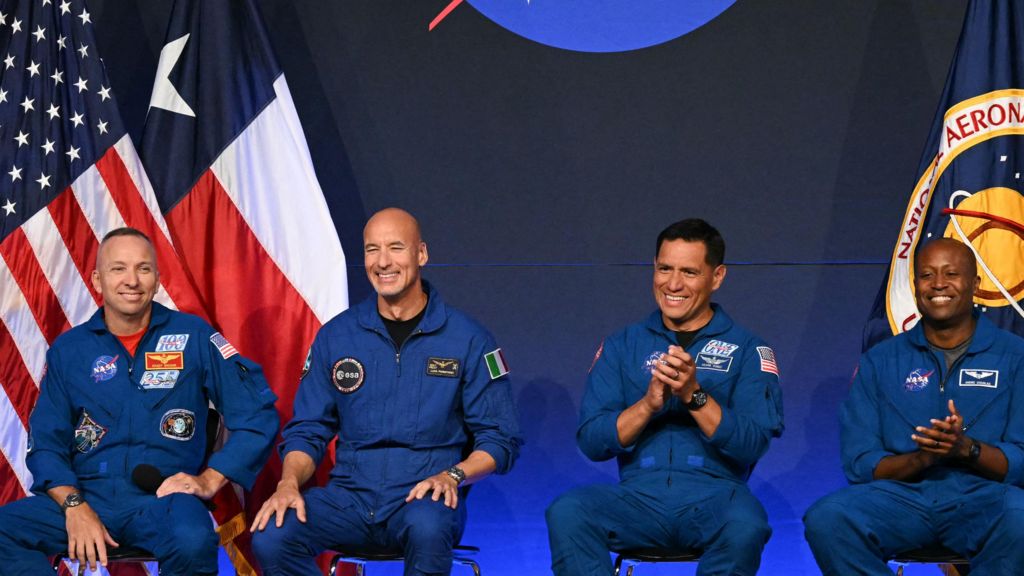
NASA has officially introduced the four-person crew for its long-awaited Artemis III mission, a mission whose scope has shifted dramatically from its original groundbreaking goal in the face of unexpected technical and infrastructure setbacks across its commercial partner network. Originally pitched as humanity’s first crewed lunar landing since NASA’s Apollo 17 mission in 1972, the 2027 flight was meant to see two astronauts touch down near the Moon’s permanently shadowed south pole to conduct a week of surface research.
In a major course correction announced in February this year, however, NASA redefined Artemis III as a low-Earth orbit test flight, operating only marginally farther from Earth than the International Space Station. Its new core objective will be to complete docking maneuvers with prototype lunar landers, a key procedural test that agency leaders say is critical before attempting a full landing attempt. Despite the scaled-back orbital profile, NASA Administrator Jared Isaacman framed the mission as a historic engineering challenge, noting that it will demand unprecedented coordination between government teams and private spaceflight stakeholders for a series of heavy-lift rocket launches.
The agency has now named the full core crew: veteran NASA astronaut Randy Bresnik will command the mission, while Italian Space Agency astronaut Luca Parmitano, who has accumulated more than 300 days of on-orbit experience across previous missions, will serve as pilot. Rounding out the core team are mission specialists Andre Douglas and Frank Rubio, both American astronauts. Experienced test pilot Bob Heintz, who has 170 days of spaceflight time under his belt, will act as backup, ready to step into any role on the crew if needed.
The major reshaping of Artemis III traces back to unresolvable delays in the development of SpaceX’s Starship, the craft selected to ferry astronauts from lunar orbit down to the Moon’s surface. A March 2026 report from the U.S. Government Accountability Office found that SpaceX had only made limited progress in maturing two critical, untested technologies: in-orbit refueling and cryogenic propellant storage. Starship’s massive size means it cannot reach lunar orbit without being refueled in low-Earth orbit first, a process that requires multiple sequential fuel tanker launches to transfer super-cold liquid methane and liquid oxygen to the crew vehicle – a complex maneuver that has never been successfully demonstrated in space. Agency officials also concluded that jumping straight from Artemis II’s upcoming lunar flyby to a full landing would carry too much risk, making an Earth-orbit docking test a necessary intermediate step.
Worsening the program’s timeline pressures, the Artemis program suffered a second major setback in late May when a catastrophic explosion destroyed Blue Origin’s New Glenn rocket during a routine hot-fire engine test. The blast left the launch pad extensively damaged, and no personnel were injured in the incident. Unlike SpaceX, which had alternate launch infrastructure after a 2016 explosion that kept it out of service for 15 months, Blue Origin has no backup pad for New Glenn launches, leaving the company facing months of potential downtime.
The damage has already created ripple effects across the entire Artemis schedule: the Blue Moon cargo lander, planned for a possible launch to the Moon as early as fall 2026, is now at high risk of missing its launch window. The crewed Blue Moon lander planned for Artemis IV faces major timeline uncertainty, and even the two prototype landers Artemis III is supposed to test are now facing scheduling questions.
In NASA’s most optimistic current projection, Artemis III will launch in 2027 as an orbital demonstration, followed by Artemis IV’s targeted lunar landing in early 2028, and Artemis V – which will carry out a second landing and begin construction of a lunar outpost – later that same year. While Blue Origin vice president John Couluris says the company and NASA are working around the clock to get back on track for a 2027 launch, most independent space analysts view that timeline as extremely aggressive.
Growing geopolitical competition adds extra urgency to NASA’s timeline: China has publicly targeted a 2030 crewed lunar landing, and a December 2025 executive order from former President Trump required NASA to return astronauts to the Moon by 2028 – the end of his current presidential term – and have initial base infrastructure in place by 2030. Many experts warn that the deck is stacked against NASA meeting its current goals. “It would not surprise me at all if China gets there first,” Dr. Simeon Barber, a lunar scientist at the Open University, told BBC News.
With untested refueling technology for Starship still undemonstrated and a key commercial partner left without a working launch pad, NASA’s path to a lunar landing now depends on a long chain of entirely unproven procedures all going exactly according to plan, leaving the agency with very little margin for error. Following the May explosion, Isaacman reaffirmed NASA’s commitment to supporting Blue Origin’s recovery efforts, but the critical open question remains: how long will recovery take, and can the already tight Artemis timeline absorb the delay?