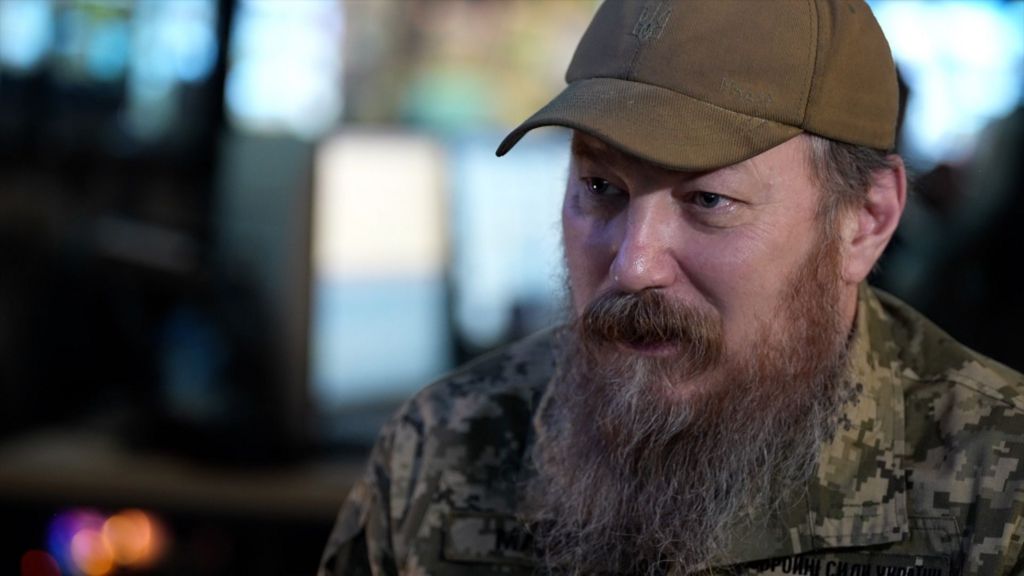
In a rare on-the-record interview with the BBC from a hidden, heavily secured launch site in eastern Ukraine, the commander of all of Kyiv’s unmanned military forces has laid out Ukraine’s escalating strategy of deep strikes into Russian territory, a campaign that has grown in intensity over recent weeks to levels never seen before in the full-scale invasion.\n\nRobert Brovdi, an ethnic Ukrainian Hungarian from the western city of Uzhhorod who goes by the military call sign “Magyar”, says his drone units have become a constant, disruptive threat to Russian forces, bringing the war home to Russian territory that Moscow has long considered an unassailable, peaceful rear. “We’re like a red rag to the enemy. Because we’re taking the war to their territory so that they feel it too,” Brovdi told the BBC. “1,500 to 2,000km inside Russian territory is no longer the ‘peaceful rear’. The freedom-loving Ukrainian ‘bird’ flies there whenever and wherever it wants.”\n\nOn the drizzly, unmarked field where the reporting team visited, crews worked at breakneck speed to assemble and prepare a long-range drone for launch, racing against the clock to avoid detection by Russian electronic warfare systems and subsequent ballistic missile strikes. After a shouted launch command, the engine roared to life, and the small, jet-like drone lifted off in a flash of white streaking skyward, bound for targets deep inside Russia.\n\nIn recent weeks, these deep strikes have overwhelmingly prioritized Russian oil export and energy infrastructure, causing what Ukrainian President Volodymyr Zelensky has described as tens of billions of dollars in critical losses for Moscow’s energy sector, even amid the recent rally in global crude oil prices. Brovdi defends the targeting of energy facilities, arguing that Russian fossil fuel revenues directly fund the invasion of Ukraine. “Putin extracts natural resources and converts them into blood dollars that they then direct against us in the form of Shahed drones and ballistic missiles,” he said. “If oil refineries are a tool to make money that’s used for war, then they are a legitimate military target, subject to destruction.”\n\nFollowing repeated strikes on the Tuapse refinery on Russia’s Black Sea coast, local residents have reported toxic rain and widespread disruption to daily life, a outcome Brovdi views as an intentional, necessary consequence of the invasion Russia launched.\n\nThe expansion of Ukraine’s long-range drone campaign has been enabled by two key shifts: advances in domestic drone manufacturing, and a deliberate strategic reorientation to prioritize these deep strikes. Locally produced Ukrainian drones are now cheaper than ever, with extended flight ranges: the model launched during the BBC’s visit can travel more than 1,000 kilometers, and other models already in service can fly twice that distance.\n\nBrovdi commands Ukraine’s Unmanned Systems Forces from a high-tech underground command bunker, accessed through blacked-out van rides and reinforced staircases lined with sleeping quarters for personnel. The cavernous operations room is lined floor-to-ceiling with display screens, where dozens of operators in casual clothing monitor real-time video feeds from drone pilots across the frontline and deep inside Russia. Despite making up only 2% of Ukraine’s total military manpower, Brovdi says his forces are responsible for one-third of all Russian targets destroyed in Ukraine, with an annual casualty rate for his own personnel of less than 1% – a stark contrast to high frontline casualty rates for conventional infantry units. All strikes are recorded for verification and logged in a real-time public scoreboard displayed on one wall of the command center.\n\nBefore Russia’s full-scale invasion, Brovdi was a wealthy grain dealer and art collector, comfortable in international auction houses like Christie’s rather than underground military bunkers. Fragments of his pre-war life remain: works by Ukrainian artists are displayed throughout the command center alongside decommissioned missile casings and captured Russian drones. A clean-shaven civilian before 2022, he now sports a long, mixed ginger and grey beard.\n\nBrovdi joined Ukraine’s Territorial Defence forces just weeks before the full-scale invasion, saying “we all knew war was inevitable.” He fought in some of the war’s bloodiest engagements, including the months-long battle for Bakhmut. His interest in drone warfare began unexpectedly when he was pinned down by Russian fire in Kherson: he recalled a small recreational drone he had bought for his own children, and began integrating similar devices into his unit’s operations. What started as a tactic for self-preservation quickly transformed his unit’s capabilities, allowing them to spot Russian positions and relay coordinates to artillery units for precision strikes. Within months, his unit was building its own armed drones, and gained renown as the 414th Brigade, nicknamed the “Birds of Magyar.”\n\nBrovdi’s strategy goes far beyond deep strikes on Russian energy infrastructure. A second core priority is eroding Russia’s manpower advantage, a pressing need as Ukraine faces its own challenges mobilizing new frontline troops. “Those who wanted to fight are already fighting,” Brovdi acknowledged. To offset this disadvantage, he has ordered his units to kill more Russian soldiers each month than Russia can recruit new personnel – a target of more than 30,000 enemy casualties per month. “30% of all drone strikes have to be against military personnel. You can call it a kill plan, yes, and right now we are exceeding it,” he said, adding that his forces have hit the target for four consecutive months, with every casualty verified by video footage to be counted. The BBC was not able to independently verify this casualty claim.\n\nBrovdi frames the brutal strategy as a matter of survival for Ukraine. “Russian troops are far beyond their own borders, sent by Putin who wants to destroy our nation. If we don’t kill them, they kill us. That is clear,” he said. He rejects any suggestion of moral ambiguity, refusing to “be gnawed by pity” for enemy troops deployed to attack his country.\n\nA third, less discussed pillar of Brovdi’s strategy is targeting Russian domestic morale. He says Putin cannot afford to end the war given the catastrophic political risks of a failed invasion, so putting constant pressure on Russian civilians and institutions deep inside the country is critical to creating domestic discontent with the war. Viral footage of distraught Tuapse residents whose lives have been upended by drone strikes, he argues, is a sign that the cost of the war is finally reaching ordinary Russians, beyond the small circles of opposition that have criticized Putin since the invasion began. “With every drone, I aim to make more Russians question the war their country is fighting and the president who started it,” he said.\n\nUnlike some Ukrainian military and political leaders who have framed the war’s goal as a full reconquest of all occupied Ukrainian territory through large-scale counter-offensives, Brovdi says he has no illusions about his forces’ role. His goal, he says, is not seizing large swathes of land, but containing Russian advances and slowing any offensive progress. “We have an effective weapon: not to conduct an offensive war, but to prevent the enemy advancing effectively on our territory,” he said. He dismissed Putin’s stated goal of seizing the remainder of Ukraine’s Donbas region within months as absurd. “What is he smoking? That’s not realistic. It’s absurd,” he said.
标签: Europe
欧洲
-

King Charles III heads to Washington on a delicate mission to restore the UK-US relationship
Two hundred and fifty years after the 13 American colonies severed formal political ties with the British Empire under King George III, George III’s direct descendant King Charles III will touch down in Washington, D.C. on Monday for a landmark four-day state visit — one unfolding at a moment of unprecedented strain across the Atlantic and heightened focus on security protocols.
Just two days before the king’s arrival, a shooting incident at a Washington-area dinner attended by U.S. President Donald Trump prompted urgent last-minute security reviews of the itinerary, which is designed to mark the 250th anniversary of U.S. independence and honor the longstanding “special relationship” between the two nations. Buckingham Palace quickly confirmed that the king was deeply relieved to learn Trump, First Lady Melania Trump, and all other attendees escaped unharmed, and that after a full security assessment, the visit would go forward as originally scheduled.
Political tensions have loomed over the trip long before the security scare. A growing rift between the Trump administration and the U.K.’s Labour government led by Prime Minister Keir Starmer, rooted primarily in disagreements over U.S. military action against Iran, has elevated the political stakes of the royal visit. In recent weeks, Trump has launched repeated public attacks on Starmer, criticizing the prime minister for refusing to join U.S. strikes on Iran and dismissing him as a far cry from Winston Churchill — the World War II leader who first coined the term “special relationship” to describe the bilateral bond.
This friction with the U.K. is part of a broader rift between Trump and NATO allies, whom the president has publicly derided as “cowards” and “useless” for declining to participate in anti-Iran military action. Adding to the unease, a leaked Pentagon email recently suggested the U.S. could revisit its longstanding position backing British sovereignty over the Falkland Islands — the South Atlantic territory that sparked a 1982 war between the U.K. and Argentina.
Despite these public disagreements, Trump has repeatedly emphasized that political tensions will not overshadow the royal visit, noting the British monarch holds no formal governing power and bears no responsibility for NATO policy disputes. The president has spoken in consistently glowing terms about King Charles, referring to him as a personal friend and a “great guy,” and has highlighted his own landmark September 2024 state visit to the U.K. — an unprecedented second state visit for a U.S. president, hosted by the royal family at Windsor Castle with full ceremonial pomp including scarlet guardsmen, military brass bands, and a state banquet. Starmer personally delivered the king’s invitation for this return visit to the Oval Office just five weeks after Trump’s second inauguration, a deliberate public outreach effort to mend bilateral relations.
“President Trump has always had great respect for King Charles, and their relationship was further strengthened by the president’s historic visit to the United Kingdom last year,” White House spokesperson Anna Kelly told the Associated Press. “The president looks forward to a special visit by Their Majesties, which will include a beautiful state dinner and multiple events throughout the week.” Trump himself told the BBC he believes the king’s visit “absolutely” can help repair frayed transatlantic ties, adding, “He’s fantastic. He’s a fantastic man. Absolutely the answer is yes.”
Not all stakeholders have supported proceeding with the visit, however. Some U.K. politicians have publicly called for the trip to be canceled, warning it puts the monarchy in an awkward and potentially embarrassing position amid Trump’s controversial rhetoric. Those concerns were amplified after recent public broadsides Trump launched against Pope Leo XIV. Ed Davey, leader of the U.K.’s centrist opposition Liberal Democrats, labeled Trump “a dangerous and corrupt gangster” in remarks to the House of Commons earlier this month and urged the government to scrap the itinerary. “I really fear for what Trump might say or do while our king is forced to stand by his side,” Davey said. “We cannot put His Majesty in that position.” Starmer has pushed back against those calls, defending the visit by noting that the monarchy has long built cross-generational connections that bolster critical bilateral ties.
Another shadow hanging over the visit is the ongoing controversy surrounding the king’s younger brother, Prince Andrew, who was stripped of his honorary royal titles and exiled from public life over his long-standing friendship with convicted sex offender Jeffrey Epstein. Andrew has repeatedly denied any criminal wrongdoing, but survivors of Epstein’s abuse have publicly called on King Charles to meet with them during the U.S. trip, a step that observers widely expect the king will not take.
This visit marks a historic first for King Charles: while he has traveled to the U.S. 19 times previously, this is his first official state visit to the country since he ascended the throne following Queen Elizabeth II’s death in 2022. The 77-year-old monarch, who revealed an undisclosed cancer diagnosis in early 2024, will be accompanied throughout the four-day trip by Queen Camilla. Beyond the core Washington engagements — which include a private tea with the Trumps, a White House garden party, a formal state dinner, and a one-on-one bilateral meeting with President Trump — the royal couple will travel to New York to visit the National September 11 Memorial and Museum, then to Virginia for a public 250th anniversary “block party” where the king will meet Indigenous leaders working on nature conservation, a policy issue he has championed for decades.
The diplomatic centerpiece of the visit will come on Tuesday, when King Charles addresses a joint meeting of the U.S. Congress. He will be only the second British monarch ever to receive this honor, following Queen Elizabeth II’s 1991 address to Congress. On that occasion, the late queen praised liberal democratic values, rejected the idea that “power grows from the barrel of a gun,” and celebrated the shared cultural and ethnic diversity of both nations.
As University of Exeter American history professor Kristofer Allerfeldt notes, the two governments hold sharply different objectives for the high-profile visit. “For Charles, the trip is about reinforcing long-term ties, showcasing the monarchy’s soft power and reminding the world that Britain still carries diplomatic weight,” Allerfeldt explained. For Trump, by contrast, the event is largely a media spectacle focused on ceremonial optics, resembling a meeting “of two gilded monarchs.”
While the king’s long-held policy priorities — from climate action to interfaith harmony — stand in clear contrast to Trump’s policy agenda, observers do not expect him to openly highlight those differences. Instead, Allerfeldt suggests the monarch will likely use subtle rhetoric to convey his perspective in the congressional address. “He does have an unorthodox way of looking at the world, and I think maybe he can actually have something valid to say when he addresses Congress,” Allerfeldt said.
More broadly, the visit underscores the enduring role of the British monarchy as a tool of soft power, more than three centuries after the crown lost all formal political power in the U.K. Elected governments continue to deploy royal state visits to smooth strained international relationships and signal the U.K.’s core global priorities, a tradition King Charles is carrying forward with this trip.
-

Italian soccer rocked by another refereeing scandal as head of referees Rocchi faces fraud probe
Italian soccer is grappling with yet another high-profile crisis, this time a criminal investigation into top refereeing officials for alleged sports fraud, coming just weeks after the men’s national team suffered a devastating third consecutive failure to qualify for the FIFA World Cup.
Gianluca Rocchi, the chief of refereeing operations for Italy’s top two men’s divisions, Serie A and Serie B, has been named in a criminal probe connected to claims of match influence through referee selection and Video Assistant Referee (VAR) manipulation. He will make his first court appearance in Milan this Thursday. Andrea Gervasoni, a senior VAR supervisor working alongside Rocchi, is also facing the same criminal investigation.
In response to the investigation announcement, Rocchi has voluntarily stepped back from his official post pending the outcome of the judicial process. He stands accused of two key violations: manipulating VAR match decisions and altering pre-assigned referee selections for high-stakes fixtures to favor specific clubs.
Serie A president Ezio Simonelli released an official statement addressing the unfolding scandal, emphasizing the league’s core commitment to upholding transparency and fair play across all competitions. “Trusting in the work of the competent judicial bodies, it cannot be a notice of investigation that calls into question the intellectual honesty and the work of an entire system,” Simonelli said. “If it turns out that someone made a mistake, it will be right for them to pay. But it is never allowed to question the credibility of the system and the regularity of the championship.”
The investigation centers on incidents that occurred during the ongoing 2024-25 Serie A season. One specific incident under scrutiny is the March 1, 2025 league match between Udinese and Parma, where Rocchi allegedly intervened in VAR operations by banging on the window of the VAR officiating booth and pressuring officials to conduct an on-field review of a potential penalty call.
Italian media reports have also outlined a second line of inquiry into Rocchi’s referee assignment process. Investigators are examining claims that he re-assigned a scheduled referee for an Inter Milan fixture to an official alleged to be more favorable to the Nerazzurri, the club’s popular nickname. Inter Milan, which finished the 2024-25 season just one point behind eventual champions Napoli, has not been implicated in any wrongdoing connected to the alleged incident.
The Italian Football Federation (FIGC) previously opened an internal disciplinary probe into the Udinese-Parma VAR incident last year, but ultimately dismissed all proceedings against Rocchi in July. The scandal has now been reignited after Milan judicial authorities launched the formal criminal investigation, bringing fresh scrutiny to Italian soccer’s governing structures.
FIGC Prosecutor Giuseppe Chiné confirmed that the federation is maintaining close communication with Milan’s public prosecutor’s office, and has stated that the governing body will reconsider reopening its own internal investigation if new, credible evidence emerges from the criminal probe.
This latest controversy arrives at a moment when Italian soccer is already reeling from institutional upheaval. Earlier this month, the men’s national team failed to qualify for its third straight World Cup, a historic slump that forced the immediate resignations of FIGC president Gabriele Gravina and national team head coach Gennaro Gattuso. Sports analysts note that the new refereeing scandal has deepened public distrust in Italian soccer’s governance, compounding the damage from the national team’s repeated international failures.
-
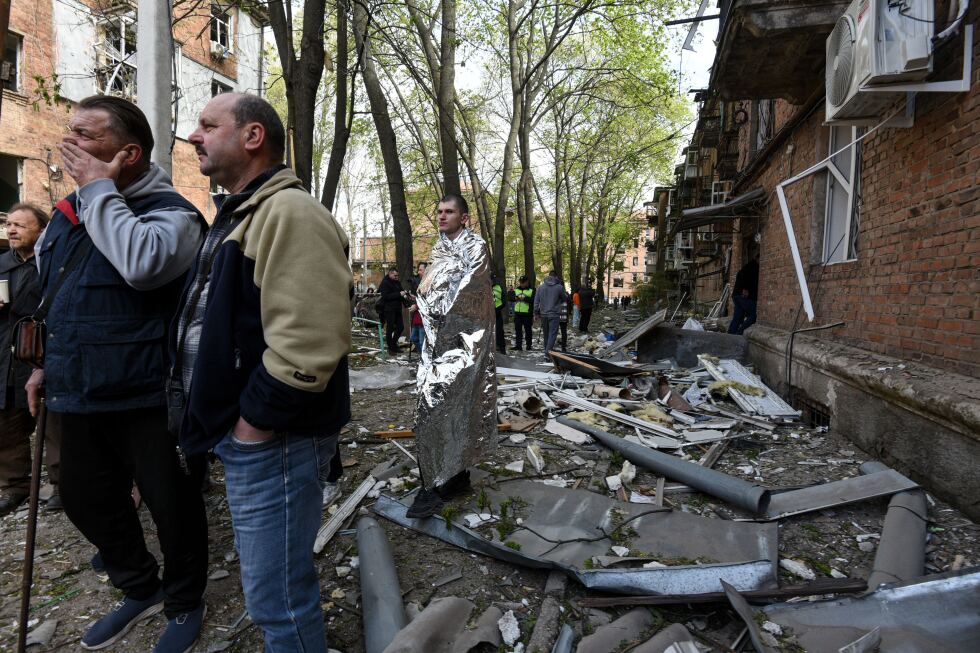
At least 16 dead in strikes as Chernobyl anniversary highlights nuclear risks of Russia-Ukraine war
On the 40th anniversary of the 1986 Chernobyl nuclear catastrophe, a wave of reciprocal drone and missile strikes across Ukraine, Russian-occupied territories and mainland Russia has left at least 16 people dead, amplifying urgent global warnings about nuclear risks stemming from more than two years of Russian full-scale invasion of Ukraine.
In southern Ukraine’s Dnipro, regional governor Oleksandr Hanzha announced Sunday that the death toll from recent Russian drone and missile attacks on the city climbed to nine. Cross-border strikes have extended into Russian-held areas as well: Moscow-appointed officials in Sevastopol, the main port on the annexed Crimean Peninsula, reported one fatality from a Ukrainian drone strike. Since Russia’s 2014 illegal annexation of Crimea, the peninsula has functioned as a key military staging and supply hub for Russian forces in the ongoing war. Further north, in Russia-claimed Luhansk Oblast of eastern Ukraine, Moscow-installed leader Leonidypasechnik stated three civilians were killed in an overnight Ukrainian drone attack on a rural village, following two deaths from a separate strike in the same region early Saturday. Ukraine has not issued official comment on any of these strikes against Russian-held territory, and the details of the attacks could not be independently verified by the Associated Press.
The streak of cross-border attacks preceded these fatal incidents: Russian local authorities reported one woman killed in a Ukrainian drone strike on the border region of Belgorod just days prior. On Sunday, Ukraine’s General Staff confirmed it had targeted a major oil refinery in Yaroslavl, a facility located hundreds of kilometers inside Russian territory. The strike ignited large fires at the refinery, which processes 15 million tons of crude annually and supplies gasoline, diesel and jet fuel directly to the Russian military. Moscow has not yet released an official response to the Yaroslavl attack.
Kyiv’s expanded long-range strike capability is rooted in its domestically produced drone program, which has developed systems capable of reaching targets 1,500 kilometers deep into Russian territory. In recent weeks, Ukraine has repeatedly targeted Russian energy infrastructure, particularly oil processing facilities. These strikes come after the Trump administration granted Russia a temporary sanctions waiver to boost energy exports, a move Kyiv has openly criticized, arguing that the additional export revenue will be funneled into new military weapons to intensify attacks on Ukraine.
The flurry of attacks coincided with global commemorations of the 40th anniversary of the Chernobyl disaster, drawing renewed attention to the ongoing threat of nuclear catastrophe at the abandoned plant. In his official address marking the anniversary, Ukrainian President Volodymyr Zelenskyy warned that Russian military aggression risks repeating the 1986 disaster. “Through its war, Russia is once again bringing the world to the brink of a man-made disaster,” Zelenskyy wrote on Facebook. “Russian-Iranian Shahed drones regularly fly over the Chernobyl plant, and one of them struck the confinement structure last year.” He added, “The world must not allow this nuclear terrorism to continue, and the best way is to force Russia to stop its reckless attacks.”
International Atomic Energy Agency (IAEA) Director General Rafael Grossi echoed these warnings during a visit to Kyiv, stressing that urgent repairs to the plant’s damaged outer protective shell must begin without delay. Grossi noted that IAEA safety assessments confirm damage from last year’s strike has already compromised a core safety function of the structure. Leaving the damage unrepaired for years, he warned, would increase risks to the original reinforced sarcophagus that contains radioactive debris from the 1986 reactor explosion. The European Bank for Reconstruction and Development has estimated that critical repairs will cost at least 500 million euros ($586 million).
Ukrainian officials say a Russian drone struck the New Safe Confinement, a $2.1 billion arch-shaped protective enclosure completed in 2019 over the ruins of Chernobyl’s Reactor No.4, in February 2024. Moscow has repeatedly denied targeting the plant, claiming Kyiv staged the incident to rally international support.
-

Sabastian Sawe of Kenya becomes first person to run a sub-2-hour marathon to win in London
On a sun-drenched, dry Sunday along the streets of London, distance running entered a new era when Kenya’s Sabastian Sawe etched his name into sports history as the first athlete to break the mythical 2-hour marathon mark in an officially sanctioned race. The 29-year-defending champion crossed the finish line on The Mall in a stunning 1 hour, 59 minutes and 30 seconds, shattering the previous world record set by Kenya’s Kelvin Kiptum at the 2023 Chicago Marathon by a massive 65 seconds. What made the performance even more extraordinary was the depth of elite competition on display: Ethiopia’s Yomif Kejelcha, running his very first career marathon, also finished under the 2-hour barrier with a time of 1:59:41, while Uganda’s Jacob Kiplimo clocked 2:00:28 – seven seconds faster than Kiptum’s prior world record.
Sawe, who retained his London Marathon title, gave credit to the tens of thousands of cheering spectators that lined the entire 26.2-mile course for pushing him to the historic achievement. “What comes today is not for me alone, but for all of us today in London,” he told reporters after the race. “I think they help a lot, because if it was not for them you don’t feel like you are so loved … with them calling, you feel so happy and strong.”
Race analysts and observers noted Sawe’s remarkable pacing strategy: he accelerated as the race progressed, covering the second 13.1 miles in just 59 minutes and 1 second. After breaking away from the lead pack alongside Kejelcha at the 30-kilometer mark, Sawe made his decisive solo push in the final two kilometers, sprinting to the finish line to roars from the crowd.
While the 2-hour barrier has been broken before, it never came in an official race context. Kenyan running legend Eliud Kipchoge first cracked 2 hours at the custom 2019 Ineos 1.59 Challenge in Vienna, an event organized specifically to target the milestone. That race used a repeated closed circuit, rotating pacemakers, and optimized conditions that did not meet World Athletics official race requirements, so Kipchoge’s 1:59:40 time was never ratified as an official world record. Sawe’s 1:59:30 mark not only bests Kipchoge’s unofficial time by 10 seconds, but came on the open, public London course under standard competition rules.
Former London Marathon champion Paula Radcliffe, commentating for the BBC, summed up the magnitude of the moment: “The goalposts have literally just moved for marathon running.” For context, at the turn of the 21st century, the men’s marathon world record stood at 2:05:42, set by Khalid Khannouchi at the 1999 Chicago Marathon. Over the subsequent 24 years, the record has been steadily lowered by a generation of elite East African runners including Haile Gebrselassie, Wilson Kipsang, Kipchoge, and Kiptum, with Sawe’s run marking the most dramatic drop in the record’s history.
The historic day delivered more than one world record, with Ethiopia’s Tigst Assefa also claiming a landmark win in the women’s race. Assefa pulled away from the field in the final 500 meters to defend her title in 2:15:41, the fastest time ever recorded in a women’s-only elite marathon. The time was 16 seconds off the overall London course record set by Radcliffe in 2003, when the women’s race ran in a mixed field alongside men.
In the wheelchair divisions, Switzerland completed a sweep of both titles. Marcel Hug claimed his sixth consecutive London men’s wheelchair championship – and eighth total – while Catherine Debrunner defended her women’s wheelchair title with a tight finish over American star Tatyana McFadden. -

Police in Northern Ireland declare security alert after reports of a car bomb explosion
BELFAST, Northern Ireland – Law enforcement in Northern Ireland has activated a major security alert in Dunmurry, a suburban town on the edge of Belfast, following confirmation that a vehicle-borne explosive device detonated close to a local police station. The Police Service of Northern Ireland (PSNI) announced Sunday that residents living in the surrounding area have been evacuated from their homes, and the general public has been urged to steer clear of the cordoned-off zone to avoid potential risks from further explosive hazards.
Local UK Member of Parliament Sorcha Eastwood, who represents the Lagan Valley constituency southwest of Belfast, spoke publicly about her reaction to the overnight incident, describing the news as deeply unsettling. “It is distressing and disturbing to wake up to the news that a car bomb exploded outside Dunmurry police station last night,” Eastwood said. She went on to note that the targeted area is a densely populated hub that is home to residential neighborhoods, local small businesses, and regularly sees large numbers of residents out for social activities or work on weekend evenings. She emphasized that the absence of any injuries or fatalities was nothing short of a stroke of luck. “It is only through the grace of God that there are no casualties,” she added.
As of Sunday, investigators have not released any confirmed details about potential suspects or the underlying motive for the attack. The incident also comes in the wake of a similar attempted bombing just one month prior roughly 32 kilometers southwest of Dunmurry, targeting another PSNI station in the town of Lurgan.
According to law enforcement accounts of the Lurgan incident, two men wearing masks intercepted a delivery driver, forced the driver at gunpoint to drive a vehicle fitted with a crude but functional improvised explosive device to the station’s entrance. The incident forced the evacuation of more than 100 local homes before a controlled explosion could be carried out to disable the device. Officials concluded the attack was orchestrated by dissident Republican factions opposed to the 1998 Good Friday Agreement, a landmark peace deal that brought an end to decades of sectarian conflict in Northern Ireland. PSNI characterized the Lurgan attack as a “pathetic attempt to remain relevant and provoke fear” among local communities.
The Good Friday Agreement, brokered in 1998, effectively ended 30 years of violent unrest known as The Troubles, which pitted Republican groups seeking unification with the Republic of Ireland against pro-union factions that wish to keep Northern Ireland part of the United Kingdom. While the peace deal has drastically reduced large-scale violence, small dissident groups that reject the power-sharing framework of the agreement continue to carry out sporadic low-level attacks targeting police and government infrastructure.
-
Despite Russia’s war, one Ukrainian city still gathers for midnight Chernobyl vigil
Four decades after the world’s worst nuclear disaster shattered communities across what is now northern Ukraine, residents of Slavutych defied wartime curfews and official warnings against large public gatherings to honor the dead and heroes of the 1986 Chernobyl catastrophe in a midnight commemoration held on the 25th of April, 2026.
Slavutych, the purpose-built city located roughly 50 kilometers from the shattered remains of the Chernobyl Nuclear Power Plant, is inextricably tied to the disaster’s legacy. Built in the aftermath of the April 26, 1986 explosion to house displaced plant workers and their families, the city welcomed its first permanent residents in 1988. Today, it holds the collective memory of a catastrophe that exposed decades of dangerous negligence and institutional secrecy under the former Soviet Union. For 48 hours after the reactor exploded, Soviet authorities hid the scale of the accident from the public, only acknowledging the disaster after radioactive fallout drifted across Northern Europe and Swedish scientists raised public alarm.
An estimated 600,000 emergency responders and cleanup workers, widely known as Chernobyl’s “liquidators,” were drafted into the deadly work of extinguishing the reactor fire and containing radioactive contamination. Thirty workers lost their lives within months of the accident, claimed by the blast or acute radiation sickness. Millions of people across Ukraine and neighboring Belarus were exposed to life-threatening radiation levels, and hundreds of towns and villages were permanently abandoned, forcing hundreds of thousands of residents into mass permanent evacuation.
Like much of northern Ukraine, Slavutych has faced new upheaval amid Russia’s full-scale invasion of Ukraine. The city was briefly occupied by Russian forces early in the war during Moscow’s failed push to capture Kyiv, and it has endured brutal winters marked by widespread power outages that left some residents cooking meals over open fires in city streets. Even with these risks and ongoing restrictions, the annual commemoration vigil has gone ahead without fail, drawing crowds of all ages to the city’s central square.
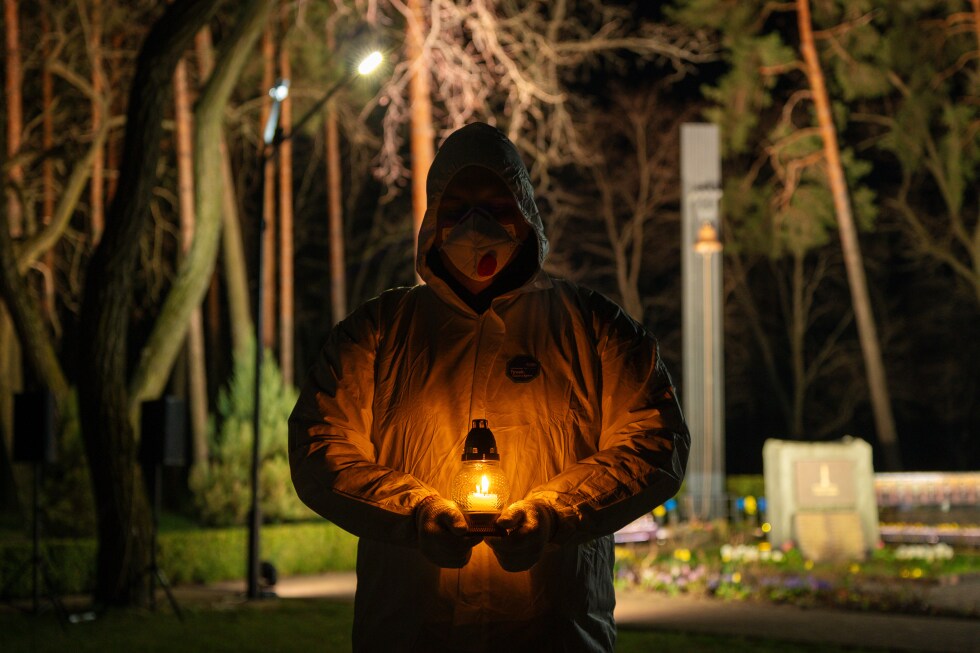
This year, attendees streamed into the plaza before midnight, many arriving as families carrying armfuls of spring tulips and daffodils. They arranged candles across the ground to form a giant radiation hazard symbol, a quiet tribute to those who lost their lives to the disaster. The gathering unfolded against a backdrop of Soviet-era apartment blocks, with a war memorial honoring local residents killed in the ongoing invasion standing a short distance away.
For many attendees, the vigil is a deeply personal ritual. Seventy-one-year-old Liudmyla Liubyva once attended the ceremony with her husband, a former Chernobyl plant worker who developed a radiation-linked disability that left him unable to walk. She told attendees that while honoring the sacrifices of liquidators remains a critical duty, Russia’s war has reignited long-dormant fears that the nuclear danger was never fully laid to rest. Referencing a 2025 Russian drone strike that damaged the New Safe Confinement — the massive steel dome constructed to seal radioactive contamination from the destroyed reactor — Liubyva said, “When the drone struck the arch, it felt like the world could return to 1986. We all — young and old alike — must protect our land, because it is so vulnerable.”
As soft instrumental music played, poetry about the disaster echoed across the square through loudspeakers. “Years pass, generations change, but the pain of Chernobyl does not fade,” a woman’s voice recited. At the front of the gathering, attendees dressed in white protective suits and face masks, symbolic of the gear liquidators were often forced to use during cleanup, stood in silent vigil holding lit candles.
Sixty-seven-year-old Larysa Panova, who was forced to abandon her native hometown of Chernobyl and resettle in Slavutych after the accident, said the new city has become her home, but she still longs for the forests and open land of the community she left behind. Before the full-scale invasion, Panova regularly traveled back to the Chernobyl Exclusion Zone to visit remaining relatives or revisit the places of her childhood. The war has cut off that access, leaving her with only memories. “I never stop thinking of Chernobyl as my homeland,” Panova said. “You remember your school, your childhood, your youth — everything happened there, in Chernobyl.”
This reporting was contributed by AP correspondents Vasilisa Stepanenko and Volodymyr Yurchuk based in Kyiv, with financial support for nuclear security coverage provided by the Outrider Foundation. The Associated Press retains full editorial control over all content.
-

A growing amateur choir brings joy and community to hundreds in Serbia
Four years after launching with just a couple dozen singers in the small central Serbian town of Gornji Milanovac, an unconventional amateur pop choir has grown into a nationwide movement, offering a much-needed outlet for joy and connection in a country grappling with persistent political division and social tension.
Founded by trained music educator Nenad Azanjac and his wife, Pop Hor (Pop Choir) operates on a radical, inclusive founding principle: anyone can sing, no experience required. Unlike most traditional vocal groups, the organization has no auditions, no mandatory music reading skills, and no voice tests—an approach that sets it apart in Serbia, where community choirs remain far less common than in many other parts of the world. Modeled after inclusive international community singing projects, the initiative invites participants ranging in age from 5 to 105, framing group singing as a tool for stress relief and joy rather than professional performance.
Today, the movement has expanded to 10 cities across the Balkan nation, attracting hundreds of members, the vast majority of whom are women of all generations. Since its 2022 founding, roughly 2,000 people have sung with Pop Hor, and the group’s founders have ambitious plans to expand across the entire Balkan region. Weekly performances regularly fill community halls and venues across Serbia, with the choir’s repertoire drawing primarily from popular Serbian music, alongside occasional tracks from Croatian and Bosnian artists. Despite its entirely amateur status, the group has even been invited to perform at festivals and public events both across Serbia and in neighboring countries.
For many members, the choir has become a vital escape from the daily stress of Serbia’s volatile political climate. Seventy-two-year-old member Nevenka Bila, who participates in ongoing pro-democracy protests across the country, explained that the choir offers a gentle, positive counterpoint to the tension of public activism. “In this madness that we are living, where I spend half of my free time in the streets fighting for basic human rights, I found something that feels so good for me,” Bila said. “I discovered a new world.”
Sixty-two-year-old economist Radmila Kozarac echoed that sentiment, saying the choir has transformed her life for the better. “I never miss a class,” Kozarac said, noting that she has formed deep new friendships through the group and looks forward to post-rehearsal coffee and chats with fellow members. “It is joyful, it reduces stress,” she said of the group’s impact on her mental health.
Experts back up the perceived mental health benefits of the choir’s model. Aleksandra Djuric, a psychologist and professor at Belgrade’s Singidunum University, explained that group singing has well-documented positive neurobiological and psychological effects. When people sing together, she noted, shared collective energy lowers stress hormone (cortisol) levels while boosting production of endorphins and other positive mood hormones tied to connection and happiness. At a time when most people are constantly bombarded by overwhelming, often distressing news and information, Djuric emphasized the critical need for dedicated spaces to disconnect, relax, and build social connection.
Serbia has a long history of systemic stress: the country endured years of armed conflict, international sanctions, and crippling economic crisis in the 1990s, and remains politically fractured today, with ongoing economic struggles. In 2024, widespread youth-led protests erupted against the government of populist President Aleksandar Vucic, triggered by a deadly train station accident that many blamed on systemic negligence and corruption in large state-run infrastructure projects.
Azanjac said many new members join the choir on the recommendation of their therapists, who prescribe group singing as a natural way to manage chronic stress. For these participants, the biggest benefit is not singing itself—but the sense of belonging and togetherness the group fosters. “Singing comes second, socializing comes first,” Azanjac said, adding that participants “find a sense of belonging here, they enjoy it.” With growing momentum across Serbia, Azanjac says the movement will continue expanding: his end goal is to get the entire Balkan region singing together.
-

How the Irish novelty song that ‘toppled’ Céline Dion is making a comeback
Three decades after upsetting global superstars to claim the top spot on Ireland’s music charts, beloved Irish comedic singer-songwriter Richie Kavanagh’s iconic hit *Aon Focal Eile* has captured a whole new generation of fans, going viral across social media platforms. To mark the 30th anniversary of the track’s historic 1996 chart run, Kavanagh has teamed up with his grandson CJ to re-release the cheeky hit, which leans into playful wordplay around a vulgar Irish four-letter term. A collaborative TikTok clip of the pair performing the track side-by-side has already racked up more than 500,000 views, catapulting the 77-year-old entertainer back into the spotlight. “I’m probably more popular now than I was when we had the number one hit,” Kavanagh shared in a recent interview.
-
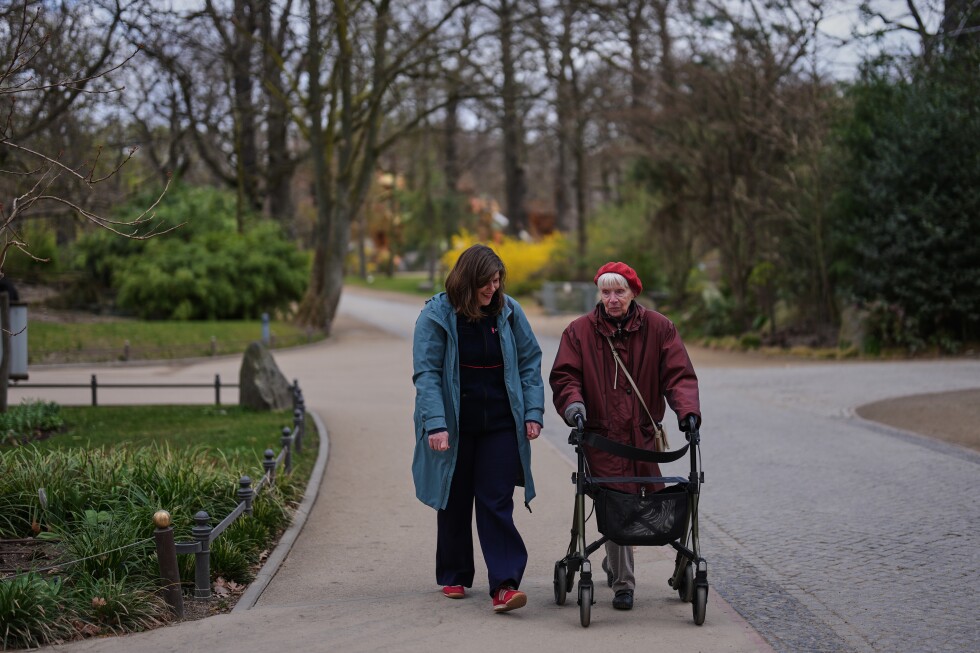
Getting the most out of barrier-free tours for yourself or someone with a disability
For millions of people living with disabilities around the world, tourism has long been marked by preventable obstacles. These barriers range from highly visible infrastructure gaps — such as a broken elevator at a popular attraction — to invisible challenges that are often overlooked: an overly long walking itinerary that causes exhaustion, or a crowded, loud environment that triggers sensory overload.
As the large baby boomer generation continues to age, the global travel industry has begun to shift toward catering to older adults, who typically have both disposable income and flexible time for international sightseeing, and many of whom require some form of travel assistance. But industry advocates note that true inclusive accessibility extends far beyond just aging travelers, needing to accommodate a far broader range of visitors: from people living with permanent physical disabilities, to neurodivergent travelers on the autism spectrum, to those living with dementia.
To better serve both travelers with visible and invisible disabilities, museums, cultural institutions and tourism organizations across the globe are rolling out specialized programming and barrier-free tour options, many enabled by modern technological innovation. These customized offerings include sign-language guided tours for Deaf and hard-of-hearing visitors, tactile exhibit experiences for guests who are blind or have low vision, and structured outings designed specifically to meet the needs of neurodivergent travelers. Dedicated travel agencies focused exclusively on serving disabled travelers have also emerged in regions across the world to fill gaps in mainstream offerings.
Ashley Grady, an accessibility program specialist at the Office of Visitor Accessibility at Washington D.C.’s Smithsonian Institution, explains that offering intentional barrier-free services sends a clear message that disabled travelers are valued guests in public cultural spaces. “These services are a way of saying, ‘we’ve thought of you,’” Grady said. “We want you to come to our museums. We want you to see yourselves reflected in our staff and our collections. And we want to make these programs as accessible as possible for you, your family, your loved ones, your friends.”
Despite this progress, significant gaps in accessible tourism remain industry-wide. Ivor Ambrose, managing director of the nonprofit European Network for Accessible Tourism, points out that there is still a widespread lack of awareness about the wide spectrum of accessibility needs that different disabled travelers require. “This is actually a really big market and an opportunity, which is still not fulfilled by the operators in all these different areas of tourism,” Ambrose noted.
To help disabled travelers navigate existing options and advocate for themselves, accessibility experts share three key pieces of advice for planning an enjoyable, accessible trip.
First, prioritize detailed research and advance planning. Josh Grisdale, founder of Accessible Japan — a resource platform for disabled travelers visiting Japan — has cerebral palsy and uses a power wheelchair. When planning trips to new destinations, he cross-references information from multiple public sources: browsing travel discussions on Reddit, watching user-generated travel videos on YouTube, and using Google Street View to scout for potential barriers like stairs that would block wheelchair access. Grisdale also recommends contacting a destination’s concierge or visitor services ahead of time to confirm accessibility details, as most cultural institutions now publish their barrier-free offerings online. To address the global lack of centralized, lived-experience accessibility information, Grisdale launched *tabifolk*, a crowdsourced platform where disabled travelers can share on-the-ground knowledge about accessible destinations worldwide. “Even though I’m in a wheelchair and I’ve had a disability my whole life, there’s things that I don’t know about other disabilities,” he explained.
In Africa, where iconic travel experiences like safaris and Mount Kilimanjaro climbs are often out of reach for disabled travelers without advance planning, advance preparation is equally critical, according to Joanne Ndirangu, founder and director of the Kenyan accessible tourism agency Scout Group Agency. Ndirangu, who advocates for expanding accessible tourism across the continent, urges disabled travelers to partner with local travel experts who have first-hand knowledge of the region’s existing accessible options. Many local experts have worked directly with hotels and restaurants to install accessibility features like ramps and train staff to support neurodivergent guests, and can steer travelers away from inaccessible spots while offering equally compelling alternatives. “Let’s say you want to see giraffes somewhere,” Ndirangu gave as an example. “I can now advise you, ‘That place is not viable if you’re on a wheelchair or on crutches because of the hills and the valleys.’ So I can give you an alternative — and you get to see the giraffes.”
Second, seek out specialized accessible programming instead of defaulting to general public tours. Mass-market tours are often designed for able-bodied, neurotypical travelers, with features that create barriers — from exhibits placed too high for wheelchair users to view, to loud, crowded environments that trigger sensory distress. The Smithsonian Institution, the world’s largest museum complex, addresses this gap with its popular sensory-friendly “Morning at the Museum” program, which opens participating museums to neurodivergent travelers and their families one morning a month before general public entry. During these events, visitors can explore at their own pace or participate in structured multi-sensory activities, without overwhelming crowds or noise. “We can control the environment, we can reduce the crowds,” Grady said. “It’s a completely judgment-free environment and one that’s really meant to hopefully be that full bridge to inclusion, where they are able to come to a museum, have a great experience, and then maybe come back when we’re open to the public.”
In Berlin, the Catholic aid organization Malteser Deutschland has stepped in to address another overlooked gap: accessible programming for people living with dementia. The organization developed customized barrier-free tours for this population at top local destinations including Berlin Zoo, the Museum of Natural History, Britzer Garden, and Charlottenburg Palace, with plans to expand to more locations. The Berlin Zoo tour, for example, is limited to a small group of participants and capped at 90 minutes, focusing on just a small selection of animal habitats instead of trying to cover the zoo’s entire collection, to avoid tiring or overwhelming guests.
Third, don’t hesitate to communicate your needs ahead of time, and share feedback after your visit to help improve options for future travelers. Ndirangu notes that her team proactively asks all guests about required accessibility accommodations upfront, but many travelers don’t disclose their needs, leaving agents unable to adjust plans. For example, most hotels in Kenya only offer one or two fully accessible rooms, which can be fully booked if a guest’s need isn’t communicated in advance. “Give us that opportunity to give you solutions,” Ndirangu said. “We’ve had guests who don’t mention anything.”
The European Network for Accessible Tourism encourages travel providers to fold the cost of accessibility services into overall trip pricing, rather than charging extra only to disabled guests, a model that many major cultural institutions already follow. Most museums already offer discounted entry for disabled visitors, often with free or reduced admission for travel companions.
Grady adds that the Smithsonian regularly updates its accessibility offerings based on feedback from visitors and a disabled advisory board, with changes ranging from adjusting app color contrasts for low-vision visitors to working with curators to design new exhibits to be fully accessible from the planning stage. At the end of the day, Grady says, disabled travelers aren’t asking for special treatment: “They’re not asking for anything out of the ordinary,” she said. “They’re literally just trying to experience a visit just like anyone else.”