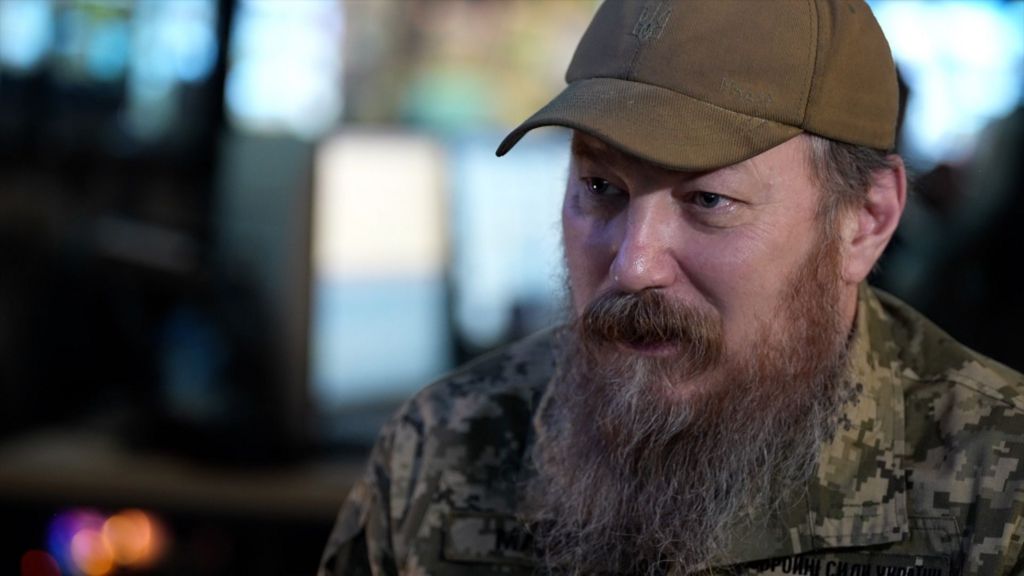
In a rare on-the-record interview with the BBC from a hidden, heavily secured launch site in eastern Ukraine, the commander of all of Kyiv’s unmanned military forces has laid out Ukraine’s escalating strategy of deep strikes into Russian territory, a campaign that has grown in intensity over recent weeks to levels never seen before in the full-scale invasion.\n\nRobert Brovdi, an ethnic Ukrainian Hungarian from the western city of Uzhhorod who goes by the military call sign “Magyar”, says his drone units have become a constant, disruptive threat to Russian forces, bringing the war home to Russian territory that Moscow has long considered an unassailable, peaceful rear. “We’re like a red rag to the enemy. Because we’re taking the war to their territory so that they feel it too,” Brovdi told the BBC. “1,500 to 2,000km inside Russian territory is no longer the ‘peaceful rear’. The freedom-loving Ukrainian ‘bird’ flies there whenever and wherever it wants.”\n\nOn the drizzly, unmarked field where the reporting team visited, crews worked at breakneck speed to assemble and prepare a long-range drone for launch, racing against the clock to avoid detection by Russian electronic warfare systems and subsequent ballistic missile strikes. After a shouted launch command, the engine roared to life, and the small, jet-like drone lifted off in a flash of white streaking skyward, bound for targets deep inside Russia.\n\nIn recent weeks, these deep strikes have overwhelmingly prioritized Russian oil export and energy infrastructure, causing what Ukrainian President Volodymyr Zelensky has described as tens of billions of dollars in critical losses for Moscow’s energy sector, even amid the recent rally in global crude oil prices. Brovdi defends the targeting of energy facilities, arguing that Russian fossil fuel revenues directly fund the invasion of Ukraine. “Putin extracts natural resources and converts them into blood dollars that they then direct against us in the form of Shahed drones and ballistic missiles,” he said. “If oil refineries are a tool to make money that’s used for war, then they are a legitimate military target, subject to destruction.”\n\nFollowing repeated strikes on the Tuapse refinery on Russia’s Black Sea coast, local residents have reported toxic rain and widespread disruption to daily life, a outcome Brovdi views as an intentional, necessary consequence of the invasion Russia launched.\n\nThe expansion of Ukraine’s long-range drone campaign has been enabled by two key shifts: advances in domestic drone manufacturing, and a deliberate strategic reorientation to prioritize these deep strikes. Locally produced Ukrainian drones are now cheaper than ever, with extended flight ranges: the model launched during the BBC’s visit can travel more than 1,000 kilometers, and other models already in service can fly twice that distance.\n\nBrovdi commands Ukraine’s Unmanned Systems Forces from a high-tech underground command bunker, accessed through blacked-out van rides and reinforced staircases lined with sleeping quarters for personnel. The cavernous operations room is lined floor-to-ceiling with display screens, where dozens of operators in casual clothing monitor real-time video feeds from drone pilots across the frontline and deep inside Russia. Despite making up only 2% of Ukraine’s total military manpower, Brovdi says his forces are responsible for one-third of all Russian targets destroyed in Ukraine, with an annual casualty rate for his own personnel of less than 1% – a stark contrast to high frontline casualty rates for conventional infantry units. All strikes are recorded for verification and logged in a real-time public scoreboard displayed on one wall of the command center.\n\nBefore Russia’s full-scale invasion, Brovdi was a wealthy grain dealer and art collector, comfortable in international auction houses like Christie’s rather than underground military bunkers. Fragments of his pre-war life remain: works by Ukrainian artists are displayed throughout the command center alongside decommissioned missile casings and captured Russian drones. A clean-shaven civilian before 2022, he now sports a long, mixed ginger and grey beard.\n\nBrovdi joined Ukraine’s Territorial Defence forces just weeks before the full-scale invasion, saying “we all knew war was inevitable.” He fought in some of the war’s bloodiest engagements, including the months-long battle for Bakhmut. His interest in drone warfare began unexpectedly when he was pinned down by Russian fire in Kherson: he recalled a small recreational drone he had bought for his own children, and began integrating similar devices into his unit’s operations. What started as a tactic for self-preservation quickly transformed his unit’s capabilities, allowing them to spot Russian positions and relay coordinates to artillery units for precision strikes. Within months, his unit was building its own armed drones, and gained renown as the 414th Brigade, nicknamed the “Birds of Magyar.”\n\nBrovdi’s strategy goes far beyond deep strikes on Russian energy infrastructure. A second core priority is eroding Russia’s manpower advantage, a pressing need as Ukraine faces its own challenges mobilizing new frontline troops. “Those who wanted to fight are already fighting,” Brovdi acknowledged. To offset this disadvantage, he has ordered his units to kill more Russian soldiers each month than Russia can recruit new personnel – a target of more than 30,000 enemy casualties per month. “30% of all drone strikes have to be against military personnel. You can call it a kill plan, yes, and right now we are exceeding it,” he said, adding that his forces have hit the target for four consecutive months, with every casualty verified by video footage to be counted. The BBC was not able to independently verify this casualty claim.\n\nBrovdi frames the brutal strategy as a matter of survival for Ukraine. “Russian troops are far beyond their own borders, sent by Putin who wants to destroy our nation. If we don’t kill them, they kill us. That is clear,” he said. He rejects any suggestion of moral ambiguity, refusing to “be gnawed by pity” for enemy troops deployed to attack his country.\n\nA third, less discussed pillar of Brovdi’s strategy is targeting Russian domestic morale. He says Putin cannot afford to end the war given the catastrophic political risks of a failed invasion, so putting constant pressure on Russian civilians and institutions deep inside the country is critical to creating domestic discontent with the war. Viral footage of distraught Tuapse residents whose lives have been upended by drone strikes, he argues, is a sign that the cost of the war is finally reaching ordinary Russians, beyond the small circles of opposition that have criticized Putin since the invasion began. “With every drone, I aim to make more Russians question the war their country is fighting and the president who started it,” he said.\n\nUnlike some Ukrainian military and political leaders who have framed the war’s goal as a full reconquest of all occupied Ukrainian territory through large-scale counter-offensives, Brovdi says he has no illusions about his forces’ role. His goal, he says, is not seizing large swathes of land, but containing Russian advances and slowing any offensive progress. “We have an effective weapon: not to conduct an offensive war, but to prevent the enemy advancing effectively on our territory,” he said. He dismissed Putin’s stated goal of seizing the remainder of Ukraine’s Donbas region within months as absurd. “What is he smoking? That’s not realistic. It’s absurd,” he said.