标签: Asia

亚洲

  • How China quietly erased Taiwan from coffee’s world stage

    How China quietly erased Taiwan from coffee’s world stage

    In April 2026, barista Bala claimed the top prize at the World Latte Art Championship in San Diego, wowing judges with intricate latte art of a raccoon, giraffe, and red pandas to secure a winning score of 531 points. The event counted Chinese coffee chain Luckin Coffee as an official sponsor, and when Bala stepped onto the winner’s podium, competition organizers initially listed him as representing Taiwan.

    What followed just one week later was a quiet, unannounced revision that has exposed how geopolitical pressure can penetrate even niche, seemingly apolitical global cultural industries. The Specialty Coffee Association (SCA), which oversees the World Coffee Championships (WCC), altered Bala’s affiliation in official records, changing the listing from “Taiwan” to “Chinese Taipei” with no public explanation. The organization went further, removing older ranking documents from its website that had for years listed past Taiwanese champions under the same original designation.

    This small bureaucratic change is far more than a trivial footnote to broader geopolitical tensions between Beijing and Taiwan. It marks a clear signal that Chinese coercive pressure has expanded into an under-monitored domain: the global governance infrastructure of the international specialty coffee sector. The incident also lays bare a stark truth: when private non-governmental organizations that manage global cultural and industrial activities face large-scale geopolitical pressure, their long-proclaimed neutrality collapses almost immediately.

    Taiwan’s specialty coffee community climbed to global prominence gradually, building its legacy over more than two decades of competition. The World Barista Championship launched in 2000, but it was not until 2007 that the first Taiwanese competitor, national champion Lin Tung-Yuan (Van Lin), stepped onto the international stage. What came next was an extraordinary streak of success: Pang-Yu Liu took gold at the 2014 World Cup Tasters Championship, while Jacky Lai won the 2014 World Coffee Roasting Championship in the same year. Berg Wu became Taiwan’s first World Barista Champion in 2016, followed by Chad Wang’s win at the 2017 World Brewers Cup, and Xie Yi-chen claimed the 2024 World Latte Art Championship title. Bala’s 2026 victory was the latest milestone in this decades-long journey.

    As recently as 2022, the SCA itself celebrated Taiwan’s thriving specialty coffee scene when it announced it would bring the WCC event to Taipei, highlighting the island’s estimated 4,000 roasters and 16 world championship finalists, explicitly naming the island’s top competitors under their Taiwanese affiliations. Through 19 years of advocacy, the Taiwan Coffee Association had fought to retain the “Taiwan” designation for its competitors — a fight that ended in defeat with the 2026 revision.

    The name change did not occur in a vacuum. Just six months prior, in October 2025, the SCA made another consequential institutional shift: it absorbed the widely recognized Q Grader Program — a global certification for coffee quality assessment held by roughly 10,000 professionals worldwide — from the Coffee Quality Institute, which had managed the program for 20 years. The SCA restructured the certification around its 2023 Coffee Value Assessment (CVA) framework, which for the first time formally recognizes origin, processing method, and cultural context as core components of a coffee’s overall value, noting publicly that “coffee is more than a score — it is culture, craftsmanship and context.”

    The contrast between this rhetoric and the quiet renaming of Taiwan is not a contradiction, but a reflection of a single underlying logic. Once origin becomes a formal part of commercial coffee value, the question of who controls how an origin is named shifts from a mundane administrative task to an exercise of geopolitical power. The progressive language of respect for cultural context serves as a market positioning tool, while the renaming demonstrates how that power is actually exercised.

    In a May 1 statement, the SCA defended its decision, framing it as a routine administrative change and pointing to the naming conventions used by the International Olympic Committee and FIFA as precedent. That comparison confirms the core issue: like these large international sports bodies, the SCA is a private organization that governs a global cultural activity while remaining highly vulnerable to pressure from its largest single market, China. Its commitment to neutrality holds only until pressure becomes too great to resist.

    Coinciding with the SCA’s revision was another major shift in the global coffee industry that underscores growing Chinese influence. In late April 2026, just days before the name change was implemented, Centurium Capital — the controlling shareholder of Luckin Coffee, the official sponsor of Bala’s winning championship — announced it had acquired iconic American third-wave coffee chain Blue Bottle Coffee from Nestle in a deal worth under $400 million. While the two events have not been publicly linked, their timing tells a broader story: Chinese capital is not only lobbying for policy changes in global coffee governance, it is actively buying up the cultural infrastructure that these global bodies regulate.

    For analysts and policymakers tracking Chinese “sharp power” expansion, the incident carries a clear warning: coercive pressure has now reached niche global sectors that have flown under the radar of most monitoring efforts. The Taipei Times reported that the name change followed suspected behind-the-scenes political pressure from China, with sources noting Luckin’s role as a top championship sponsor points to implicit Chinese influence. If a global standards body for a cultural industry can be pressured into such a change with no public pushback, no similar private global governance body is immune to the same pressure — from industry consortia to certification groups to sports federations across the world.

    For consumers who see purchasing ethically sourced specialty coffee as a small political act of supporting producers and their identities, the lesson is equally sobering. The specialty coffee industry’s widely used progressive language of honoring origin, terroir, and cultural context did not protect Taiwan’s coffee community from erasure of its identity. In fact, it created the conditions for that erasure, by shifting authority over defining origin from producers themselves to global certifying bodies.

    In response to the change, Taiwan’s coffee community has launched a public pushback, organizing a “one-person-one-email” campaign calling on the WCC to reverse the revision. Berg Wu, the 2016 world champion, was among the first to speak out publicly. “Taiwan is not just a name,” he wrote on Facebook shortly after the change. “It is an identity and a shared memory built by many competitors, coaches, judges, cafes, roasters, and all the consumers who have supported us along the way.” That 26-year-old shared legacy was altered in just seven days, a quiet reminder of how geopolitical power can reshape even the most unexpected corners of global culture.

  • Trump pauses ‘Project Freedom’ amid potential deal with Iran

    Trump pauses ‘Project Freedom’ amid potential deal with Iran

    Tensions in one of the world’s most critical energy chokepoints have taken a sudden turn, after former U.S. President Donald Trump announced a temporary halt to Washington’s newly launched naval escort mission through the Strait of Hormuz. The pause, he says, comes amid unexpected signals that a breakthrough in a negotiated agreement with Iran could be close at hand.

    Launched just days earlier amid an ongoing Iranian blockade of the strategic waterway, the U.S. mission — codenamed Operation Project Freedom — was framed by the Trump administration as an effort to free commercial vessels blocked by Tehran and secure safe passage for global maritime traffic. In a post to his Truth Social platform, Trump clarified that while the naval escort operation will be paused for a short window, the existing economic blockade on Iran will stay fully in place, unchanged.

    The pause was agreed following a request from Pakistan and other partner nations, Trump explained, to create space for negotiators to work toward finalizing and signing a new agreement between Washington and Tehran. A spokesperson for U.S. Central Command (Centcom) had previously characterized the initiative as a targeted temporary mission to protect maritime transit, designed to create what officials called a “safe corridor” and “security umbrella” spanning the strait. The spokesperson added that the U.S. had already received encouraging feedback from international shipowners and maritime insurance providers ahead of the pause. The operation, which drew on a force of more than 100 aircraft and roughly 15,000 military personnel, was billed by Trump when it launched on Sunday as a humanitarian mission to retrieve vessels that Tehran had barred from exiting the waterway. At that time, the president issued a sharp warning to Iran, stating that any attempt to interfere with the operation would trigger an immediate U.S. military response.

    The days leading up to the pause have been marked by competing, conflicting claims of military clashes between the two nations. Shortly after Trump’s initial warning, Iran’s Fars News Agency reported that Iranian forces had hit a U.S. warship with two missiles as it moved through the strait. Trump quickly denied the report the following Monday, and instead claimed that only a South Korean-flagged vessel had been struck, adding that U.S. forces had destroyed seven Iranian fast-attack boats operating in the Gulf. Iran has since denied Trump’s account of the clash.

    Located between Iran on its northern coast and Oman to the south, the Strait of Hormuz is widely recognized as the world’s most vital energy chokepoint. Roughly one-fifth of the globe’s daily crude oil and global liquefied natural gas supplies transit through the narrow waterway, making any disruption to shipping there a critical concern for global energy markets. The International Energy Agency has previously noted that a full or prolonged closure of the strait would cause the largest global supply disruption in history, cutting off more than 10 million barrels of daily oil output and reducing global LNG supplies by 20 percent.

    Trump’s announcement of the operational pause comes against a backdrop of steadily escalating regional tensions, even after a regional ceasefire went into effect on April 8. Just days before the pause, U.S. military forces claimed to have targeted multiple Iranian vessels operating in the strait. Separately, the United Arab Emirates’ defense ministry has accused Iran of carrying out back-to-back days of missile and drone attacks on Emirati territory. Iran’s foreign ministry spokesperson has rejected those accusations as entirely unfounded, insisting that all recent Iranian military action has been directed solely at U.S. targets. The spokesperson added in an official statement that Iran will not hesitate to take all necessary and appropriate measures to defend its core national interests and territorial security.

  • Bus and oil tanker collide in Indonesia, killing at least 16 people

    Bus and oil tanker collide in Indonesia, killing at least 16 people

    On a midday Wednesday in Indonesia’s Sumatra island, a devastating highway collision between a passenger intercity bus and a fuel tanker has left at least 16 people dead and four others injured, local disaster management officials confirmed. The crash unfolded on the Trans-Sumatra Highway in North Musi Rawas regency, South Sumatra province, as the bus traveling from Lubuklinggau city in South Sumatra to the neighboring city of Jambi carried roughly 20 passengers when it veered into the opposite lane and struck the oncoming tanker.

    Preliminary investigations, shared by Mugono, a local disaster agency official who goes by a single name consistent with common Indonesian naming conventions, point to a sudden mechanical emergency just moments before impact. According to initial findings, the bus began emitting sparks, prompting the driver to swerve right off the bus’s original travel lane in an attempt to prevent an on-board fire. That evasive maneuver put the bus directly in the path of the speeding oncoming tanker, leaving the tanker’s driver no time to react to avoid a catastrophic head-on crash.

    The extreme force of the collision ignited an intense blaze that quickly engulfed both the bus and the tanker, trapping dozens of people inside the burning vehicles. All fatalities died from burns sustained in the fire: the count of the dead includes the bus driver, 13 bus passengers, and the tanker’s driver and assistant. Among the four survivors pulled from the wreckage, three suffered critical burn injuries while the fourth sustained only minor harm, and all four were immediately transported to a nearby local health clinic for emergency care.

    Authorities have not yet finalized the total death toll, as officials are still working to trace the bus’s full passenger manifest and cross-check data to confirm how many people were on board at the time of the crash. Visual documentation released by Indonesia’s National Search and Rescue Agency captures the scale of the disaster: thick black plumes of smoke billow into the sky above roaring orange flames as firefighters work to extinguish the blaze. After the fire was contained, the highway was left strewn with twisted, charred metal wreckage from both destroyed vehicles.

    Rescue teams composed of disaster management personnel, local traffic police, and other first responders worked to evacuate victims and clear the crash site, but the operation faced significant complications. Multiple victims remained pinned under the wreckage, slowing recovery efforts and causing major traffic disruptions along the busy Trans-Sumatra Highway.

    This fatal collision is far from an isolated incident: deadly road and transit accidents are an all-too-common occurrence across Indonesia, a pattern widely attributed to underfunded road infrastructure and widespread lax vehicle and driver safety standards. Just one week prior to this Sumatra crash, another deadly transit incident near Jakarta, the nation’s capital, claimed 15 lives. In that earlier crash, a long-distance passenger train hit a broken-down taxi stranded on the tracks, then collided with a stopped commuter train near a suburban station. All 15 fatalities were women, all seated in the commuter train’s women-only rear carriage.

  • China is stepping up its Iran war diplomacy ahead of Trump’s summit with Xi

    China is stepping up its Iran war diplomacy ahead of Trump’s summit with Xi

    As a highly anticipated bilateral meeting between U.S. President Donald Trump and Chinese President Xi Jinping approaches, China’s growing diplomatic influence in the ongoing Iran conflict has moved into the global spotlight, following high-stakes talks Wednesday between the two nations’ top foreign policy officials in Beijing.

    Over the past decade, Beijing has steadily expanded its footprint in global diplomacy, shifting from its long-standing policy of avoiding entanglement in distant regional conflicts to emerge as a key power broker mediating disputes spanning from Southeast Asian border tensions to the war in Eastern Europe. While Beijing has not taken on the formal title of mediator in the Iran war, both Washington and Tehran have publicly acknowledged its outsized quiet influence in pushing for de-escalation of the conflict.

    The Trump administration has repeatedly pushed Beijing to leverage its close economic ties with Tehran to force the reopening of the Strait of Hormuz, a critical global oil chokepoint that Iran has blockaded amid the fighting. During Wednesday’s talks with Iranian Foreign Minister Abbas Araghchi — his first visit to Beijing since the war began on February 28 — Chinese Foreign Minister Wang Yi reiterated China’s call for an immediate comprehensive ceasefire, stating that Beijing is deeply troubled by the human and security costs of the ongoing conflict.

    “The entire international community shares a urgent collective goal of restoring normal, secure passage through the Strait of Hormuz, and China hopes all relevant parties will move quickly to answer the strong calls from the global community,” Wang told Araghchi, according to China’s official state news agency Xinhua. Wang also added that Beijing recognizes Iran’s legitimate right to develop peaceful nuclear energy and welcomes Tehran’s long-standing pledge to refrain from pursuing nuclear weapons.

    The timing of Araghchi’s visit is not accidental, with the Trump-Xi summit scheduled for next week in Beijing, where the Iran conflict is expected to top the bilateral agenda. A day ahead of the Beijing talks, U.S. Secretary of State Marco Rubio urged Chinese officials to use the meeting to pressure Tehran to lift its blockade of the strategic waterway.

    Araghchi signaled that progress on reopening the strait could be within reach, telling reporters through Xinhua that “currently, it is possible to resolve the issue of reopening the Strait of Hormuz as soon as possible.” Wang’s renewed public call for the strait’s reopening has already created new momentum for behind-the-scenes negotiations between Washington and Tehran to end the conflict, analysts note.

    Regional and global policy experts have offered mixed assessments of what the high-profile meeting signals about China’s evolving role. Tuvia Gering, a nonresident fellow at the Atlantic Council’s Global China Hub, noted that the coordinated visit demonstrates Beijing and Tehran’s aligned messaging, and reinforces China’s ambition to secure a permanent seat at the table for any future regional security agreement. “However, unless Beijing rolls out a concrete, actionable peace initiative, I would not characterize this as a meaningful shift in China’s approach to the conflict,” Gering added.

    Hoo Tiang Boon, a professor of Chinese foreign policy at Singapore’s Nanyang Technological University, pointed out that the visit was arranged at Beijing’s initiative, marking a deliberate display of China’s leverage over Tehran. “By summoning the Iranian foreign minister and holding high-profile talks, Beijing cannot be accused of sitting on the sidelines and refusing to engage,” Hoo noted.

    Many analysts highlight that China holds a unique position in any mediation efforts thanks to its status as a leading economic power with deep ties to all key stakeholders in the conflict, from Iran to major Gulf Arab states and Pakistan. Unlike most other global powers, Beijing is positioned to offer large-scale postwar reconstruction investment and targeted economic relief to war-impacted regions, tools few other actors can match.

    George Chen, a partner at the international advisory firm The Asia Group, argued that China’s role in the Iran dispute is irreplaceable. As Tehran’s largest crude oil buyer, Beijing’s policy positions carry significant weight with Iranian leadership, he noted, adding that China is also one of the few major powers that has publicly expressed sympathy for Iran’s position at the United Nations. The U.S. government has additionally noted that Iran’s ballistic missile program was developed with early Chinese technology support, and Beijing continues to sell Iran dual-use industrial components that can be repurposed for missile manufacturing.

    This is not China’s first high-profile mediation success in the Middle East. In 2023, Beijing played a central role in brokering the restoration of formal diplomatic relations between longtime regional rivals Saudi Arabia and Iran, a breakthrough that drastically reduced the risk of direct and proxy conflict across the Gulf. Muhammad Zulfikar Rakhmat, a researcher at Indonesia’s Center of Economic and Law Studies, called the 2023 deal a major geopolitical win for China, but noted that Beijing is deliberate about when it chooses to engage. “Its mediation tends to be opportunistic and low-risk, often occurring when conditions are already ripe for an agreement,” Rakhmat explained, noting that both Riyadh and Tehran already had strong incentives to re-engage before Beijing stepped in.

    Beyond the Middle East, Beijing has built a growing track record of conflict mediation in recent years. It hosted multiple rounds of talks between Thailand and Cambodia during their 2024 border conflict, and joined the U.S. for initial ceasefire negotiations in Malaysia, helping broker a second ceasefire when fighting resumed late last year. Beijing has also put forward formal peace proposals for the war in Ukraine, and even hosted Ukraine’s foreign minister for talks, despite its public “no-limits” strategic partnership with Russia.

    Experts note that China’s diplomatic messaging in global conflicts follows a consistent pattern, with Beijing repeatedly emphasizing respect for the U.N. Charter and national sovereignty. Amid the Iran conflict, President Xi last month reiterated this framing, calling for “upholding the principles of peaceful coexistence, upholding national sovereignty, upholding the rule of international law, and coordinating development and security.” Hoo noted that this consistent messaging has become a hallmark of China’s mediation efforts.

    Thitinan Pongsudhirak, a professor of international relations at Thailand’s Chulalongkorn University, argued that for distant conflicts, Beijing often faces low tangible stakes but can reap major diplomatic benefits, particularly as the world adjusts to the Trump administration’s unconventional negotiating style. “What the U.S. is doing under Trump is deeply damaging, and everyone suffers from it … and China is displaying global leadership and exerting its global role by speaking to the rules-based international system,” Pongsudhirak said. “It’s an inescapable contrast” between the two approaches to global diplomacy, he added.

    Wu contributed reporting from Bangkok.

  • Australian court rejects convicted murderer’s appeal of deportation to small island nation

    Australian court rejects convicted murderer’s appeal of deportation to small island nation

    In a landmark unanimous ruling by Australia’s highest judicial body, an Iranian man convicted of murdering his wife has lost his final legal challenge to prevent his deportation to the Pacific island nation of Nauru, clearing the way for the Australian government’s controversial multi-million-dollar resettlement deal to move forward.

    The 61-year-old perpetrator, identified in court documents only as TCXM to protect refugee confidentiality standards in Australia, had appealed a lower court’s 2023 ruling that greenlit his deportation to Nauru under a 30-year visa arrangement. All seven High Court justices rejected his appeal, closing off the last avenue of legal recourse for the convicted murderer.

    TCXM first arrived in Australia from Iran in 1990 and was granted a protection visa five years later. In 1999, he was sentenced to 22 years in prison for the fatal murder of his wife. His visa was canceled in 2015 following his conviction, and he was moved from prison to immigration detention, where he remained for eight years. Iran does not allow the forced repatriation of its citizens from other countries, and Australia maintains a longstanding policy of not refouling refugees to nations where they would face persecution, leaving Australian authorities with no clear path to remove him from the country until the Nauru deal was struck.

    The Nauru resettlement agreement emerged as a policy solution to a political and legal crisis created by a 2023 High Court ruling. That earlier decision found that Australia could no longer hold stateless people or non-citizens who cannot be returned to their home countries in indefinite immigration detention with no path to third-country resettlement. In response to that ruling, more than 350 non-citizens — many of them convicted criminals, including TCXM — were released from detention on temporary bridging visas, creating widespread public and political pressure on the government to find a long-term solution.

    Under the 2023 bilateral deal, Australia agreed to pay Nauru a total of AU$408 million (US$296 million) to host up to an agreed number of unwanted non-citizens over a 30-year period, with an additional annual ongoing payment of AU$70 million (US$51 million) to the small island nation, which has a total population of just 12,000 people. To date, eight men have already been resettled in Nauru under the agreement, which has faced fierce domestic criticism for what opponents call its exorbitant and unjustified cost to Australian taxpayers.

    In his appeal to the High Court, TCXM put forward two core arguments against his deportation. First, he claimed that Nauru’s limited public health infrastructure could not provide adequate care for his severe chronic asthma. Second, he argued that the bilateral resettlement agreement between Canberra and Nauru was unlawful, and that his deportation amounted to punitive action by the executive branch of government, which violates the Australian Constitution — the document reserves the power of punishment exclusively to the judicial system, not the government. Both arguments were rejected by the court’s full bench.

    Immigration Minister Tony Burke, who had defended the deportation order through the legal process, praised the High Court’s outcome as a critical victory for Australia’s sovereign control of its immigration system. “I welcome the decision of the court. A canceled visa must have consequences in our migration system,” Burke said in a post-ruling statement.

    TCXM was permitted to remain in Australian territory during his legal challenge, and no official timeline has been announced for when his deportation will be carried out. He was one of the first three non-citizens selected for resettlement in Nauru under the new program, and his legal challenge was widely viewed as a key test case for the validity of the government’s entire deal with the Pacific nation.

    This is not the first time Australia has partnered with Nauru to manage irregular migration and unwanted non-citizens. For more than a decade, Canberra funded offshore detention camps on Nauru and in Papua New Guinea for asylum seekers who attempted to reach Australia by boat, a policy that largely ended the large-scale people smuggling trade that once flourished in Southeast Asia, as thousands of asylum seekers attempted the dangerous crossing on rickety, overloaded fishing vessels.

  • China calls for Strait to be reopened ‘as soon as possible’ in Iran talks

    China calls for Strait to be reopened ‘as soon as possible’ in Iran talks

    In a high-stakes diplomatic gathering in Beijing on Wednesday, Chinese Foreign Minister Wang Yi held talks with his newly appointed Iranian counterpart Abbas Araqchi, marking Araqchi’s first visit to China since the outbreak of the US-Israeli military conflict against Iran. At the top of the agenda was the ongoing crisis in the Strait of Hormuz, with Wang pressing for the immediate reopening of the critical global waterway that has been largely blocked by reciprocal restrictions from Iran and the US since the war began.

    As one of the world’s most vital chokepoints for global energy trade, the Strait of Hormuz carries roughly a fifth of the world’s daily crude oil supplies. Its prolonged closure has sent ripples through energy markets, leaving the international community on edge about potential price spikes and supply disruptions. Wang emphasized in the meeting that restoring safe and unobstructed navigation through the strait aligns with the shared interests of the entire global community, and he called on all relevant parties to answer the international community’s urgent call to lift the blockades without delay.

    On the broader conflict, Wang stressed that reaching a lasting, comprehensive ceasefire remains the world’s most urgent priority. He warned that any resumption of large-scale hostilities would only deepen the region’s crisis and bring more catastrophic harm to civilians and infrastructure. Reaffirming China’s consistent neutral mediation position, Wang noted that Beijing has long avoided direct entanglement in the conflict while working quietly behind the scenes to push all sides toward dialogue. He reiterated that China remains fully ready to facilitate further talks and support international efforts to de-escalate tensions across the Middle East.

    In a notable gesture of diplomatic engagement, Wang also publicly recognized Iran’s longstanding commitment to not developing nuclear weapons, a point that aligns with China’s broader efforts to preserve the non-proliferation framework in the region. According to Iranian state media readouts of the meeting, Araqchi used the occasion to reaffirm Iran’s commitment to deepening bilateral cooperation with China, telling Wang that partnership between the two countries will grow even stronger in the coming years.

    This meeting comes as the international community prepares for a landmark summit next week between US President Donald Trump and Chinese President Xi Jinping, a meeting that was originally scheduled for March but postponed after the US and Israel launched their wide-ranging military strikes on Iran. If the summit proceeds as planned next week, it will mark the first visit by a sitting US president to China in nearly a decade, and the Iran conflict and the Strait of Hormuz impasse are widely expected to top the bilateral agenda.

    Notably, both US and Iranian officials have already credited Chinese diplomatic mediation for helping broker the April ceasefire between the two sides, which was formally arranged through Pakistan. China has also repeatedly criticized the US naval blockade of Iranian ports, describing the move as “irresponsible and dangerous” that risks unraveling the fragile ceasefire agreement that has been in place for months.

    For China, the stakes of the Strait of Hormuz reopening are deeply personal. China is one of the largest buyers of Iranian crude oil, even as the oil remains under US unilateral sanctions. Data from the Center on Global Energy Policy shows that China imported an average of 1.38 million barrels of Iranian crude per day in 2025, accounting for roughly 12 percent of China’s total crude imports. Despite this heavy reliance on energy supplies that pass through the strait, Trump told reporters at the White House earlier this week that Xi Jinping has acted with “very respectful” posture toward the US in recent months. He claimed that China has not challenged US positions on the conflict, adding that “Xi would not challenge the US because of me.”

    As diplomatic activity ramps up on multiple fronts ahead of the Trump-Xi summit, the outcome of the talks on the Strait of Hormuz could have far-reaching implications for global energy security, the future of the Iran conflict, and the trajectory of bilateral relations between the world’s two largest economies.

  • China’s top envoy tells his Iranian counterpart a ‘comprehensive ceasefire’ is needed

    China’s top envoy tells his Iranian counterpart a ‘comprehensive ceasefire’ is needed

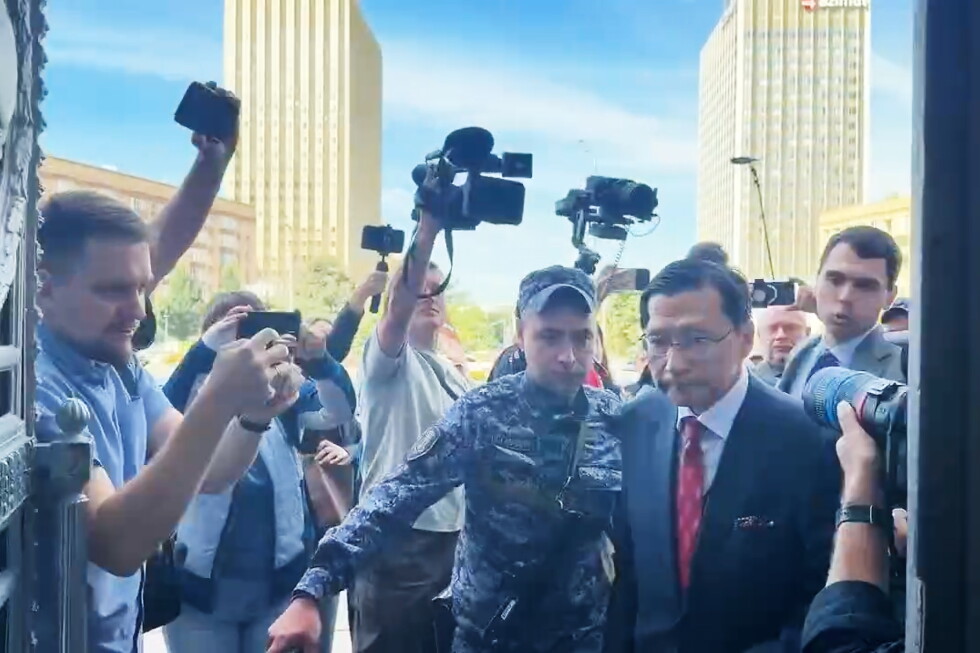
    BEIJING – In a high-profile diplomatic meeting marked by growing international concern over protracted military hostilities, China’s top foreign policy official Wang Yi conveyed deep unease Wednesday about the more than two-month-long conflict involving Iran, Israel and the United States, while stressing that an immediate full cessation of fighting is the only acceptable path forward.

    The talks held in Beijing marked a significant milestone: it was the first in-person visit to China by Iranian Foreign Minister Abbas Araghchi since active hostilities broke out between the three parties on February 28. The face-to-face engagement comes as global pressure mounts for major powers to step in and de-escalate tensions that threaten to spiral into a wider regional conflict.

    Captured on video from the closed-door meeting, Wang laid out China’s clear stance on the escalating crisis. “We believe that a comprehensive ceasefire is urgently needed, that a resumption of hostilities is not acceptable, and that it is particularly important to remain committed to dialogue and negotiations,” Wang stated, emphasizing Beijing’s long-held position that diplomatic negotiation is the only sustainable solution to protracted international conflict.

    The meeting comes amid heightened global attention on China’s role in Middle Eastern diplomacy, as the country has positioned itself as a neutral broker working to reduce tensions across the region. The in-person talks between the two top diplomats signal ongoing diplomatic outreach to bring all parties back to the negotiating table amid months of stalled de-escalation efforts.

  • ‘A big pact’: How the US plans to unite Libya through two ruling families

    ‘A big pact’: How the US plans to unite Libya through two ruling families

    Amid widespread global energy market volatility triggered by the U.S.-Israeli war on Iran, the United States is actively negotiating a landmark power-sharing agreement aimed at unifying oil-rich Libya under the control of its two most influential rival political families, multiple informed sources including current and former Western officials, regional Arab insiders, and independent analysts have confirmed to Middle East Eye.

    The proposed framework would restructure Libyan governance by aligning the western-based Dbeibeh family and the eastern-based Haftar clan, while transitioning leadership from the older generation of political strongmen to a new cohort of younger leaders. Though negotiations have been ongoing for months, the initiative has gained urgent new momentum in recent weeks as rising oil prices driven by the Iran conflict have rekindled interest from U.S. energy firms in accessing Libya, which holds the largest proven crude oil reserves on the African continent.

    Libya’s existing ruling factions have already seen a dramatic surge in revenue amid the Brent crude price rally: the country’s National Oil Corporation reported April oil revenues hit $2.9 billion, a three-fold increase from the start of 2025, and Libya’s oil minister traveled to Washington for high-level talks last week.

    “This process has been in the works for several months, and the U.S. is actively laying the groundwork for a comprehensive agreement between the two families,” explained Riccardo Fabiani, North Africa director at the International Crisis Group. “There is enormous profit to be gained from expanded upstream oil exploration, so Washington has enormous stake in this outcome—especially now with the ongoing conflict in Iran.”

    Leading the U.S. diplomatic push is Massad Boulos, U.S. President Donald Trump’s special envoy for Africa. While the proposed deal has been acknowledged in limited public discourse and faces widespread opposition from Libyan civil society groups, it has received little mainstream attention in Western capitals, overshadowed by the regional focus on the war against Iran.

    Under the terms of the draft arrangement, the Trump administration is pushing for Ibrahim Dbeibeh, a veteran western Libyan powerbroker, to replace his cousin, incumbent prime minister Abdul Hamid Dbeibeh, who has struggled with ongoing health issues in recent months. An Arab source familiar with negotiations and a former senior Western official confirmed that Boulos coordinated this leadership reshuffle with Turkish officials as recently as April during the Antalya Forum, which hosted a high-level Libyan delegation.

    As previously reported and confirmed by *The New York Times*, Ibrahim has built an unusually close relationship with Boulos, and the pair have held private discussions about unlocking billions of dollars in Libyan sovereign assets that have been frozen in Western financial institutions for decades. On the eastern side of the proposed power split, 35-year-old Saddam Haftar—son of 82-year-old eastern Libyan strongman General Khalifa Haftar, who has controlled the eastern half of the country for more than a decade—would be appointed as Libya’s president.

    Saddam Haftar currently serves as deputy commander of his father’s Libyan National Army, and has already moved to rework the Haftar family’s diplomatic ties, building new relationships with former rivals including Turkey. He is widely viewed as the U.S.’s preferred successor to his aging father, and the Arab source confirmed Saddam met with the Central Intelligence Agency’s deputy director during an official visit to Washington last year. As part of Boulos’s negotiating process, Ibrahim Dbeibeh and Saddam Haftar held high-level unity talks at the Élysée Palace in Paris earlier this year.

    This latest effort to unify Libya comes after more than 14 years of fragmented governance following the 2011 NATO-backed uprising that ousted and killed long-time dictator Muammar Gaddafi. Since 2011, the country has been split into two competing political blocs: an internationally recognized government based in the western capital of Tripoli, and a parallel administration in the east led by Khalifa Haftar. The two sides fought a brutal civil war in 2019, when Khalifa Haftar launched an assault on Tripoli that devolved into a full proxy conflict: Turkey backed the UN-recognized western government, while Russia, Egypt, and the United Arab Emirates provided military and financial support to the Haftar-led eastern bloc. Abdul Hamid Dbeibeh was appointed prime minister in 2021 as part of a UN-backed initiative to lead the country toward unified democratic elections, which have been repeatedly delayed and ultimately collapsed.

    “Outside powers, including the U.S., have effectively abandoned any pretense of pushing for democratic elections in Libya,” said one former senior Western official. “Their preference is to cut a deal with the already entrenched ruling families and split the country’s energy wealth between the two most corrupt factions. But the Haftar name is toxic in western Libya, and the Dbeibeh family does not exert full control over the west. This entire process bypasses the Libyan people entirely, and it could easily backfire.”

    The Dbeibeh family has built alliances with powerful militias in western Libya but faces persistent opposition from other regional factions. Any power-sharing deal that includes Saddam Haftar is expected to face fierce pushback in Misrata, a key Mediterranean coastal city with a large, influential network of independent business families. Libya’s highest religious authority, Grand Mufti Sadiq al-Ghariani, publicly came out against any power-sharing agreement between the two families in late April.

    Even within the rival clans, internal divisions threaten to derail the deal: while Saddam Haftar has consolidated control over the eastern military, he is locked in a bitter power struggle with his brothers, most notably Belqasim Haftar, who controls the lucrative Benghazi-based Fund for Development and Reconstruction.

    “Neither the Dbeibeh family nor the Haftar clan currently operate as cohesive, unified political blocs,” said Jalal Harchaoui, a Libya expert at the Royal United Services Institute. “That fragmentation could actually make this change possible. The status quo is completely unsustainable, so if a new unified government is announced, it would mark the start of a new political process for the country.”

    A former U.S. official familiar with the Libya initiative noted that the Trump administration is building on gradual reconciliation efforts first launched by the Biden administration, but the current White House’s willingness to negotiate unlocking frozen assets and approve new commercial deals has accelerated diplomatic progress. “This is not just a personal initiative from Boulos—it is a whole-of-government effort designed to open Libya up to U.S. oil companies and create new economic opportunities for Libyan stakeholders,” the former official said. “Let’s be honest: the UN-led election process never delivered on its promises.”

    Negotiators have already notched limited tactical wins: in early April, Libya’s Central Bank announced the country’s first unified national budget in more than a decade. Last month, eastern and western Libyan military units conducted joint training exercises in Sirte as part of the U.S.-led Flintlock security drills, a surprise development for many long-time Libya analysts.

    U.S. energy firms had already begun scouting investment opportunities in Libya before the outbreak of the Iran war: Chevron won an exploration license for Libya’s Sirte Basin back in February, and Exxon Mobil signed a memorandum of understanding with the National Oil Corporation to re-enter the Libyan market by August 2025. Libya’s National Oil Corporation reported oil exports hit 1.2 million barrels per day in April, a 10-year high, though some analysts question the accuracy of those figures and argue the Iran conflict has not meaningfully altered the country’s long-term investment climate.

    Most of Libya’s oil infrastructure is more than 50 years old, and official national data remains notoriously unreliable due to the lack of transparent governance across the country. Jason Pack, founder of Libya-Analysis and author of *Libya and the Global Enduring Disorder*, argues that Washington and its allies will be disappointed if they expect Libya to replace the oil volumes lost from global markets amid the Iran conflict.

    “Libya’s inability to ramp up oil production stems from deep internal governance failures, not a lack of U.S. or external support,” Pack explained. “The idea that Libya can deliver globally significant volumes of additional oil over the course of the Iran war is completely unrealistic.” Pack noted that a similar debate emerged after Russia’s 2022 invasion of Ukraine, when policymakers claimed Libya could replace Russian natural gas supplies to Europe— a goal Libya never came close to meeting. “At the start of the Ukraine war, everyone claimed Libya would become the new Algeria for European energy, and they failed to deliver. They will fail again this time,” he said.

    That said, most experts agree that a power-sharing deal that unites the two ruling families under U.S. mediation to divide Libya’s current energy profits is a far more achievable short-term goal, in large part because the external powers that once turned Libya into a proxy battleground have significantly reworked their regional alliances. Saddam Haftar has actively courted Turkey and has begun receiving new weapons shipments from Pakistan under Saudi auspices, while Egypt—once a staunch backer of Haftar and opponent of the Tripoli government—has built closer ties with the western administration and mended relations with Turkey, its former rival in Libya.

    “Turkey and Egypt are both willing to support a deal between the two sides because the regional political context is completely different than it was even a few years ago,” Pack said. “This dynamic has nothing to do with the current U.S. administration.” Harchaoui added that the U.S. already has formal backing from Turkey, which remains one of the most influential military actors on the ground in Libya. “There are clear signs that Turkey is comfortable with whatever major announcement is coming, and that carries a lot of weight,” he said. “Saudi Arabia will likely back whatever Turkey agrees to, largely because of shared strategic interests in Sudan.”

    The initiative also gives Washington an opportunity to push Russia out of its foothold in eastern Libya: Russia has deployed private mercenary forces to support Haftar for years and has long sought permanent port access in the country. With a Russian-backed military regime in neighboring Mali on the brink of collapse amid an advance by al-Qaeda-linked militants, U.S. officials see an opening to shift Haftar away from Moscow. “It is not just energy money drawing U.S. policymakers to this initiative. Russia is already retreating in Mali, so it is not unreasonable to think they could be pushed out of Libya too,” Harchaoui said.

  • AI boom drives a rally in buying of tech shares, pushing South Korea’s Kospi to a record

    AI boom drives a rally in buying of tech shares, pushing South Korea’s Kospi to a record

    Global equity markets surged across multiple regions this week, led by a historic rally in South Korea’s benchmark index fueled by twin tailwinds: booming investor optimism around artificial intelligence-driven chip demand and growing hopes for de-escalation of the U.S.-Iran conflict.

    When South Korean markets reopened Wednesday following a one-day national holiday, the Korea Composite Stock Price Index (Kospi) skyrocketed nearly 7% to hit an all-time closing high of 7,398.34. The rally was anchored by outsized gains in the country’s two leading semiconductor manufacturers, which supply the high-performance chips critical to powering generative AI and large language model applications. Samsung Electronics, the world’s largest memory chip producer, saw its share price jump almost 13% in early trading, while rival SK Hynix notched a 10% gain.

    Market sentiment got an additional boost from geopolitical developments: Iranian officials confirmed they would travel to China for diplomatic talks ahead of the scheduled summit between former U.S. President Donald Trump and Chinese President Xi Jinping. This diplomatic movement helped ease fears of prolonged disruption to global energy supplies, pulling oil prices lower after the sharp volatility triggered by the outbreak of the U.S.-Iran war.

    The upward momentum extended across most Asian markets, even as several major exchanges including Tokyo remained closed for public holidays. Australia’s S&P/ASX 200 climbed 1.0% to 8,766.80 in morning trading. Hong Kong’s Hang Seng Index added 0.7% to reach 26,081.52, while China’s Shanghai Composite Index rose 1.0% to 4,152.68.

    In global energy markets, oil prices extended the downward correction that began Tuesday, erasing the sharp spikes recorded earlier in the week as conflict erupted. Benchmark U.S. crude fell $1.37 to settle at $100.90 per barrel, and international benchmark Brent crude dropped $1.50 to $108.37 a barrel. Even with the decline, prices remain far higher than the pre-conflict level of roughly $70 a barrel. U.S. military officials have confirmed an unofficial ceasefire is currently in effect, though significant uncertainties persist. U.S. forces are currently working to re-open shipping lanes through the Strait of Hormuz, the critical chokepoint that carries roughly a third of the world’s seaborne oil exports out of the Persian Gulf, to allow commercial tanker traffic to resume.

    The rally extended to U.S. markets as well, with all three major Wall Street benchmarks closing at record highs. The broad S&P 500 index gained 0.8% to close at 7,259.22, surpassing its prior all-time high set just the previous week. The Dow Jones Industrial Average added 0.7% to finish at 49,298.25, and the tech-heavy Nasdaq Composite climbed 1% to hit a new record of 25,326.13.

    U.S. economic data released alongside the rally painted a mixed picture. One report showed service sector growth slowed unexpectedly in the most recent month, with some businesses reporting that the ongoing Middle East conflict has started to dampen consumer spending. A separate labor market report offered more encouraging news, showing U.S. employers posted slightly more job openings at the end of March than analysts had forecast, signaling continued resilience in the national job market.

    In foreign exchange markets, the U.S. dollar edged marginally lower against the Japanese yen, falling to 157.88 yen from 157.89 yen in the prior trading session. The euro appreciated slightly, rising to $1.1720 from $1.1693.

    AP Business Writer Stan Choe contributed reporting from New York.

  • The rapid embrace of AI in China, its biggest testing ground, may shape how AI is used globally

    The rapid embrace of AI in China, its biggest testing ground, may shape how AI is used globally

    Across major Chinese cities from Beijing to Shenzhen, crowds of ordinary people and business professionals are gathering in droves to access hands-on support installing cutting-edge artificial intelligence tools, highlighting a sweeping, rapid shift toward mass AI integration in the world’s most populous nation. More than a year after Chinese AI developer DeepSeek stunned global tech circles with its high-performance advanced model, China has evolved into the world’s largest live testing environment for widespread consumer and enterprise AI use. While U.S.-built AI models still hold an edge in raw computational power, Chinese users and companies have embraced the technology at an unprecedented pace, embedding it into nearly every sector of daily life and economic activity.

    As global AI integration accelerates across workplaces and personal routines, Chinese residents are leveraging generative AI tools for an extraordinary range of routine tasks, from travel planning and food delivery to ride-hailing and professional workflow optimization. Official data from the China Internet Network Information Center reveals that as of December 2024, over 600 million of China’s 1.4 billion people were active generative AI users — marking a 142% year-over-year surge in adoption. The recent boom in demand for agentic AI tools such as the popular OpenClaw, which can autonomously complete complex multi-step tasks, has driven a corresponding spike in AI data consumption. According to OpenRouter, an AI gateway platform that tracks usage across models, the weekly share of AI data tokens (the core units of processed AI data) consumed by Chinese-developed models has now surpassed that of leading U.S. models.

    The trend of mass AI adoption cuts across all demographics, from working professionals to retirees. Sixty-four-year-old Jason Tong, a retired IT engineer based in Shanghai, has used domestic AI chatbots including Doubao and Kimi for daily queries since their launch, and recently began using an AI-powered personalized blood glucose monitoring service. Tong has found the tool’s fast, customized health advice invaluable, and he views widespread AI integration as an inevitable technological shift. “Just as carriages were eventually replaced by trains, this is bound to happen,” he explained.

    Chinese AI-integrated products, from smart cars with voice-activated planning capabilities to humanoid robots with advanced cognitive functions, have also seen major technical leaps in recent months. Lizzi Lee, a fellow at the Asia Society Policy Institute’s Center for China Analysis specializing in technology and economics, notes that global AI competition is rapidly shifting from standalone model development to building full integrated ecosystems. “Chinese users are basically acting as real-time testers at scale,” Lee observed.

    Leading Chinese technology giants including Tencent, Alibaba and Baidu are now locked in a race to commercialize AI at scale. Tencent has already integrated OpenClaw into WeChat, China’s ubiquitous super-app that combines messaging, food delivery, mobile payments and dozens of other daily services into one platform, while Alibaba has embedded agentic AI into its internal business and merchant workflows.

    OpenClaw, which was originally developed by Austrian software engineer Peter Steinberger in 2023, has exploded in popularity in China thanks to its ability to connect multiple digital tools to complete complex end-to-end tasks. For Zhao Yikang, a college student in Macao, the tool has transformed both his academic work and professional internship at a Zhuhai real estate agency, where he uses it to automatically generate promotional content and manage social media accounts. Zhao highlighted the tool’s low cost and high efficiency: he recently asked OpenClaw to build a fully functional website for his upcoming post-graduation photo services business, and the project was completed in 10 minutes for less than 0.70 U.S. dollars. “AI can understand things in a second,” Zhao said. “You just need to act as a commander and tell it what to do.”

    While Chinese regulators issued temporary warnings over potential data security risks as OpenClaw installations skyrocketed, that has done little to dampen public enthusiasm for the tool. Across the country, domestic businesses are increasingly setting internal mandatory targets to scale AI adoption to boost operational efficiency. Janet Tang, a technology partner and managing director at global consultancy AlixPartners, notes that China’s unique market landscape offers an unmatched range of use cases for AI testing. Wang Xiaogang, co-founder of leading Chinese AI firm SenseTime and chairman of ACE Robotics, echoed that sentiment: “The industry is developing very fast and the people, they are very open and they are eager to try the AI in a lot of scenarios.”

    Chinese policymakers have actively supported the AI boom, investing heavily in talent development and subsidizing low-cost electricity to power energy-intensive AI computing infrastructure. In the national five-year plan running through 2030, Beijing has pledged to deliver an average annual growth rate of at least 7% in national research and development spending, with AI as a core priority. A national “AI Plus” strategy lays out a roadmap to integrate artificial intelligence into every major sector from healthcare to education to public administration: a court in Shenzhen reported that it processed 50% more cases in 2024, in part thanks to AI tools that streamline judicial workflows.

    However, U.S. export controls on advanced semiconductors remain a key bottleneck for China’s AI advancement. Samm Sacks, a senior fellow at New America focusing on Chinese technology policy, explained that U.S. restrictions on cutting-edge AI chips have slowed the expansion of Chinese chipmaking capacity and remain the biggest vulnerability for many Chinese AI research labs. Even so, Sacks added, the restrictions have also forced greater coordination across China’s domestic tech supply chain, uniting design, manufacturing and end-user adoption around a homegrown innovation agenda. “Over time this dynamic could fuel, not foil, China’s ambitions,” Sacks said.

    The impact of that growing domestic coordination is already visible: when DeepSeek launched its highly anticipated V4 AI model preview last month, the system is partially powered by chips from Chinese tech giant Huawei, reducing the country’s dependence on leading U.S. chipmakers such as Nvidia. A recent report from Stanford University’s Institute for Human-Centered AI concluded that the performance gap between top U.S. and Chinese AI models has “effectively closed.”

    While U.S. policymakers and leading AI firms including OpenAI and Anthropic have accused Chinese AI startups of intellectual property theft, Chinese officials have rejected those claims as unsubstantiated. Even with ongoing U.S. export controls and China’s domestic internet censorship regime, analysts believe the gap between the two global AI powers will continue to narrow. Lian Jye Su, chief analyst at global research firm Omdia, noted that barriers such as the Great Firewall have only had limited impact on AI development, as the technology has already been tested, integrated and scaled within China’s regulated domestic internet ecosystem. “It won’t be long before China moves from fast follower to parallel innovator,” Su predicted.