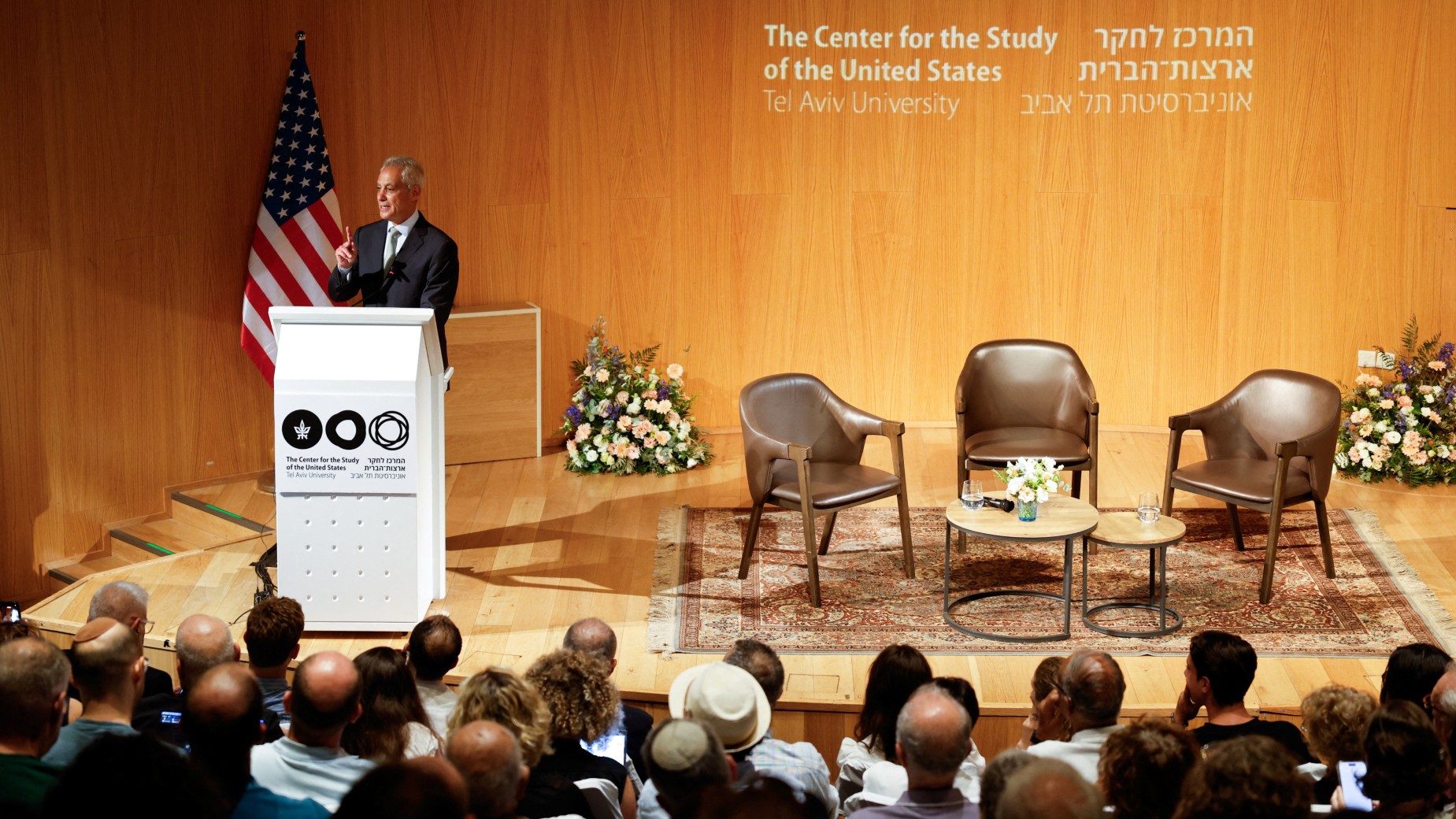
Ahead of the 2028 U.S. presidential election, influential Democratic figure and likely White House hopeful Rahm Emanuel has delivered a sharp rebuke of Washington’s decades-long policy of unqualified, blind support for the Israeli government, calling the long-standing approach a fundamental misstep. Speaking at a public event hosted by Tel Aviv University’s Center for the United States on Wednesday, Emanuel — a Jewish former White House official with deep roots in U.S. Middle East policy — argued that current Israeli leadership has steered the country toward growing international isolation, branding it a “territorial pariah” on the global stage.
Emanuel emphasized that no nation can sustain perpetual conflict once the international community no longer accepts the legitimacy of its fight. “You must instead find a new sustainable path to peace, security, and economic prosperity. America stands ready,” he added. He also took a sarcastic swipe at the Israeli government’s recent diplomatic efforts, noting that its most high-profile new diplomatic win is recognition from Somaliland, a self-declared state that lacks broad international recognition. Quoting his grandmother, he joked, “You lost Europe, you lost America, and you picked up Somaliland; such a deal,” prompting laughter from the audience.
During his current visit to Israel, Emanuel held a meeting with Israeli President Isaac Herzog but intentionally skipped a meeting with Prime Minister Benjamin Netanyahu. The two have a long-standing feud: Netanyahu labeled Emanuel a “self-hating Jew” back in 2008 after Emanuel condemned Israel’s expansion of illegal settlements in Palestinian territories. Speaking to reporters ahead of his Wednesday speech, Emanuel explained his choice to avoid sitting with Netanyahu, noting that Israeli general elections are scheduled for this autumn. “I’m not going to give the prime minister an opportunity to twist this politically,” he said. In a post-meeting social media statement, Herzog highlighted that maintaining strong, positive ties with both U.S. major political parties — Democrats and Republicans alike — is a critical priority for Israel.
Breaking from the long-standing mainstream U.S. framing of a two-state solution to the conflict, Emanuel put forward what he calls a “23-state solution”: he proposed that 21 existing Arab states take on active, shared responsibility to support the establishment of an independent Palestinian state, while also formalizing international recognition of Israel’s territorial claims.
Throughout his remarks, Emanuel made clear that his criticism reflects a broader, long-building shift in attitudes within the U.S. Democratic Party toward U.S.-Israel relations, a shift that has sparked intense public debate since the launch of Israel’s 2023 military campaign in Gaza. He warned that the bilateral relationship between Washington and Tel Aviv is currently “at a crossroads” that demands “significant changes and a new direction.” “The status quo is unacceptable, where you can’t say anything negative, which acts as an implicit endorsement,” he stated.
In his sharp rebuke of Netanyahu’s leadership, Emanuel argued that decades of unconditional U.S. backing have enabled the Israeli prime minister to act without accountability: “Unconditional support has produced a prime minister who has presumed that his strategic interest would incur no political costs if he ignored America’s concerns about settlements and sparked a regional war.” Emanuel also put forward concrete policy changes, suggesting that Washington cut defense subsidies to Israel, and impose targeted sanctions on Israeli settlers who carry out attacks against Palestinian civilians as well as Israeli politicians who openly endorse settler violence. In a separate interview with Israeli Channel 12, he even noted that Palestinian scholar and activist Edward Said is more popular among American Jewish voters than Netanyahu.
Emanuel’s political credentials on Middle East policy carry significant weight: he served as a senior advisor to President Bill Clinton during the 1990s Oslo peace negotiations, and held the post of White House Chief of Staff under President Barack Obama from 2009 to 2010, where he shaped U.S. policy across the Middle East. A former U.S. congressman and Chicago mayor, he has been open about his plans to launch a 2028 Democratic presidential bid, even though no major contender has formally declared candidacy for the race yet.
His high-profile criticism comes as public opinion across the United States has shifted dramatically on the Israel-Palestine conflict, particularly within the Democratic base. A recent joint poll conducted by The Associated Press-NORC Center for Public Affairs Research recorded a steep drop in public support for Israel, with growing opposition among Democrats and emerging internal divisions among Republicans. The data shows that 58 percent of Democratic voters now believe the U.S. is “too supportive of Israel,” up sharply from 45 percent in January 2024. Furthermore, roughly one-third of all U.S. adults — including half of all Democratic respondents — agree that Israel has committed acts of genocide against Palestinian civilians in Gaza.
Stances on unconditional U.S. support for Israel and the Gaza war have become a defining litmus test for Democratic candidates, most recently in party primary elections where progressive candidates openly critical of the status quo have secured multiple upset victories against more establishment opponents.